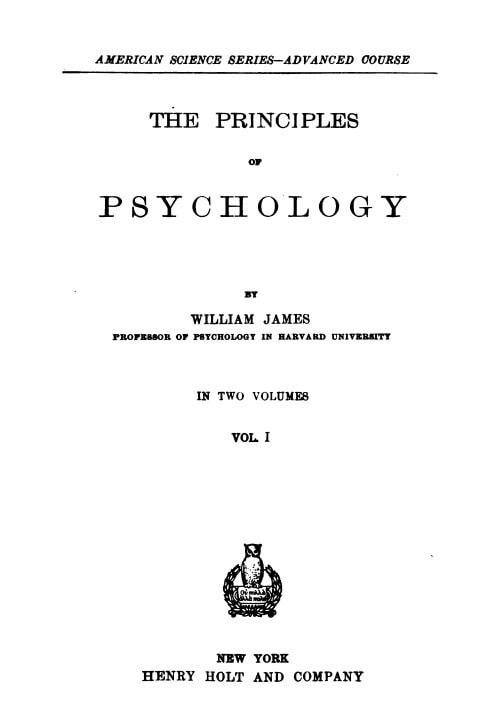
The Principles of Psychology, Volume 1 (of 2)
1890
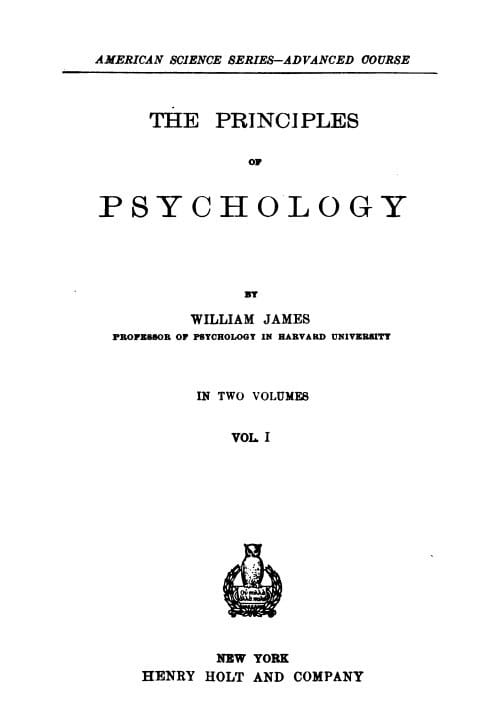
The Principles of Psychology, Volume 1 (of 2)
1890
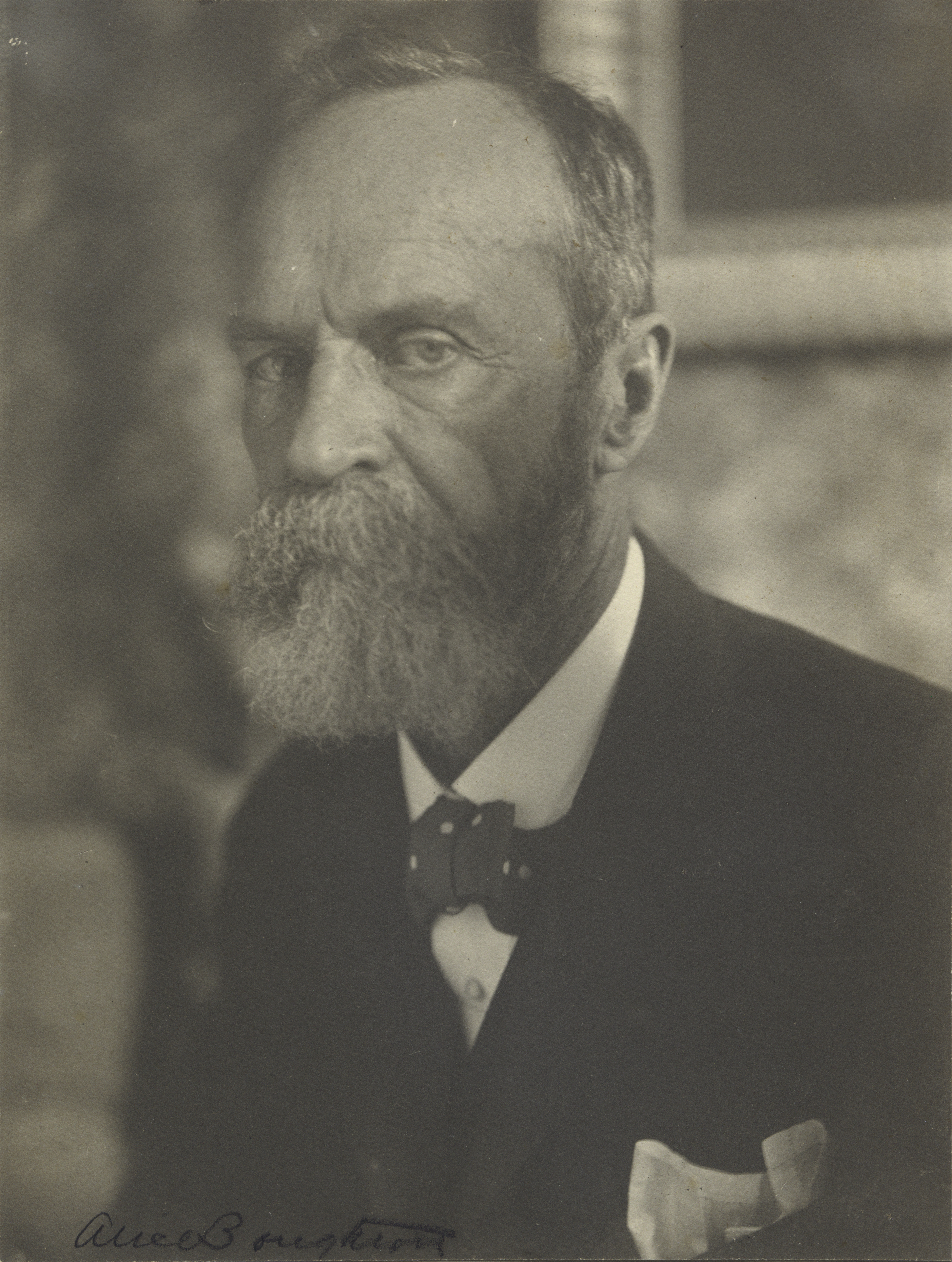
Published in 1890, this is the book that invented the modern concept of the mind. William James was the first to describe consciousness not as a collection of discrete states but as a continuous stream, a river with no clear edges or interruptions, and in doing so he changed how humans think about themselves forever. Before James, psychology barely existed as a discipline; after him, it could never be the same. He writes with a novelist's ear for prose and a philosopher's rigor, tackling memory, attention, emotion, perception, and the physical basis of thought in language that still crackles with energy more than a century later. This is not a dusty historical document but a vital work of ideas that anyone curious about what it means to think, feel, and be conscious will find startlingly relevant.
Editions
X-Ray
“The attempt at introspective analysis... is in fact like seizing a spinning top to catch its motion, or trying to turn up the gas quickly enough to see the darkness.””
— William James
“But it is the bane of psychology to suppose that where results are similar, processes must be the same. Psychologists are too apt to reason as geometers would, if the latter were to say that the diameter of a circle is the same thing as its semi-circumference, because, forsooth, they terminate in the same two points.””
— William James
“A man's Self is the sum total of all that he can call his, not only his body and his psychic powers, but his clothes and his house.””
— William James
“Metaphysics means nothing but an unusually obstinate effort to think clearly. The fundamental conceptions of psychology are practically very clear to us, but theoretically they are very confused, and one easily makes the obscurest assumptions in this science without realizing, until challenged, what internal difficulties they involve.””
— William James
“But psychology is passing into a less simple phase. Within a few years what one may call a microscopic psychology has arisen in Germany, carried on by experimental methods, asking of course every moment for introspective data, but eliminating their uncertainty by operating on a large scale and taking statistical means. This method taxes patience to the utmost, and could hardly have arisen in a country whose natives could be bored. Such Germans as Weber, Fechner, Vierordt, and Wundt obviously cannot ; and their success has brought into the field an array of younger experimental psychologists, bent on studying the elements of the mental life, dissecting them out from the gross results in which they are embedded, and as far as possible reducing them to quantitative scales. The simple and open method of attack having done what it can, the method of patience, starving out, and harassing to death is tried ; the Mind must submit to a regular siege, in which minute advantages gained night and day by the forces that hem her in must sum themselves up at last into her overthrow. There is little of the grand style about these new prism, pendulum, and chronograph-philosophers. They mean business, not chivalry. What generous divination, and that superiority in virtue which was thought by Cicero to give a man the best insight into nature, have failed to do, their spying and scraping, their deadly tenacity and almost diabolic cunning, will doubtless some day bring about.No general description of the methods of experimental psychology would be instructive to one unfamiliar with the instances of their application, so we will waste no words upon the attempt.””
— William James
“However inadequate our ideas of causal efficacy may be, we are less wide of the mark when we say that our ideas and feelings have it, than the Automatists are when they say they haven’t it. As in the night all cats are gray, so in the darkness of metaphysical criticism all causes are obscure. But one has no right to pull the pall over the psychic half of the subject only . . . whilst in the same breath one dogmatizes about material causation as if Hume, Kant, and Lotze had never been born.””
— William James
“If we knew thoroughly the nervous system of Shakespeare . . . we should be able to show why . . . his hand came to trace on certain sheets of paper those crabbed little black marks which we . . . call the manuscript of Hamlet. We should understand the rationale of every erasure and alteration therein . . . without in the slightest degree acknowledging the existence of the thoughts in Shakespeare’s mind. The words and sentences would be taken, not as signs of anything beyond themselves, but as little outward facts, pure and simple.””
— William James
“Of course we measure ourselves by many standards. Our strength and our intelligence, our wealth and even our good luck, are things which warm our heart and make us feel ourselves a match for life. But deeper than all such things, and able to suffice until itself without them, is the sense of the amount of effort which we can put forth.””
— William James
“There is something almost shocking in the notion of so chaste a function carrying this Kantian hurlyburly in her womb.””
— William James
Link to this book
Add a free, dofollow link to Lex on your blog, forum, syllabus, or reading list.

<a href="https://lex-books.com/book/the-principles-of-psychology-volume-1-of-2-387f4007-b5bf-4fa6-8cd1-4406e2434450"><img src="https://lex-books.com/badges/read-on-lex.svg" alt="Read The Principles of Psychology, Volume 1 (of 2) by William James free on Lex" width="160" height="40"></a>[](https://lex-books.com/book/the-principles-of-psychology-volume-1-of-2-387f4007-b5bf-4fa6-8cd1-4406e2434450)[url=https://lex-books.com/book/the-principles-of-psychology-volume-1-of-2-387f4007-b5bf-4fa6-8cd1-4406e2434450][img]https://lex-books.com/badges/read-on-lex.svg[/img][/url]Read The Principles of Psychology, Volume 1 (of 2) by William James free on Lex: https://lex-books.com/book/the-principles-of-psychology-volume-1-of-2-387f4007-b5bf-4fa6-8cd1-4406e2434450Cite this book
Reading this edition for a paper or guide? Copy a citation.
James, William. The Principles of Psychology, Volume 1 (of 2). Lex, lex-books.com/book/the-principles-of-psychology-volume-1-of-2-387f4007-b5bf-4fa6-8cd1-4406e2434450.James, W. (1890). The Principles of Psychology, Volume 1 (of 2). Lex. https://lex-books.com/book/the-principles-of-psychology-volume-1-of-2-387f4007-b5bf-4fa6-8cd1-4406e2434450James, William. The Principles of Psychology, Volume 1 (of 2). Lex. https://lex-books.com/book/the-principles-of-psychology-volume-1-of-2-387f4007-b5bf-4fa6-8cd1-4406e2434450.