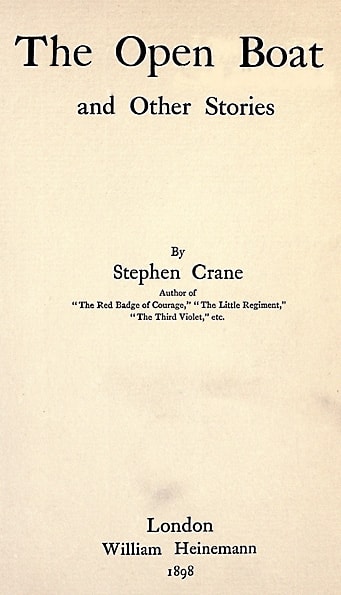
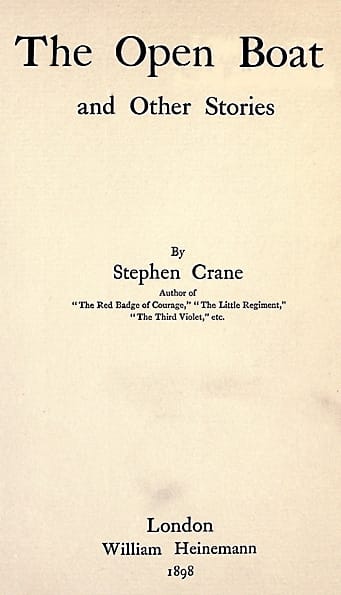
The Open Boat and Other Stories
1898
Crane drew this story from his own near-death experience, and that intimacy pulses through every page. Four men an oiler, a cook, a correspondent, and a captain claw for survival in a tiny dinghy after their ship sinks beneath them. The ocean offers no mercy, no meaning only relentless waves and the terrible silence of a universe that does not care whether they live or die. Yet in this void, something remarkable emerges: the men forge bonds born of shared peril, their petty quarrels and quiet heroics laid bare against the indifferent deep. The correspondent particularly wrestles with questions that would haunt any survivor: Why did I live? What did I deserve? Is there a God listening, or only salt water? These eight linked stories capture Americans at their most vulnerable, stripped of society's comforts and forced to confront what lies beneath. The title story stands as a masterpiece of American naturalism, its prose as spare and brutal as the sea it describes. For readers who crave fiction that does not flinch from darkness while finding strange beauty in endurance.
Editions
X-Ray
“When it occurs to a man that nature does not regard him as important, and that she feels she would not maim the universe by disposing of him, he at first wishes to throw bricks at the temple, and he hates deeply the fact that there are no bricks and no temples.””
— Stephen Crane
“Nature . . . did not seem cruel to him then, nor beneficent, nor treacherous, nor wise. But she was indifferent, flatly indifferent.””
— Stephen Crane
“None of them knew the color of the sky.””
— Stephen Crane
“If I am going to be drowned-- if I am going to be drowned--if I am going to be drowned, why, in the name of the seven mad gods who rule the sea, was I allowed to come thus far and contemplate sand and trees? Was I brought here merely to have my nose dragged away as I was about to nibble the sacred cheese of life? It is preposterous. If this old ninny-woman, Fate, cannot do better than this, she should be deprived of the management of men's fortunes. She is an old hen who knows not her intention. If she has decided to drown me, why did she not do it in the beginning and save me all this trouble? The whole affair is absurd....””
— Stephen Crane
“A singular disadvantage of the sea lies in the fact that after successfully surmounting one wave you discover another behind it just as important and just as nervously anxious to do something effective in the way of swamping boats. In a ten-foot dinghy one can get an idea of the resources of the sea in the line of waves that is not probable to the average experience, which is never at sea in a dinghy.””
— Stephen Crane
“The wind had a voice as it came over the waves, and it was sadder than the end.””
— Stephen Crane
“This tower was a giant, standing with its back to the plight of the ants. It represented in a degree, to the correspondent, the serenity of nature amid the struggles of the individual--nature in the wind, and nature in the vision of men. She did not seem cruel to him, nor beneficent, nor treacherous, nor wise. But she was indifferent, flatly indifferent. It is, perhaps, plausible that a man in this situation, impressed with the unconcern of the universe, should see the innumerable flaws of his life and have them taste wickedly in his mind and wish for another chance. A distinction between right and wrong seems absurdly clear to him, then, in this new ignorance of the grave-edge, and he understands that if he were given another opportunity he would mend his conduct and his words, and be better and brighter during an introduction, or at a tea.””
— Stephen Crane
“The correspondent wondered ingenuously how in the name of all that was sane could there be people who thought it amusing to row a boat. It was not an amusement; it was a diabolical punishment, and even a genius of mental aberrations could never conclude that it was anything but a horror to the muscles and a crime against the back.””
— Stephen Crane
“When it occurs to a man that nature does not regard him as important,and that she feels she would not maim the universe by disposing of him,he at first wishes to throw bricks at the temple, and he hates deeplythe fact that there are no brick and no temples. Any visible expressionof nature would surely be pelleted with his jeers.Then, if there be no tangible thing to hoot he feels, perhaps, thedesire to confront a personification and indulge in pleas, bowed to oneknee, and with hands supplicant, saying: "Yes, but I love myself.””
— Stephen Crane
Link to this book
Add a free, dofollow link to Lex on your blog, forum, syllabus, or reading list.

<a href="https://lex-books.com/book/the-open-boat-and-other-stories-9e641d78-536d-470e-a92d-062145ff2e79"><img src="https://lex-books.com/badges/read-on-lex.svg" alt="Read The Open Boat and Other Stories by Stephen Crane free on Lex" width="160" height="40"></a>[](https://lex-books.com/book/the-open-boat-and-other-stories-9e641d78-536d-470e-a92d-062145ff2e79)[url=https://lex-books.com/book/the-open-boat-and-other-stories-9e641d78-536d-470e-a92d-062145ff2e79][img]https://lex-books.com/badges/read-on-lex.svg[/img][/url]Read The Open Boat and Other Stories by Stephen Crane free on Lex: https://lex-books.com/book/the-open-boat-and-other-stories-9e641d78-536d-470e-a92d-062145ff2e79Cite this book
Reading this edition for a paper or guide? Copy a citation.
Crane, Stephen. The Open Boat and Other Stories. Lex, lex-books.com/book/the-open-boat-and-other-stories-9e641d78-536d-470e-a92d-062145ff2e79.Crane, S. (1898). The Open Boat and Other Stories. Lex. https://lex-books.com/book/the-open-boat-and-other-stories-9e641d78-536d-470e-a92d-062145ff2e79Crane, Stephen. The Open Boat and Other Stories. Lex. https://lex-books.com/book/the-open-boat-and-other-stories-9e641d78-536d-470e-a92d-062145ff2e79.