The Last Place on Earth
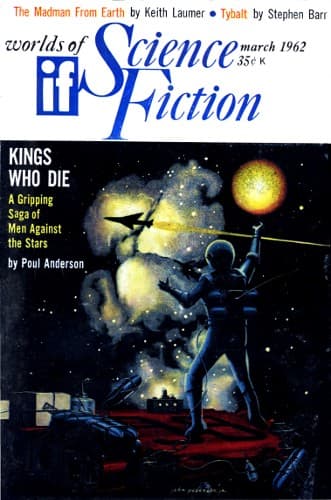
The Last Place on Earth is a psychological science fiction novel likely written in the early 1960s by Jim Harmon. It follows Sam Collins, a man struggling with his identity and haunted by a troubled past, as he encounters Doc Candle, a local undertaker who claims to be an alien with a sinister agenda. The narrative explores themes of control, alien influence, and the blurred lines between sanity and madness, ultimately leading Collins to confront his dark impulses amid futuristic elements and government intrigue.
Editions
X-Ray
“Where imaginary mole hills turn into hallucinatory mountains””
— Jim Harmon
“Our plan is one, one and again one alone”
— Jim Harmon
“In the snows Amundsen grasped that it was usually best to lead from behind. He could see his men and survey the situation, the foundation of command. And the last man has the responsibility of retrieving what falls off the sledges. However careful the stowing, somehow something vital usually drops by the wayside.””
— Jim Harmon
“Men, as Amundsen liked to say, are the unknown factor in the Antarctic.””
— Jim Harmon
“Nansen had moreover introduced a startling new concept into Polar exploration. He had deliberately cut off his lines of retreat. His route was from the desolate east coast to the inhabited west. This was not bravado, but calculated exploitation of the instinct of self-preservation. It drove him on; there was no incentive to look back.””
— Jim Harmon
“The English too, were turning their eyes to the South. In 1769, there was to be a transit of the planet Venus across the disc of the sun, a rare event which astronomers wanted to observe. The newly discovered island of Tahiti was judged the perfect site. The Royal Society in London asked the Royal Navy to organize the expedition. The Navy obliged. This was to have profound and unlooked-for consequences. It led to the virtual monopolization by naval officers of British Polar exploration until the first decade of this century. The voyage inspired by the transit of Venus was commanded by a man of quiet genius, James Cook, one of the greatest of discoverers.””
— Jim Harmon
Link to this book
Add a free, dofollow link to Lex on your blog, forum, syllabus, or reading list.

<a href="https://lex-books.com/book/the-last-place-on-earth-a41b824e-01f4-4d9a-a587-f686e7b5821d"><img src="https://lex-books.com/badges/read-on-lex.svg" alt="Read The Last Place on Earth by Jim Harmon free on Lex" width="160" height="40"></a>[](https://lex-books.com/book/the-last-place-on-earth-a41b824e-01f4-4d9a-a587-f686e7b5821d)[url=https://lex-books.com/book/the-last-place-on-earth-a41b824e-01f4-4d9a-a587-f686e7b5821d][img]https://lex-books.com/badges/read-on-lex.svg[/img][/url]Read The Last Place on Earth by Jim Harmon free on Lex: https://lex-books.com/book/the-last-place-on-earth-a41b824e-01f4-4d9a-a587-f686e7b5821dCite this book
Reading this edition for a paper or guide? Copy a citation.
Harmon, Jim. The Last Place on Earth. Lex, lex-books.com/book/the-last-place-on-earth-a41b824e-01f4-4d9a-a587-f686e7b5821d.Harmon, J. (n.d.). The Last Place on Earth. Lex. https://lex-books.com/book/the-last-place-on-earth-a41b824e-01f4-4d9a-a587-f686e7b5821dHarmon, Jim. The Last Place on Earth. Lex. https://lex-books.com/book/the-last-place-on-earth-a41b824e-01f4-4d9a-a587-f686e7b5821d.