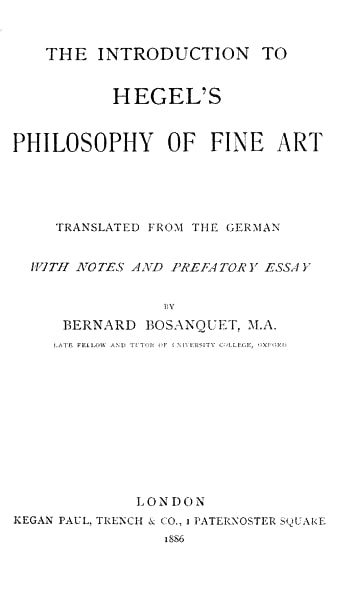
The Introduction to Hegel's Philosophy of Fine Arts: Translated from the German with Notes and Prefatory Essay
1905
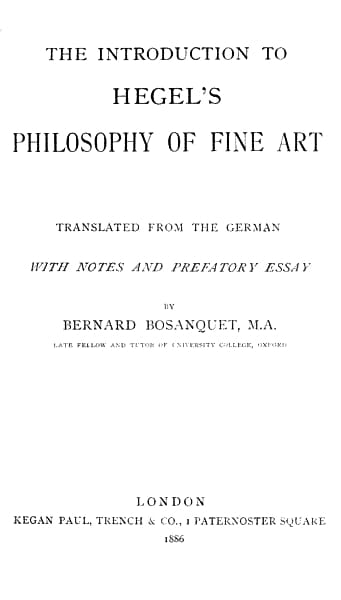
The Introduction to Hegel's Philosophy of Fine Arts: Translated from the German with Notes and Prefatory Essay
1905
Translated by Bernard Bosanquet
Hegel's lectures on the philosophy of fine art represent one of the most ambitious attempts to locate art within the grand sweep of human self-consciousness. Here, Hegel argues that art is not merely a matter of taste or private feeling, but a form of knowing: through beauty, spirit comes to recognize itself in the world. The text traces art's historical development from the symbolic forms of ancient civilizations through the classical perfection of Greek sculpture to the romantic art of the Christian era, each stage expressing a different relationship between idea and sensuous form. Yet the lectures culminate in Hegel's controversial thesis that art's highest purpose has been fulfilled, that the sensuous presentation of truth can no longer occur in art alone. This is not a dismissal of art but a profound repositioning of its role in a culture that has achieved philosophical self-knowledge. For anyone seeking to understand why modern art became so troubled, so self-questioning, so obsessed with its own limits, Hegel's analysis remains indispensable. He wrote for readers who want to think seriously about what art is, not merely what they like.
Editions
Link to this book
Add a free, dofollow link to Lex on your blog, forum, syllabus, or reading list.

<a href="https://lex-books.com/book/the-introduction-to-hegel-s-philosophy-of-fine-arts-translated-from-the-german-w-b08959ac-8fbe-4591-8efb-46044d957d3a"><img src="https://lex-books.com/badges/read-on-lex.svg" alt="Read The Introduction to Hegel's Philosophy of Fine Arts: Translated from the German with Notes and Prefatory Essay by Georg Wilhelm Friedrich Hegel free on Lex" width="160" height="40"></a>[](https://lex-books.com/book/the-introduction-to-hegel-s-philosophy-of-fine-arts-translated-from-the-german-w-b08959ac-8fbe-4591-8efb-46044d957d3a)[url=https://lex-books.com/book/the-introduction-to-hegel-s-philosophy-of-fine-arts-translated-from-the-german-w-b08959ac-8fbe-4591-8efb-46044d957d3a][img]https://lex-books.com/badges/read-on-lex.svg[/img][/url]Read The Introduction to Hegel's Philosophy of Fine Arts: Translated from the German with Notes and Prefatory Essay by Georg Wilhelm Friedrich Hegel free on Lex: https://lex-books.com/book/the-introduction-to-hegel-s-philosophy-of-fine-arts-translated-from-the-german-w-b08959ac-8fbe-4591-8efb-46044d957d3aCite this book
Reading this edition for a paper or guide? Copy a citation.
Hegel, Georg Wilhelm Friedrich. The Introduction to Hegel's Philosophy of Fine Arts: Translated from the German with Notes and Prefatory Essay. Lex, lex-books.com/book/the-introduction-to-hegel-s-philosophy-of-fine-arts-translated-from-the-german-w-b08959ac-8fbe-4591-8efb-46044d957d3a.Hegel, G. W. F. (1905). The Introduction to Hegel's Philosophy of Fine Arts: Translated from the German with Notes and Prefatory Essay. Lex. https://lex-books.com/book/the-introduction-to-hegel-s-philosophy-of-fine-arts-translated-from-the-german-w-b08959ac-8fbe-4591-8efb-46044d957d3aHegel, Georg Wilhelm Friedrich. The Introduction to Hegel's Philosophy of Fine Arts: Translated from the German with Notes and Prefatory Essay. Lex. https://lex-books.com/book/the-introduction-to-hegel-s-philosophy-of-fine-arts-translated-from-the-german-w-b08959ac-8fbe-4591-8efb-46044d957d3a.