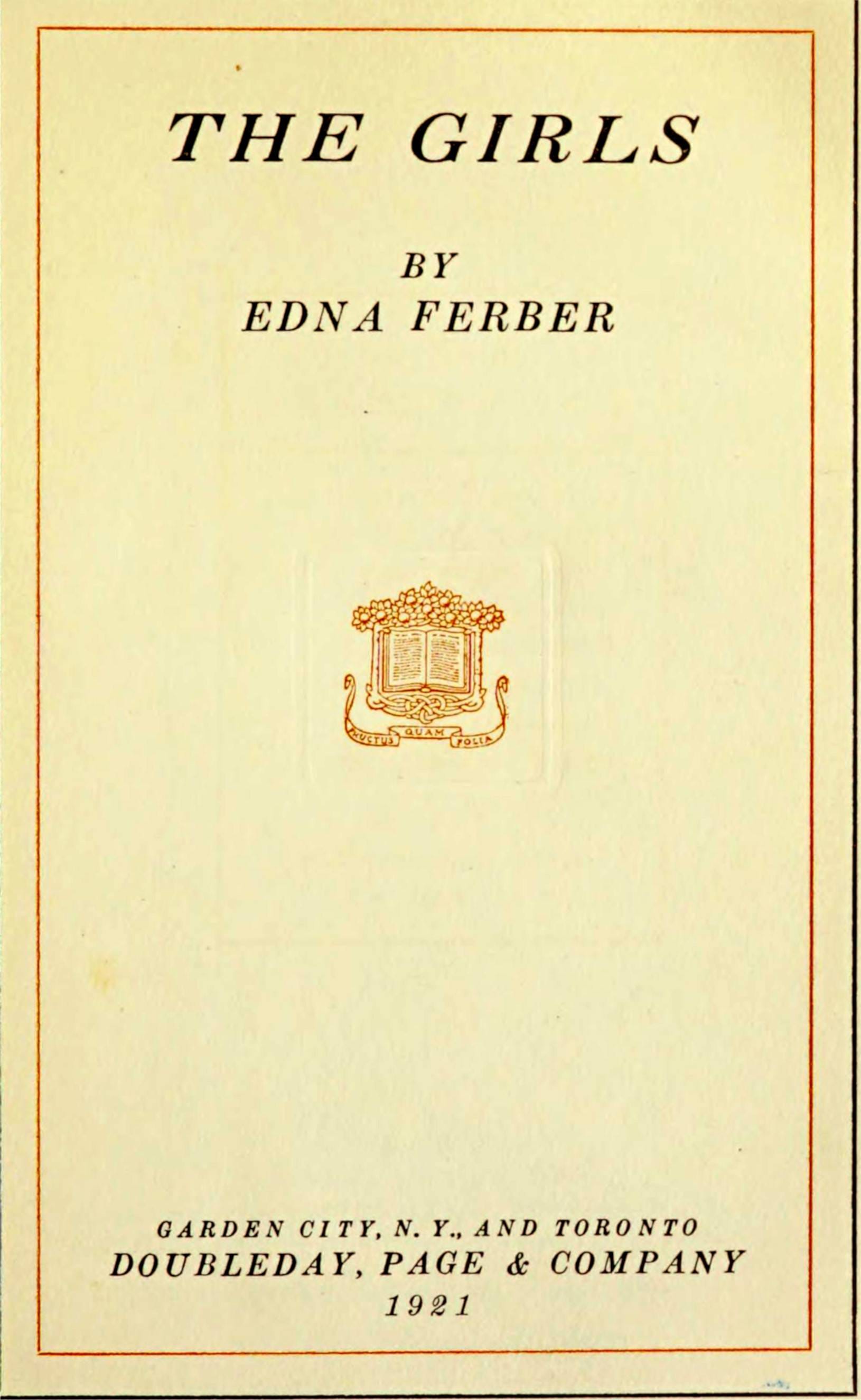
The Girls
1921
Edna Ferber's 1921 novel traces the lives of three women across generations in the Thrift family: great-aunt Charlotte, who has built a life of quiet duty and fading expectations; her niece Lottie, who chafes against the narrow margins allowed to unmarried women and dreams of something more; and Charley, a sharp-tongued teenager who watches them both with the impatience of someone certain the world should have changed by now. The three share a house in a small American town, and in that proximity, Ferber maps the unspoken wars and tender truces between women who want different things but are bound by the same forces. What makes the book endure is not its plot but its recognition that freedom looks different depending on how old you are and how long you've waited for it. Ferber writes with dry humor and genuine compassion about the particular loneliness of women who must negotiate society's expectations while barely acknowledging to themselves what they're really after. It's a quietly radical book about the courage it takes to want more.
Editions
X-Ray
“But best of all, the fascination of the People I'd Like to Know. They pop up now and then in the shifting crowds, and are gone the next moment, leaving behind them a vague regret. Sometimes I call them the People I'd Like to Know and sometimes I call them the People I Know I'd Like, but it means much the same. Their faces flash by in the crowd, and are gone, but I recognize them instantly as belonging to my beloved circle of unknown friends.””
— Edna Ferber
“Some day the marriageable age for women will be advanced from twenty to thirty, and the old maid line will be changed from thirty to forty. When that time comes there will be surprisingly few divorces. The husband of whom we dream at twenty is not at all the type of man who attracts us at thirty.””
— Edna Ferber
“It is given to very few women to know the beauty of a man's real friendship.””
— Edna Ferber
Link to this book
Add a free, dofollow link to Lex on your blog, forum, syllabus, or reading list.

<a href="https://lex-books.com/book/the-girls-40f3e545-b79b-4508-a042-ba9a6951d2e1"><img src="https://lex-books.com/badges/read-on-lex.svg" alt="Read The Girls by Edna Ferber free on Lex" width="160" height="40"></a>[](https://lex-books.com/book/the-girls-40f3e545-b79b-4508-a042-ba9a6951d2e1)[url=https://lex-books.com/book/the-girls-40f3e545-b79b-4508-a042-ba9a6951d2e1][img]https://lex-books.com/badges/read-on-lex.svg[/img][/url]Read The Girls by Edna Ferber free on Lex: https://lex-books.com/book/the-girls-40f3e545-b79b-4508-a042-ba9a6951d2e1Cite this book
Reading this edition for a paper or guide? Copy a citation.
Ferber, Edna. The Girls. Lex, lex-books.com/book/the-girls-40f3e545-b79b-4508-a042-ba9a6951d2e1.Ferber, E. (1921). The Girls. Lex. https://lex-books.com/book/the-girls-40f3e545-b79b-4508-a042-ba9a6951d2e1Ferber, Edna. The Girls. Lex. https://lex-books.com/book/the-girls-40f3e545-b79b-4508-a042-ba9a6951d2e1.