The Doctor's Dilemma
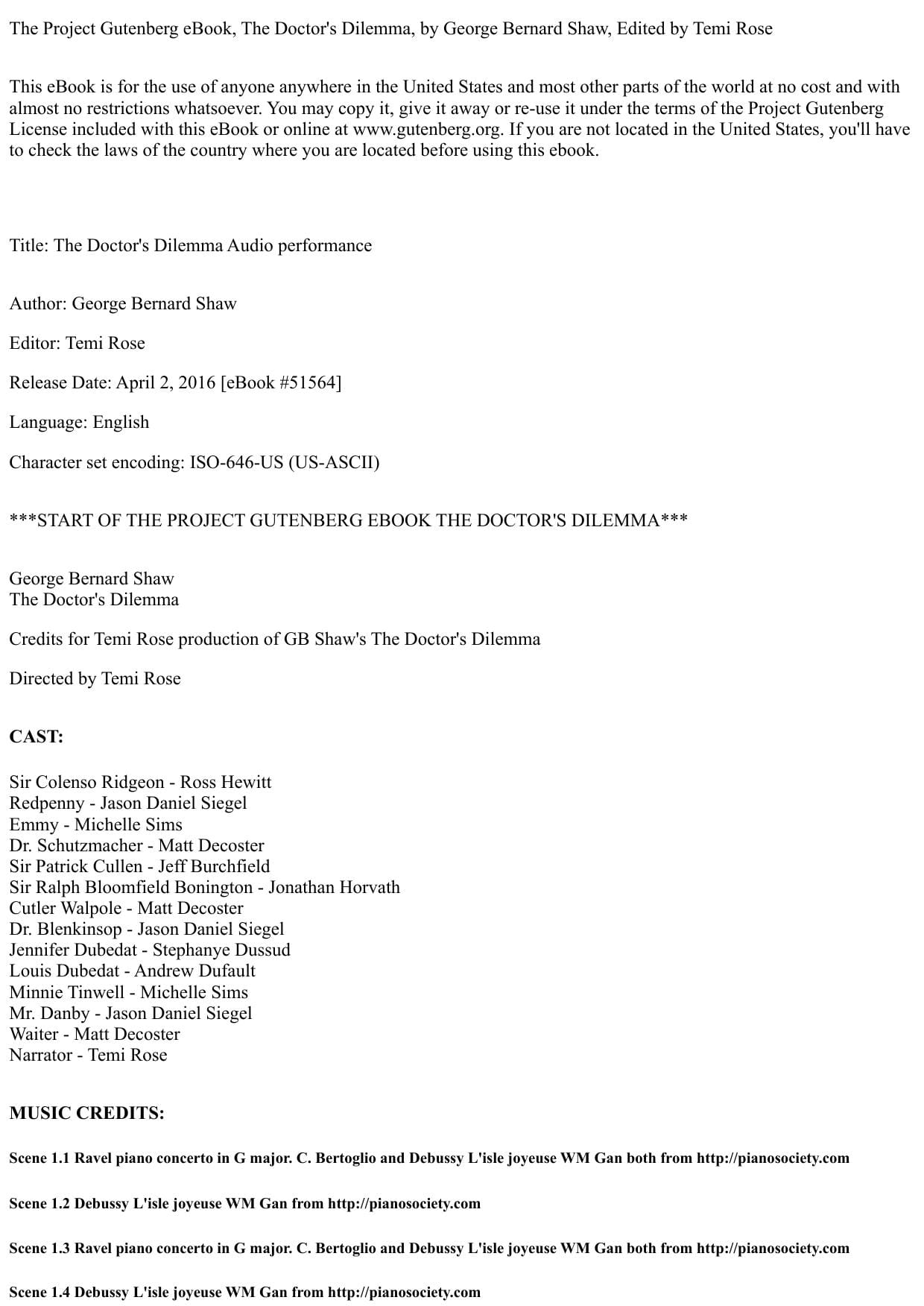
When Dr. Ridgeon discovers a revolutionary new serum capable of curing tuberculosis, he faces an impossible choice. Two patients need the single available dose: Louis Dubedat, a staggeringly talented artist of breathtaking charm who also happens to be a ruthless borrower who never pays his debts and a man who drove his first wife to suicide, and Jennifer Dubedat, his current wife, a generous young woman who has devoted herself to caring for the very man who ruined her life. Shaw's 1906 masterpiece is less a medical drama than a ruthless examination of who deserves to live when society cannot save everyone. The play dissects the pretensions of the medical profession, the brutal economics of private healthcare, and the uncomfortable truth that talent and virtue rarely arrive in the same person. With Shaw's characteristic wit and surgical precision, the play asks whether we should reward moral worth or artistic genius, and whether money and connections should determine who gets healed. The result is as uncomfortable as it is unforgettable.
Editions
X-Ray
“Life does not cease to be funny when people die any more than it ceases to be serious when people laugh.””
— Bernard Shaw
“it’s always the patient who has to take the chance when an experiment is necessary. And we can find out nothing without experiment.””
— Bernard Shaw
“Walpole has no intellect. A mere surgeon. A wonderful operator but, after all, what is operating? . . . . Manual labour.””
— Bernard Shaw
“Well, I've known over thirty men who've found out how to cure consumption. Why do people go on dying of it, Colly? Devilment I suppose!””
— Bernard Shaw
“Science is always simple and always profound. It is only the half-truths that are dangerous. Ignorant faddists pick up some superficial information about germs; and they write to the papers and try to discredit science.””
— Bernard Shaw
Link to this book
Add a free, dofollow link to Lex on your blog, forum, syllabus, or reading list.

<a href="https://lex-books.com/book/the-doctor-s-dilemma-11a3f019-8511-4c73-ba31-c7ac3ea2ce54"><img src="https://lex-books.com/badges/read-on-lex.svg" alt="Read The Doctor's Dilemma by Bernard Shaw free on Lex" width="160" height="40"></a>[](https://lex-books.com/book/the-doctor-s-dilemma-11a3f019-8511-4c73-ba31-c7ac3ea2ce54)[url=https://lex-books.com/book/the-doctor-s-dilemma-11a3f019-8511-4c73-ba31-c7ac3ea2ce54][img]https://lex-books.com/badges/read-on-lex.svg[/img][/url]Read The Doctor's Dilemma by Bernard Shaw free on Lex: https://lex-books.com/book/the-doctor-s-dilemma-11a3f019-8511-4c73-ba31-c7ac3ea2ce54Cite this book
Reading this edition for a paper or guide? Copy a citation.
Shaw, Bernard. The Doctor's Dilemma. Lex, lex-books.com/book/the-doctor-s-dilemma-11a3f019-8511-4c73-ba31-c7ac3ea2ce54.Shaw, B. (n.d.). The Doctor's Dilemma. Lex. https://lex-books.com/book/the-doctor-s-dilemma-11a3f019-8511-4c73-ba31-c7ac3ea2ce54Shaw, Bernard. The Doctor's Dilemma. Lex. https://lex-books.com/book/the-doctor-s-dilemma-11a3f019-8511-4c73-ba31-c7ac3ea2ce54.