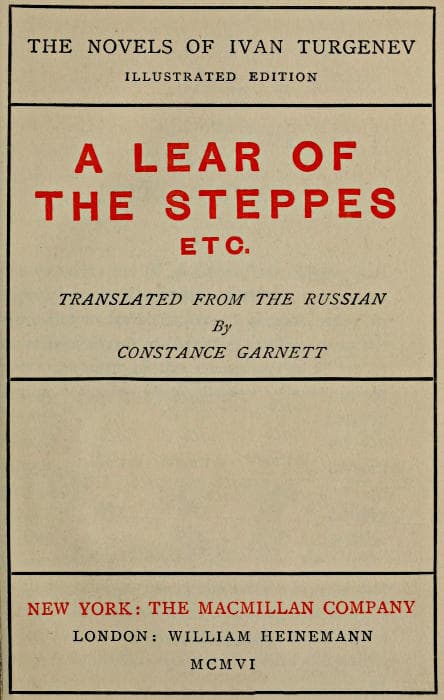
The Diary of a Superfluous Man, and Other Stories
1904
The Diary of a Superfluous Man, and Other Stories
1904
Translated by Constance Garnett
The title story is a devastating portrait of a man confronting his own irrelevance. Tchulkaturin, dying and alone, writes his diary as both confession and autopsy of a life he deems useless. Turgenev captures something precise and painful about the educated Russian nobleman of the 19th century - one who has been given everything (breeding, intellect, culture) and yet finds himself unnecessary to everyone and everything around him. His anguish is not self-pity but something more honest: a reckoning with all the things he never did, the love he never declared, the purpose he never found. The other stories in this collection orbit the same desolate territory, exploring love and loss with a melancholy that feels almost modern. Turgenev wrote these as a young man, and there is all the rawness of someone who understood intimately what it meant to feel superfluous in a world that seemed to have no place for quiet, reflective men. The "superfluous man" would become one of Russian literature's most enduring archetypes, and this is where it begins.
Editions

X-Ray
“I’ve never known a woman whose virtues afforded her less pleasure. She was crushed by the weight of her virtues and tormented everybody, beginning with herself.””
— Ivan Sergeevich Turgenev
“Oh, if only I could run my thoughts over all my memories in the same way I can run my eyes over all the objects in my room! I know these memories are unhappy and trivial, but I have no others.””
— Ivan Sergeevich Turgenev
“In the face of death, earth’s last vanities vanish. I feel I am growing calmer, simpler, more lucid. Too late to see sense! It’s a strange thing – I really am growing calmer, and yet at the same time I’m scared. Yes, I’m scared.””
— Ivan Sergeevich Turgenev
“The sun beats down and smites one. I’m in a bad way. I feel I’m disintegrating.””
— Ivan Sergeevich Turgenev
Link to this book
Add a free, dofollow link to Lex on your blog, forum, syllabus, or reading list.

<a href="https://lex-books.com/book/the-diary-of-a-superfluous-man-and-other-stories-2df24e15-de8f-4608-a237-d7abc78ab319"><img src="https://lex-books.com/badges/read-on-lex.svg" alt="Read The Diary of a Superfluous Man, and Other Stories by Ivan Sergeevich Turgenev free on Lex" width="160" height="40"></a>[](https://lex-books.com/book/the-diary-of-a-superfluous-man-and-other-stories-2df24e15-de8f-4608-a237-d7abc78ab319)[url=https://lex-books.com/book/the-diary-of-a-superfluous-man-and-other-stories-2df24e15-de8f-4608-a237-d7abc78ab319][img]https://lex-books.com/badges/read-on-lex.svg[/img][/url]Read The Diary of a Superfluous Man, and Other Stories by Ivan Sergeevich Turgenev free on Lex: https://lex-books.com/book/the-diary-of-a-superfluous-man-and-other-stories-2df24e15-de8f-4608-a237-d7abc78ab319Cite this book
Reading this edition for a paper or guide? Copy a citation.
Turgenev, Ivan Sergeevich. The Diary of a Superfluous Man, and Other Stories. Lex, lex-books.com/book/the-diary-of-a-superfluous-man-and-other-stories-2df24e15-de8f-4608-a237-d7abc78ab319.Turgenev, I. S. (1904). The Diary of a Superfluous Man, and Other Stories. Lex. https://lex-books.com/book/the-diary-of-a-superfluous-man-and-other-stories-2df24e15-de8f-4608-a237-d7abc78ab319Turgenev, Ivan Sergeevich. The Diary of a Superfluous Man, and Other Stories. Lex. https://lex-books.com/book/the-diary-of-a-superfluous-man-and-other-stories-2df24e15-de8f-4608-a237-d7abc78ab319.