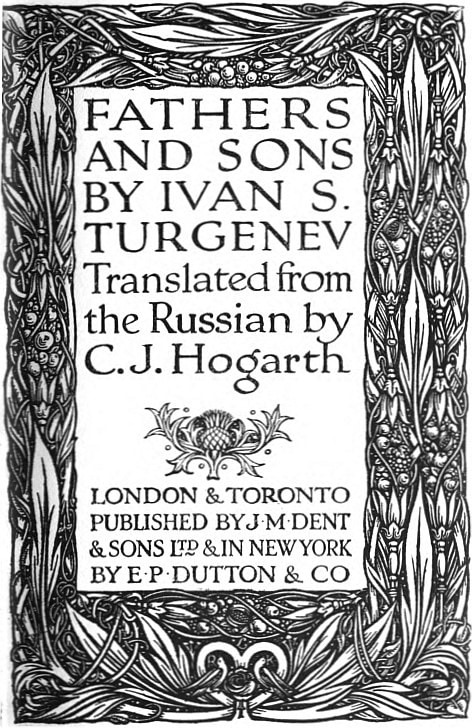
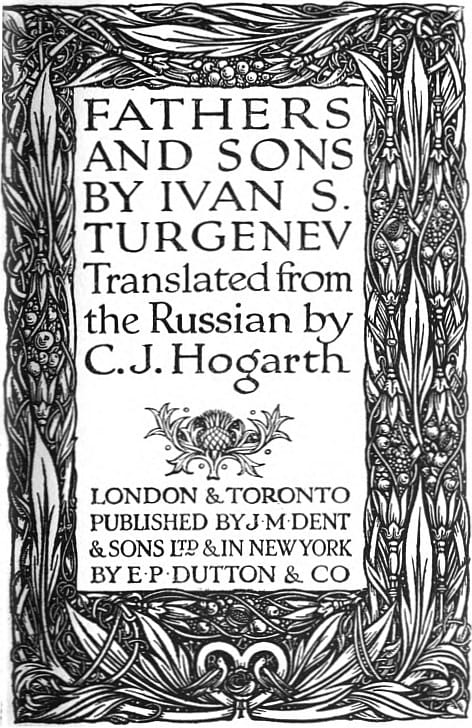
Fathers and Sons
1862
When Arkady Kirsanov brings his friend Bazarov home from university, he unlashes something dangerous on his father's quiet estate. Bazarov is a nihilist: brilliant, abrasive, and utterly unconvinced by anything the older generation holds sacred. He mocks sentiment, rejects tradition, and argues that nothing in Russia need be taken on faith. His very existence forces the Kirsanov family and their circle to confront what they believe and why. Turgenev捕捉了一代人的紧张关系,这种关系至今仍能引起共鸣。老一辈人生活在对旧世界的怀念中,而年轻人则渴望根除过去的一切。巴扎罗夫是一个令人不安的存在, 他是那么的真实、那么的有血有肉,让你不得不质疑自己对传统的依恋是否只是恐惧的伪装。当巴扎罗夫坠入爱河,当致命的疾病逼近时,这部小说变成了一场关于革命、爱情和死亡本身的深刻冥想。巴扎罗夫的死既是个人的悲剧,也是那一代人乌托邦式梦想的象征性终结。这部小说预见了后来将席卷俄国的激进运动,并继续向每一个时代的读者提出同样的问题:我们应该尊重什么,又应该摧毁什么?
Editions
X-Ray
A radical young nihilist and aspiring doctor who rejects all authority, art, and traditional values, advocating for science and utility.
A young, impressionable graduate who initially idolizes Bazarov and embraces nihilism, but eventually finds his own path in love and traditional life.
Arkady's father, a kind, gentle, and somewhat sentimental landowner struggling to adapt to new social changes and maintain his estate.
Nikolai's elder brother, a proud, elegant, and aristocratic man who clings to old-world principles and traditions, fiercely opposing Bazarov.
About Fathers and Sons
Chapter Summaries
- 1
- Nikolai Petrovitch Kirsanov, a middle-aged landowner, anxiously awaits his son Arkady's return from university at a posting-house. The chapter introduces Nikolai's background, his military family, and his quiet life as a widower managing his estate. Arkady finally arrives, bringing joy to his father.
- 2
- Arkady introduces his radical friend, Evgenii Bazarov, to Nikolai Petrovitch. Bazarov's tall, intellectual, and somewhat brusque demeanor immediately contrasts with Nikolai's gentle nature. They make arrangements for the journey to the Kirsanov estate, Marino.
- 3
- On the drive to Marino, Nikolai and Arkady converse. Nikolai reveals his struggles with estate management and his relationship with Thenichka, a young woman living with him who is the mother of his child. Arkady, displaying a newfound 'magnanimity,' assures his father of his acceptance, while Bazarov remains detached.
Key Themes
- Generational Conflict
- The novel vividly portrays the clash between the 'fathers' (Nikolai and Paul Kirsanov) and the 'sons' (Bazarov and Arkady), highlighting their differing philosophies, values, and approaches to life, love, and social reform in 19th-century Russia. This conflict drives much of the narrative and character development.
- Nihilism and Materialism
- Bazarov champions nihilism, rejecting all authority, aesthetic values, and abstract principles in favor of scientific empiricism and utility. The novel explores the intellectual appeal and practical limitations of this philosophy, especially in matters of human emotion and social change, ultimately questioning its sustainability.
- Love and Passion
- Various forms of love—paternal, maternal, romantic, and unrequited—are explored, often contrasting Bazarov's reductionist view of love as a 'mere empirical sentiment' with the profound emotional experiences of other characters. This theme ultimately challenges Bazarov's own detachment and reveals the universal human need for connection.
Characters
- Bazarov (Evgenii Vasiliev)(protagonist)
- A radical young nihilist and aspiring doctor who rejects all authority, art, and traditional values, advocating for science and utility.
- Arkady Nikolaievitch Kirsanov(protagonist)
- A young, impressionable graduate who initially idolizes Bazarov and embraces nihilism, but eventually finds his own path in love and traditional life.
- Nikolai Petrovitch Kirsanov(supporting)
- Arkady's father, a kind, gentle, and somewhat sentimental landowner struggling to adapt to new social changes and maintain his estate.
- Paul Petrovitch Kirsanov(supporting)
- Nikolai's elder brother, a proud, elegant, and aristocratic man who clings to old-world principles and traditions, fiercely opposing Bazarov.
- Anna Sergievna Odintsov(supporting)
- A beautiful, intelligent, and independent young widow who lives a disciplined life and is intrigued by Bazarov, but ultimately chooses tranquility over passionate love.
- Katerina Sergievna (Katia)(supporting)
- Anna's younger sister, shy and artistic, who develops a deep connection with Arkady and eventually marries him.
Link to this book
Add a free, dofollow link to Lex on your blog, forum, syllabus, or reading list.

<a href="https://lex-books.com/book/fathers-and-sons-7bb052c2-7106-4a59-b31c-4bbb93c00fb5"><img src="https://lex-books.com/badges/read-on-lex.svg" alt="Read Fathers and Sons by Ivan Sergeevich Turgenev free on Lex" width="160" height="40"></a>[](https://lex-books.com/book/fathers-and-sons-7bb052c2-7106-4a59-b31c-4bbb93c00fb5)[url=https://lex-books.com/book/fathers-and-sons-7bb052c2-7106-4a59-b31c-4bbb93c00fb5][img]https://lex-books.com/badges/read-on-lex.svg[/img][/url]Read Fathers and Sons by Ivan Sergeevich Turgenev free on Lex: https://lex-books.com/book/fathers-and-sons-7bb052c2-7106-4a59-b31c-4bbb93c00fb5Cite this book
Reading this edition for a paper or guide? Copy a citation.
Turgenev, Ivan Sergeevich. Fathers and Sons. Lex, lex-books.com/book/fathers-and-sons-7bb052c2-7106-4a59-b31c-4bbb93c00fb5.Turgenev, I. S. (1862). Fathers and Sons. Lex. https://lex-books.com/book/fathers-and-sons-7bb052c2-7106-4a59-b31c-4bbb93c00fb5Turgenev, Ivan Sergeevich. Fathers and Sons. Lex. https://lex-books.com/book/fathers-and-sons-7bb052c2-7106-4a59-b31c-4bbb93c00fb5.