The Book of Nonsense
1846
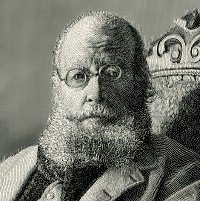
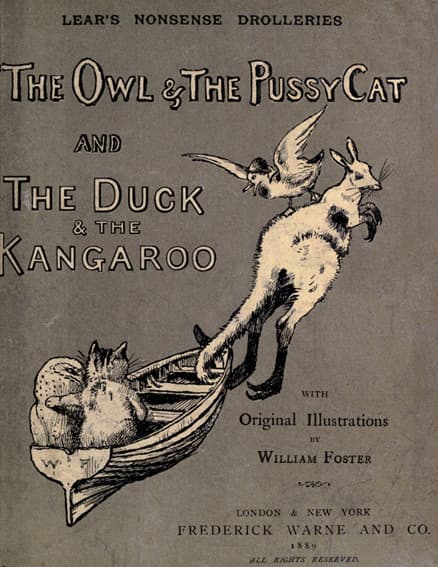
Before there was Alice in Wonderland, there was Edward Lear and hisBook of Nonsense. Published in 1846, this small volume introduced the limerick to the English-speaking world and established nonsense as a literary form worthy of adults and children alike. Each five-line verse places a peculiar character in an impossible situation: an old man so bearded that owls nest in it, a young lady whose nose dips into her soup, an elderly person who runs backwards into a well. The logic is deliberately broken. The rhymes gleefully disobey. What remains is pure linguistic play, a world where the sensible is mocked and the absurd is celebrated. Lear, the twentieth child of a London stockbroker, wrote these verses partly to amuse the grandchildren of his aristocratic patrons. What he created was something that transcended parlor entertainment. The book ripples with joy, absurdity, and a kind of reckless inventiveness that still feels fresh 180 years later. It is for anyone who needs to remember that language can be pure fun, that rules are suggestions, and that sometimes the best thing a poem can do is make you laugh.
Editions
X-Ray
“There was an Old Man of Peru, Who watched his wife making a stew; But once by mistake, In a stove she did bake, That unfortunate Man of Peru.””
— Edward Lear
“There was an Old Man of the East, Who gave””
— Edward Lear
“Which distressed that Old Man of Jamaica. nonsense””
— Edward Lear
“Young Lady of Hull, Who was chased by a””
— Edward Lear
“nonsense pictures There was a Young Lady of Troy, Whom several large flies did annoy; Some she killed””
— Edward Lear
“There was an Old Person whose habits,Induced him to feed upon Rabbits;When he'd eaten eighteen,He turned perfectly green,Upon which he relinquished those habits.””
— Edward Lear
“There was an Old Man with a beard,Who sat on a horse when he reared;But they said, "Never mind!You will fall off behind,You propitious Old Man with a beard!””
— Edward Lear
“There was an Old Man or Nepaul,From his horse had a terrible fall;But, though split quite in two,By some very strong glue,They mended that Man of Nepaul.””
— Edward Lear
“There was a Young Lady of Bute,Who played on a silver-gilt flute;She played several jigs,To her uncle's white pigs,That amusing Young Lady of Bute.””
— Edward Lear
Link to this book
Add a free, dofollow link to Lex on your blog, forum, syllabus, or reading list.

<a href="https://lex-books.com/book/the-book-of-nonsense-4658c758-a394-45b5-a422-61dec9d2d24a"><img src="https://lex-books.com/badges/read-on-lex.svg" alt="Read The Book of Nonsense by Edward Lear free on Lex" width="160" height="40"></a>[](https://lex-books.com/book/the-book-of-nonsense-4658c758-a394-45b5-a422-61dec9d2d24a)[url=https://lex-books.com/book/the-book-of-nonsense-4658c758-a394-45b5-a422-61dec9d2d24a][img]https://lex-books.com/badges/read-on-lex.svg[/img][/url]Read The Book of Nonsense by Edward Lear free on Lex: https://lex-books.com/book/the-book-of-nonsense-4658c758-a394-45b5-a422-61dec9d2d24aCite this book
Reading this edition for a paper or guide? Copy a citation.
Lear, Edward. The Book of Nonsense. Lex, lex-books.com/book/the-book-of-nonsense-4658c758-a394-45b5-a422-61dec9d2d24a.Lear, E. (1846). The Book of Nonsense. Lex. https://lex-books.com/book/the-book-of-nonsense-4658c758-a394-45b5-a422-61dec9d2d24aLear, Edward. The Book of Nonsense. Lex. https://lex-books.com/book/the-book-of-nonsense-4658c758-a394-45b5-a422-61dec9d2d24a.