A Book of Nonsense
1894
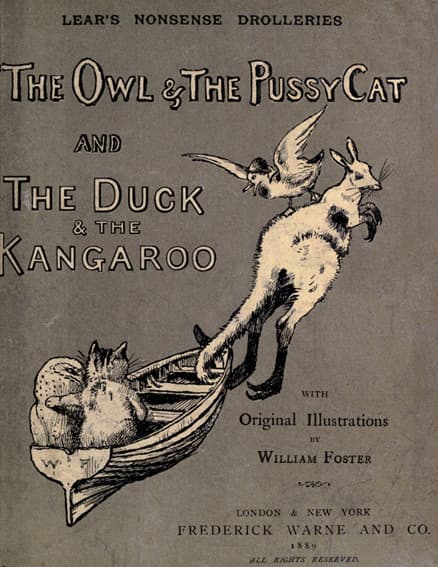
Edward Lear invented nonsense. Before him, there was no permission to be quite so absurd in English verse. A Book of Nonsense, first published in 1846, gave the world the limerick and proved that pure silliness could be elevated to art. Here are old men who sit on hot cookstoves and weep, young ladies who feed owls from spoons, and one unforgettable figure whose beard holds the nests of seven larks. Each five-line verse tumbles forward with the momentum of a child who won't stop talking, building toward a conclusion that makes no sense whatsoever - and feels exactly right. The illustrations match the verse: wobbly, gleeful, utterly unhinged. What makes Lear's nonsense endure isn't nostalgia for Victorian childhoods. It's something deeper: the recognition that logic isn't the only way to understand the world. These poems are an invitation to abandon reason, stop asking 'why,' and simply laugh at the sounds words make when they escape their meaning. Nonsense, Lear showed us, is its own kind of truth.
Editions
X-Ray
“There was an Old Man of Peru, Who watched his wife making a stew; But once by mistake, In a stove she did bake, That unfortunate Man of Peru.””
— Edward Lear
“There was an Old Man of the East, Who gave””
— Edward Lear
“Which distressed that Old Man of Jamaica. nonsense””
— Edward Lear
“Young Lady of Hull, Who was chased by a””
— Edward Lear
“nonsense pictures There was a Young Lady of Troy, Whom several large flies did annoy; Some she killed””
— Edward Lear
“There was an Old Person whose habits,Induced him to feed upon Rabbits;When he'd eaten eighteen,He turned perfectly green,Upon which he relinquished those habits.””
— Edward Lear
“There was an Old Man with a beard,Who sat on a horse when he reared;But they said, "Never mind!You will fall off behind,You propitious Old Man with a beard!””
— Edward Lear
“There was an Old Man or Nepaul,From his horse had a terrible fall;But, though split quite in two,By some very strong glue,They mended that Man of Nepaul.””
— Edward Lear
“There was a Young Lady of Bute,Who played on a silver-gilt flute;She played several jigs,To her uncle's white pigs,That amusing Young Lady of Bute.””
— Edward Lear
Link to this book
Add a free, dofollow link to Lex on your blog, forum, syllabus, or reading list.

<a href="https://lex-books.com/book/a-book-of-nonsense-47a2396b-61ca-4b08-b32a-088019621cfa"><img src="https://lex-books.com/badges/read-on-lex.svg" alt="Read A Book of Nonsense by Edward Lear free on Lex" width="160" height="40"></a>[](https://lex-books.com/book/a-book-of-nonsense-47a2396b-61ca-4b08-b32a-088019621cfa)[url=https://lex-books.com/book/a-book-of-nonsense-47a2396b-61ca-4b08-b32a-088019621cfa][img]https://lex-books.com/badges/read-on-lex.svg[/img][/url]Read A Book of Nonsense by Edward Lear free on Lex: https://lex-books.com/book/a-book-of-nonsense-47a2396b-61ca-4b08-b32a-088019621cfaCite this book
Reading this edition for a paper or guide? Copy a citation.
Lear, Edward. A Book of Nonsense. Lex, lex-books.com/book/a-book-of-nonsense-47a2396b-61ca-4b08-b32a-088019621cfa.Lear, E. (1894). A Book of Nonsense. Lex. https://lex-books.com/book/a-book-of-nonsense-47a2396b-61ca-4b08-b32a-088019621cfaLear, Edward. A Book of Nonsense. Lex. https://lex-books.com/book/a-book-of-nonsense-47a2396b-61ca-4b08-b32a-088019621cfa.