Praise of Folly

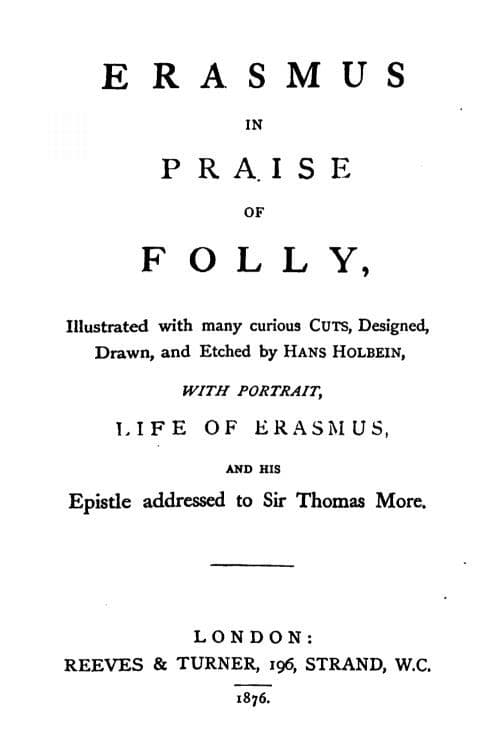
The Praise of Folly, written in 1509 by Desiderius Erasmus, is a satirical essay that critiques the superstitions and corrupt practices within the Roman Catholic Church while also exploring themes of self-deception and madness. The work begins with a humorous encomium in the style of the Greek satirist Lucian and evolves into a serious examination of folly, reflecting Erasmus' own disillusionment with the Church. This influential text is considered a catalyst for the Protestant Reformation and was banned by the Council of Trent in 1559. It has been translated into multiple languages, including English, French, and German.
Editions

Link to this book
Add a free, dofollow link to Lex on your blog, forum, syllabus, or reading list.

<a href="https://lex-books.com/book/praise-of-folly-f6ba3894-5bea-4b10-905c-31c8d9731eec"><img src="https://lex-books.com/badges/read-on-lex.svg" alt="Read Praise of Folly by Desiderius Erasmus free on Lex" width="160" height="40"></a>[](https://lex-books.com/book/praise-of-folly-f6ba3894-5bea-4b10-905c-31c8d9731eec)[url=https://lex-books.com/book/praise-of-folly-f6ba3894-5bea-4b10-905c-31c8d9731eec][img]https://lex-books.com/badges/read-on-lex.svg[/img][/url]Read Praise of Folly by Desiderius Erasmus free on Lex: https://lex-books.com/book/praise-of-folly-f6ba3894-5bea-4b10-905c-31c8d9731eecCite this book
Reading this edition for a paper or guide? Copy a citation.
Erasmus, Desiderius. Praise of Folly. Lex, lex-books.com/book/praise-of-folly-f6ba3894-5bea-4b10-905c-31c8d9731eec.Erasmus, D. (n.d.). Praise of Folly. Lex. https://lex-books.com/book/praise-of-folly-f6ba3894-5bea-4b10-905c-31c8d9731eecErasmus, Desiderius. Praise of Folly. Lex. https://lex-books.com/book/praise-of-folly-f6ba3894-5bea-4b10-905c-31c8d9731eec.
![Two Dyaloges (c. 1549): Wrytten in Laten by the Famous Clerke, D. Erasm[US] of Roterodame, One Called Polyphemus or the Gospeller, the Other Dysposyng of Thynges and Names, Translated in to Englyshe by Edmonde Becke.](/_next/image?url=https%3A%2F%2Fd3b2n8gj62qnwr.cloudfront.net%2FCOVERS%2Fgutenberg_covers75k%2Febook-14500.png&w=3840&q=75)