Philosophiae Naturalis Principia Mathematica
1687
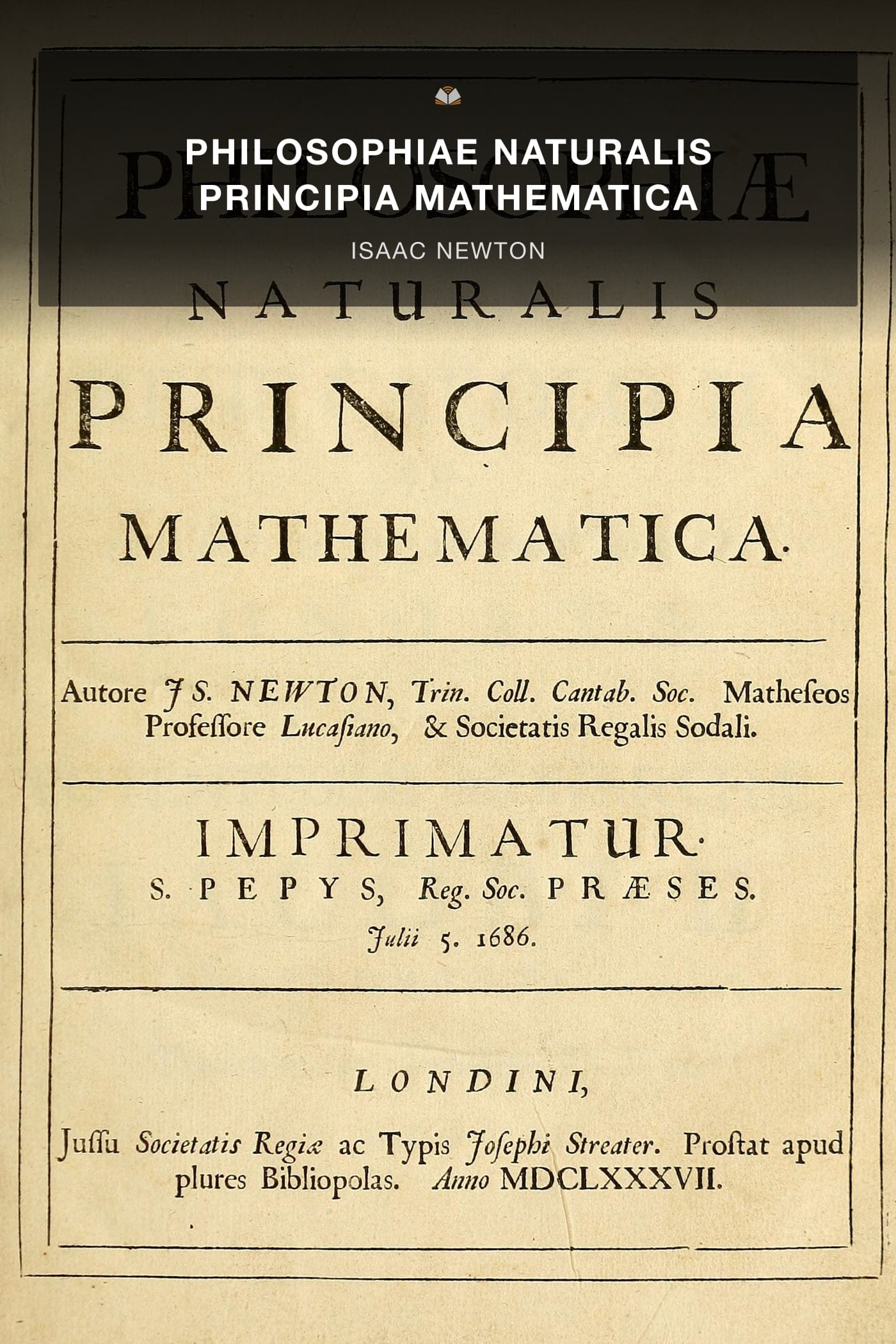
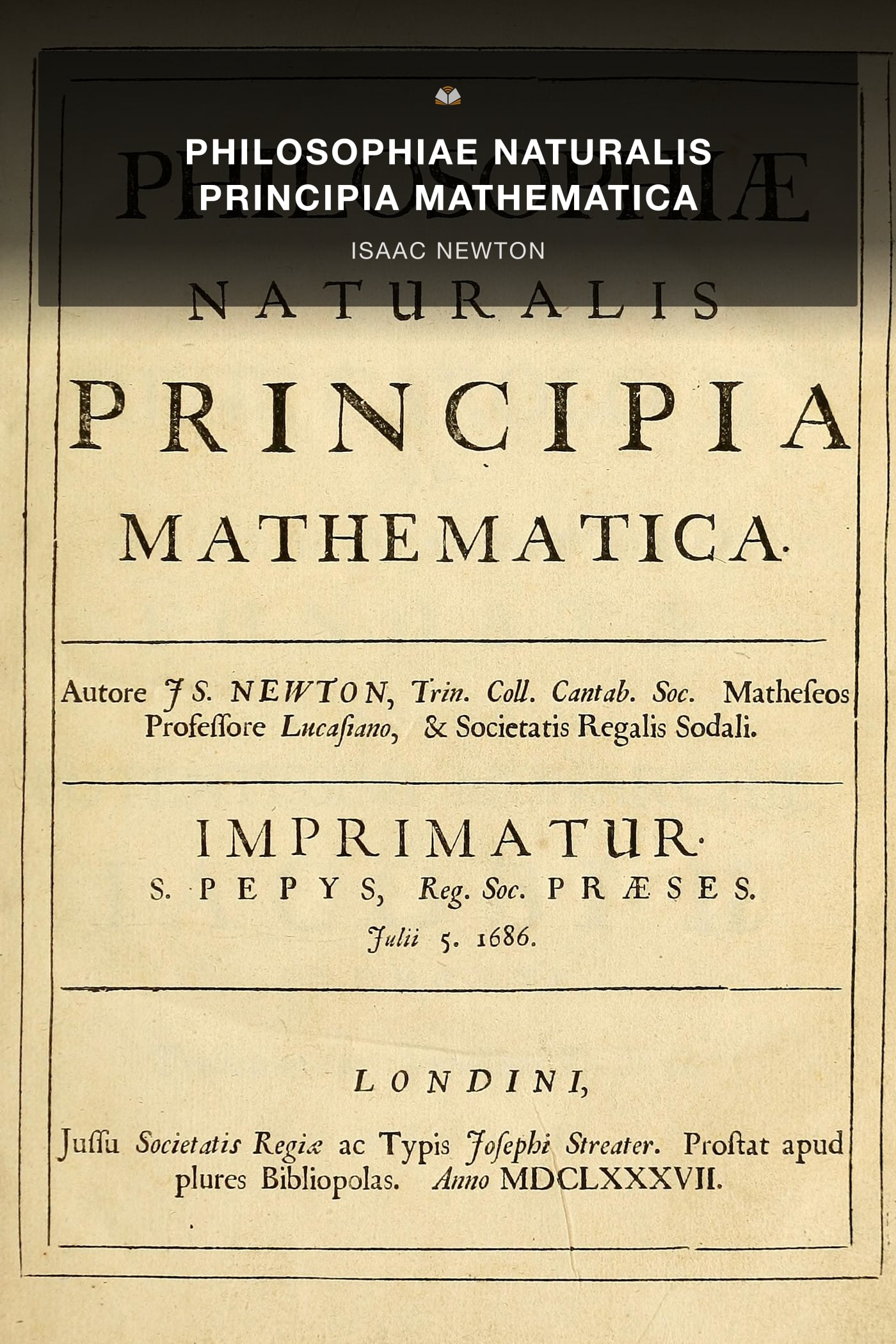
Philosophiae Naturalis Principia Mathematica
1687
In 1687, a reclusive Cambridge professor published a thin volume that would permanently alter humanity's understanding of its place in the cosmos. The Principia did something unprecedented: it revealed that the same mathematical laws governing an apple falling from a tree also dictate the orbit of the moon around the Earth and the path of comets through the heavens. Newton gave us three laws of motion and a single elegant principle universal gravitation that unified the terrestrial and celestial into one comprehensible framework. This is not merely physics; it is a declaration that the universe runs on rules we can discover and describe. More than three centuries later, we still launch spacecraft using Newton's mathematics, still calculate trajectories with his equations. Yet the Principia is also a window into a particular mind at a particular moment in history wrestling with the deepest questions humans have ever asked: What keeps the planets in their paths? Why does everything fall downward? Is there a mathematics capable of holding the entire world in its equations? This new translation renders Newton's dense Latin into crystalline contemporary prose, making accessible the text that Laplace called the greatest production of the human mind. For anyone who has ever looked up at the night sky and wondered, here is the book that began answering that question.
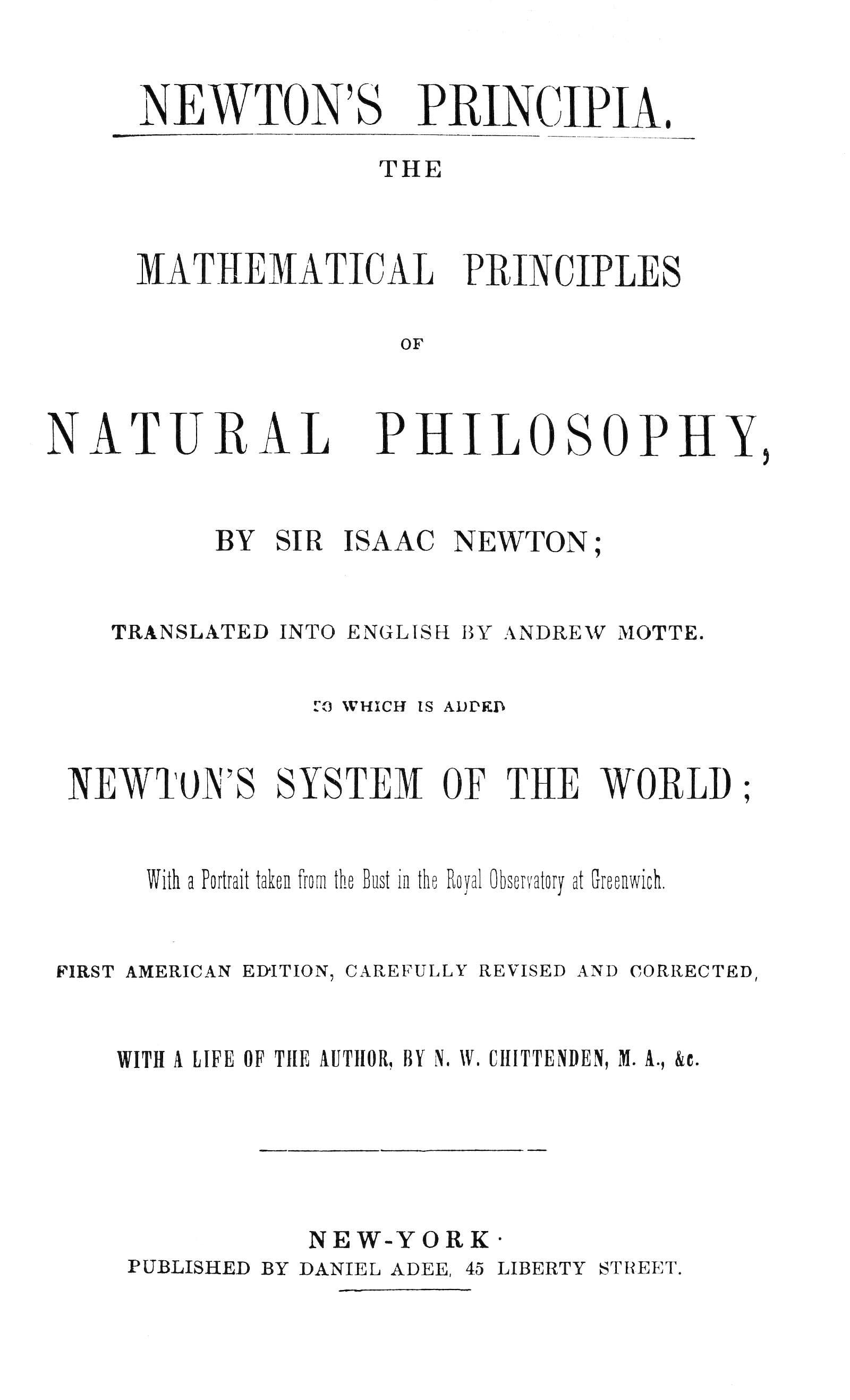
Editions

X-Ray
“This most beautiful system of the sun, planets and comets, could only proceed from the counsel and dominion of an intelligent and powerful Being...This Being governs all things, not as the soul of the world, but as Lord over all; and on account of his dominion he is wont, to be called Lord God παντοκρατωρ or Universal Ruler.””
— Isaac Newton
“God without dominion, providence, and final causes, is nothing else but Fate and Nature. Blind metaphysical necessity, which is certainly the same always and everywhere, could produce no variety of things. All that diversity of natural things which we find suited to different times and places could arise from nothing but the ideas and will of a Being necessarily existing.””
— Isaac Newton
“This most beautiful system [The Universe] could only proceed from the dominion of an intelligent and powerful Being.””
— Isaac Newton
“Resistance is usually ascribed to bodies at rest, and impulse to those in motion; but motion and rest, as commonly conceived, are only relatively distinguished; nor are those bodies always truly at rest, which commonly are taken to be so.””
— Isaac Newton
“'s laws, although not rigidly true, are sufficiently near to the truth to have led to the discovery of the law of attraction of the bodies of the solar system. The deviation from complete accuracy is due to the facts, that the planets are not of inappreciable mass, that, in consequence, they disturb each other's orbits about the Sun, and, by their action on the Sun itself, cause the periodic time of each to be shorter than if the Sun were a fixed body, in the subduplicate ratio of the mass of the Sun to the sum of the masses of the Sun and Planet; these errors are appreciable although very small, since the mass of the largest of the planets, Jupiter, is less than 1/1000th of the Sun's mass.””
— Isaac Newton
“Hypotheses non fingo (Latin for "I feign no hypotheses", "I frame no hypotheses", or "I contrive no hypotheses")””
— Isaac Newton
“We are to admit no more causes of natural things than such as are both true and sufficient to explain their appearances. To this purpose the philosophers say that Nature does nothing in vain, and more is in vain when less will serve; for Nature is pleased with simplicity and affects not the pomp of superfluous causes.””
— Isaac Newton
“the one as much as it advances that of the other. If a body impinge upon another, and by its force change the motion of the other, that body also (because of the equality of the mutual pressure) will undergo an equal change, in its own motion, towards the contrary part.””
— Isaac Newton
“I wish we could derive the rest of the phenomena of nature by the same kind of reasoning from mechanical principles; for I am induced by many reasons to suspect that they may all depend upon certain forces by which the particles of bodies, by some causes hitherto unknown, are either mutually impelled towards each other, and cohere in regular figures, or are repelled and recede from each other; which forces being unknown, philosophers have hitherto attempted the search of nature in vain; but I hope the principles here laid down will afford some light either to that or some truer method of philosophy.””
— Isaac Newton
Link to this book
Add a free, dofollow link to Lex on your blog, forum, syllabus, or reading list.

<a href="https://lex-books.com/book/philosophiae-naturalis-principia-mathematica-3de69b3f-3239-40bc-b34b-55356083e0ec"><img src="https://lex-books.com/badges/read-on-lex.svg" alt="Read Philosophiae Naturalis Principia Mathematica by Isaac Newton free on Lex" width="160" height="40"></a>[](https://lex-books.com/book/philosophiae-naturalis-principia-mathematica-3de69b3f-3239-40bc-b34b-55356083e0ec)[url=https://lex-books.com/book/philosophiae-naturalis-principia-mathematica-3de69b3f-3239-40bc-b34b-55356083e0ec][img]https://lex-books.com/badges/read-on-lex.svg[/img][/url]Read Philosophiae Naturalis Principia Mathematica by Isaac Newton free on Lex: https://lex-books.com/book/philosophiae-naturalis-principia-mathematica-3de69b3f-3239-40bc-b34b-55356083e0ecCite this book
Reading this edition for a paper or guide? Copy a citation.
Newton, Isaac. Philosophiae Naturalis Principia Mathematica. Lex, lex-books.com/book/philosophiae-naturalis-principia-mathematica-3de69b3f-3239-40bc-b34b-55356083e0ec.Newton, I. (1687). Philosophiae Naturalis Principia Mathematica. Lex. https://lex-books.com/book/philosophiae-naturalis-principia-mathematica-3de69b3f-3239-40bc-b34b-55356083e0ecNewton, Isaac. Philosophiae Naturalis Principia Mathematica. Lex. https://lex-books.com/book/philosophiae-naturalis-principia-mathematica-3de69b3f-3239-40bc-b34b-55356083e0ec.