No More Parades: A Novel
1925
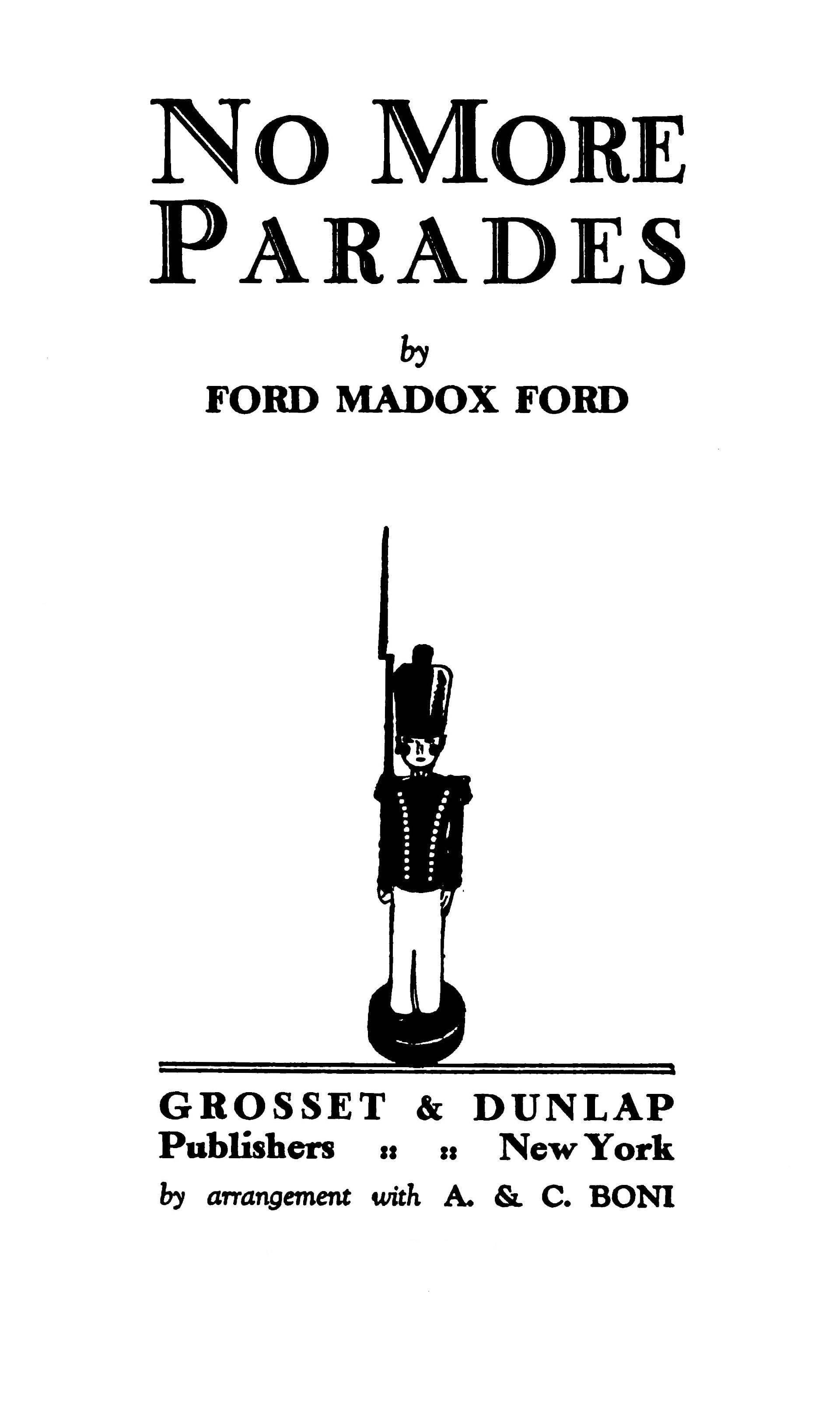
The second installment of Ford Madox Ford's masterpiece Parade's End finds Captain Christopher Tietjens entrenched in the psychological devastation of the Western Front. Ford renders the interior life of his protagonist with extraordinary precision: Tietjens, that most English of gentlemen, clings to order and duty while all around him disintegrates into chaos. The narrative pulses with the grinding tension of waiting between bombardments, the mundane horrors of camp life, and the corrosive weight of a marriage to the faithless Sylvia that haunts him even in the trenches. Ford's revolutionary use of stream of consciousness captures what bullets cannot: the way a man's mind fractures, remembers, and endures. This is war literature stripped of heroism, rendered instead as an agonizing study of loyalty, class, and the impossible demands of being an officer and a gentleman when civilization itself has collapsed.
Editions

X-Ray
“Higher than the beasts, lower than the angels, stuck in our idiot Eden.””
— Ford Madox Ford
“You seduced a young woman in order to be able to finish your talks with her. You could not do that without living with her. You could not live with her without seducing her; but that was the by-product. The point is that you can't otherwise talk. You can't finish talks at street corners; in museums; even in drawing-rooms. You mayn't be in the mood when she is in the mood – for the intimate conversation that means the final communion of your souls. You have to wait together – for a week, for a year, for a lifetime, before the final intimate conversation may be attained...and exhausted. So that...That in effect was love.””
— Ford Madox Ford
“He wouldn't write a letter because he couldn't without beginning it 'Dear Sylvia' and ending it 'Yours sincerely' or 'truly' or 'affectionately.' He's that sort of precise imbecile. I tell you he's so formal he can't do without all the conventions there are and so truthful he can't use half of them.””
— Ford Madox Ford
“But responsibility hardens the heart. It must.””
— Ford Madox Ford
“Upon my soul!' Tietjens said to himself, 'that girl down there is the only intelligent living soul I've met for years.' A little pronounced in manner sometimes; faulty in reasoning naturally, but quite intelligent, with a touch of wrong accent now and then. But if she was wanted anywhere, there she'd be! Of good stock, of course: on both sides! But positively, she and Sylvia were the only two human beings he had met for years whom he could respect: the one for sheer efficiency in killing; the other for having the constructive desire and knowing how to set about it. Kill or cure! The two functions of man. If you wanted something killed you'd go to Sylvia Tietjens in sure faith that she would kill it: emotion, hope, ideal; kill it quick and sure. If you wanted something kept alive you'd go to Valentine: she's find something to do for it. . . . The two types of mind: remorseless enemy, sure screen, dagger ... sheath!Perhaps the future of the world then was to women? Why not? He hand't in years met a man that he hadn't to talk down to - as you talk down to a child, as he had talked down to General Campion or to Mr. Waterhouse ... as he always talked down to Macmaster. All good fellows in their way ...””
— Ford Madox Ford
“The war had made a man of him! It had coarsened him and hardened him. There was no other way to look at it. It had made him reach a point at which he would no longer stand unbearable things.””
— Ford Madox Ford
“...she had always known under her mind and now she confessed it: her agony had been, half of it, because one day he would say farewell to her, like that, with the inflexion of a verb. As, just occasionally, using the word 'we' - and perhaps without intention - he had let her know that he loved her.””
— Ford Madox Ford
“If you hunch your shoulders too long against a storm your shoulders will grow bowed.…””
— Ford Madox Ford
“In every man there are two minds that work side by side, the one checking the other; thus emotion stands against reason, intellect corrects passion and first impressions act a little, but very little, before quick reflection.””
— Ford Madox Ford
Link to this book
Add a free, dofollow link to Lex on your blog, forum, syllabus, or reading list.

<a href="https://lex-books.com/book/no-more-parades-a-novel-05ed58c6-9c98-49cd-982c-57c09d3ae6ec"><img src="https://lex-books.com/badges/read-on-lex.svg" alt="Read No More Parades: A Novel by Ford Madox Ford free on Lex" width="160" height="40"></a>[](https://lex-books.com/book/no-more-parades-a-novel-05ed58c6-9c98-49cd-982c-57c09d3ae6ec)[url=https://lex-books.com/book/no-more-parades-a-novel-05ed58c6-9c98-49cd-982c-57c09d3ae6ec][img]https://lex-books.com/badges/read-on-lex.svg[/img][/url]Read No More Parades: A Novel by Ford Madox Ford free on Lex: https://lex-books.com/book/no-more-parades-a-novel-05ed58c6-9c98-49cd-982c-57c09d3ae6ecCite this book
Reading this edition for a paper or guide? Copy a citation.
Ford, Ford Madox. No More Parades: A Novel. Lex, lex-books.com/book/no-more-parades-a-novel-05ed58c6-9c98-49cd-982c-57c09d3ae6ec.Ford, F. M. (1925). No More Parades: A Novel. Lex. https://lex-books.com/book/no-more-parades-a-novel-05ed58c6-9c98-49cd-982c-57c09d3ae6ecFord, Ford Madox. No More Parades: A Novel. Lex. https://lex-books.com/book/no-more-parades-a-novel-05ed58c6-9c98-49cd-982c-57c09d3ae6ec.