Micromegas
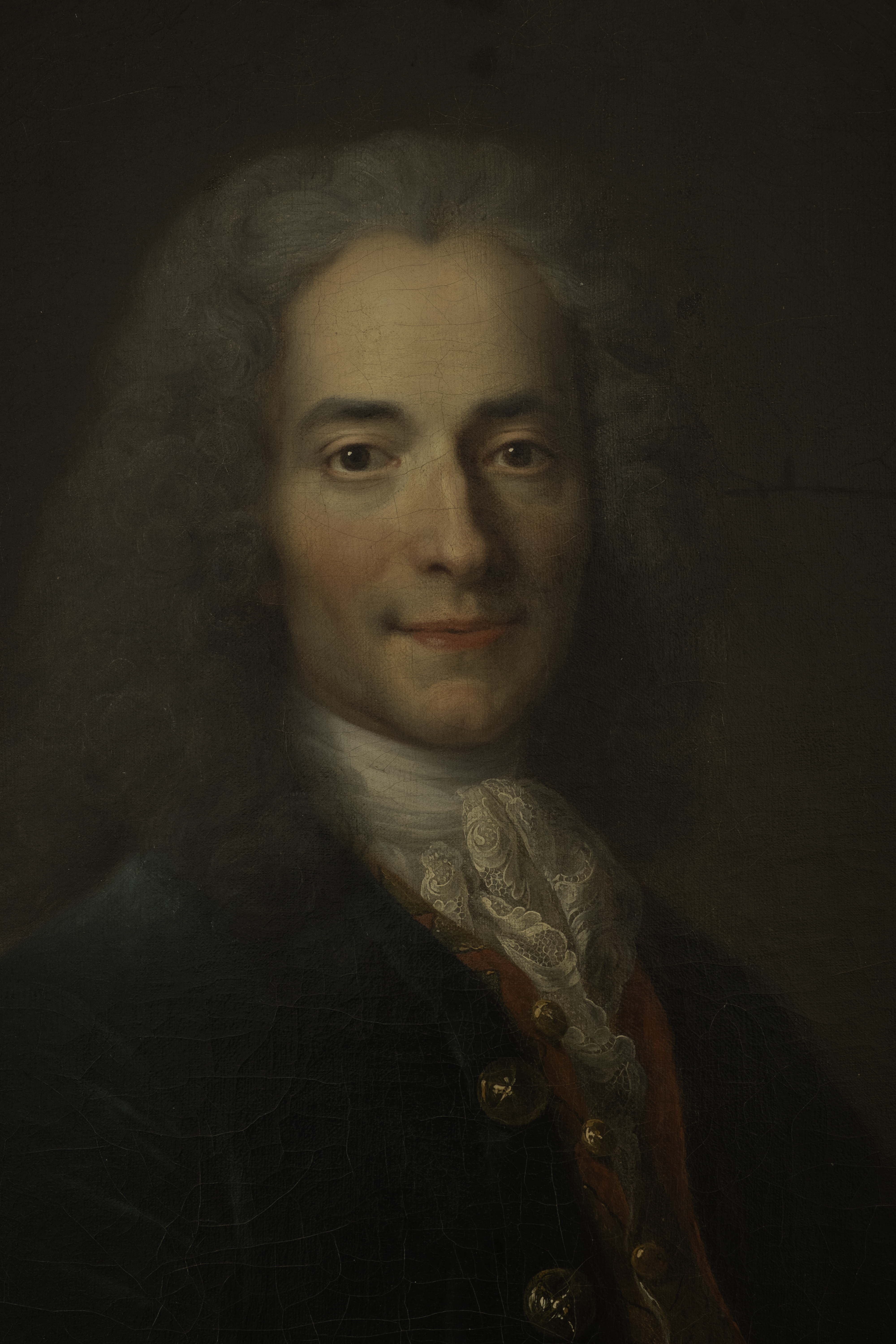
The cosmos is vast beyond comprehension, and yet somehow humanity has convinced itself it matters. This is the delicious premise of Voltaire's 1752 satire: a being from Sirius, twelve miles tall, journeys across the universe with his companion from Saturn (a mere six thousand feet). When they finally reach Earth in 1737, they must construct microscopes to perceive these supposedly intelligent creatures teeming on a small blue dot. What follows is a masterpiece of deflation. The travelers observe humans, our philosophical debates and scientific Certainty, with an outsider's amusement that reveals how absurd our sense of cosmic significance truly is. Voltaire, writing decades before Shelley or Wells, invented the science fiction conceit of cosmic perspective to serve his favorite target: human vanity. The satire cuts both ways, because the giants are also small, and the microscopes that reveal humanity also diminish what they reveal. It is philosophy disguised as a fairy tale, and it remains startlingly funny nearly three centuries later.
Editions

X-Ray
“my soul is the mirror of the universe, and my body is its frame””
— Voltaire
“One should always cite what one does not understand at all in the language one understands the least.””
— Voltaire
“I shall relate quite simply how things happened and without adding anything of my own, which is no small feat for an historian.””
— Voltaire
“I assert nothing, I content myself with believing that more is possible than people think.””
— Voltaire
“I suspected as much.””
— Voltaire
“He spoke to them with great kindness, although in the depths of his heart he was a little angry that the infinitely small had an almost infinitely great pride.””
— Voltaire
“I say again that nature is like nature. Why bother looking for comparisons?””
— Voltaire
“I do not understand Greek very well," said the giant."Neither do I," said the philosophical mite."Why then," the Sirian retorted, "are you citing some man named Aristotle in the Greek?""Because," replied the savant, "one should always cite what one does not understand at all in the language one understands the least.””
— Voltaire
“Le cartésien prit la parole, et dit: "L'âme est un esprit pur, qui a reçu dans le ventre de sa mère toutes les idées métaphysiques et qui, en sortant de là, est obligée d'áller à l'école, et d'apprendre tout de nouveau ce qu'elle a si bien su et qu'elle ne saura plus.””
— Voltaire
Link to this book
Add a free, dofollow link to Lex on your blog, forum, syllabus, or reading list.

<a href="https://lex-books.com/book/micromegas-dadd118c-0b64-496b-bae2-f243d807eb83"><img src="https://lex-books.com/badges/read-on-lex.svg" alt="Read Micromegas by Voltaire free on Lex" width="160" height="40"></a>[](https://lex-books.com/book/micromegas-dadd118c-0b64-496b-bae2-f243d807eb83)[url=https://lex-books.com/book/micromegas-dadd118c-0b64-496b-bae2-f243d807eb83][img]https://lex-books.com/badges/read-on-lex.svg[/img][/url]Read Micromegas by Voltaire free on Lex: https://lex-books.com/book/micromegas-dadd118c-0b64-496b-bae2-f243d807eb83Cite this book
Reading this edition for a paper or guide? Copy a citation.
Voltaire. Micromegas. Lex, lex-books.com/book/micromegas-dadd118c-0b64-496b-bae2-f243d807eb83.Voltaire (n.d.). Micromegas. Lex. https://lex-books.com/book/micromegas-dadd118c-0b64-496b-bae2-f243d807eb83Voltaire. Micromegas. Lex. https://lex-books.com/book/micromegas-dadd118c-0b64-496b-bae2-f243d807eb83.