Messiah
1954
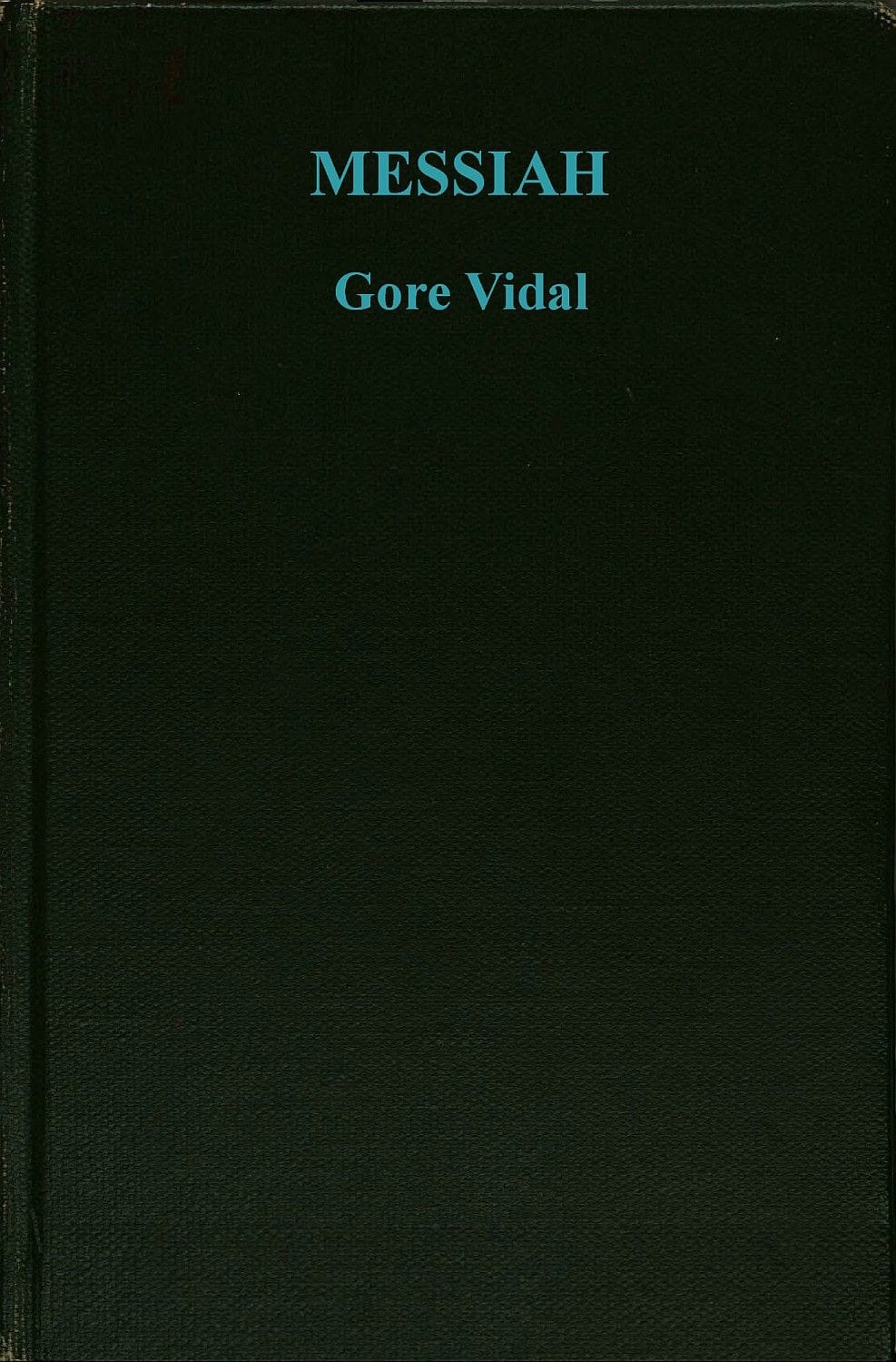
A mortician appears on television in 1954 to announce that death is infinitely preferable to life. Within months, he leads a religious movement that makes Christianity and most of Islam look like minor denominations. Gore Vidal's audacious novel follows John Ericsson Windows, a census taker who becomes entangled with the charismatic cult leader and his rapidly growing flock of the spiritually deceased. What begins as a cold war of ideas between Windows and the prophet becomes something stranger and darker: an examination of belief itself, the human hunger for transcendence, and how easily faith becomes a weapon. Written when America was still confident in its own modernity, Messiah anticipates with eerie precision the cult tragedies of the decades to come. It is both a savage satire and a genuine philosophical inquiry into why people surrender their minds to charismatic men who promise eternal life. Vidal writes with the controlled fury of a prophet and the wit of a satirist who has seen the future.
Editions
X-Ray
“Life will be wonderful when men no longer fear dying. When the last superstitions are thrown out and we meet death with the same equanimity as life. No longer will children's minds be twisted by evil gods whose fantastic origin is in those barbaric tribes who feared death and lightning, who feared life. That's it: life is the villain to to those who preach reward in death, through grace and eternal bliss, or through dark revenge.””
— Gore Vidal
“You can't break eggs without making an omelet," said Butler sententiously.””
— Gore Vidal
“The garden was at its best that first week in the month of June. The peonies were more opulent than usual and I walked slowly through the green light on the terrace above the white river, enjoying the heavy odor of peonies and of new roses rambling in hedges.””
— Gore Vidal
“We met in the late afternoon at her house. Only the three of us were present on that occasion. In the set of dialogues which I composed and published in later years I took considerable liberties with our actual conversations, especially this first one: in fact, as hostile critics were quick to suggest, the dialogues were created by me with very little of Cave in them and a good deal of Plato, rearranged to fit the occasion. In time, though, my version was accepted implicitly, if only because there were no longer any hostile critics.””
— Gore Vidal
“This morning I reread the last section, trying to see it objectively, to match what I have put down with the memory I still bear of that first encounter with John Cave. I have not, I fear, got it. But this is as close as I can come to recalling long-vanished emotions and events.””
— Gore Vidal
Link to this book
Add a free, dofollow link to Lex on your blog, forum, syllabus, or reading list.

<a href="https://lex-books.com/book/messiah-4c6b1d3f-0e91-44b8-a60f-3efc69c1d4b1"><img src="https://lex-books.com/badges/read-on-lex.svg" alt="Read Messiah by Gore Vidal free on Lex" width="160" height="40"></a>[](https://lex-books.com/book/messiah-4c6b1d3f-0e91-44b8-a60f-3efc69c1d4b1)[url=https://lex-books.com/book/messiah-4c6b1d3f-0e91-44b8-a60f-3efc69c1d4b1][img]https://lex-books.com/badges/read-on-lex.svg[/img][/url]Read Messiah by Gore Vidal free on Lex: https://lex-books.com/book/messiah-4c6b1d3f-0e91-44b8-a60f-3efc69c1d4b1Cite this book
Reading this edition for a paper or guide? Copy a citation.
Vidal, Gore. Messiah. Lex, lex-books.com/book/messiah-4c6b1d3f-0e91-44b8-a60f-3efc69c1d4b1.Vidal, G. (1954). Messiah. Lex. https://lex-books.com/book/messiah-4c6b1d3f-0e91-44b8-a60f-3efc69c1d4b1Vidal, Gore. Messiah. Lex. https://lex-books.com/book/messiah-4c6b1d3f-0e91-44b8-a60f-3efc69c1d4b1.