Life in the Sick-Room: Essays
1844
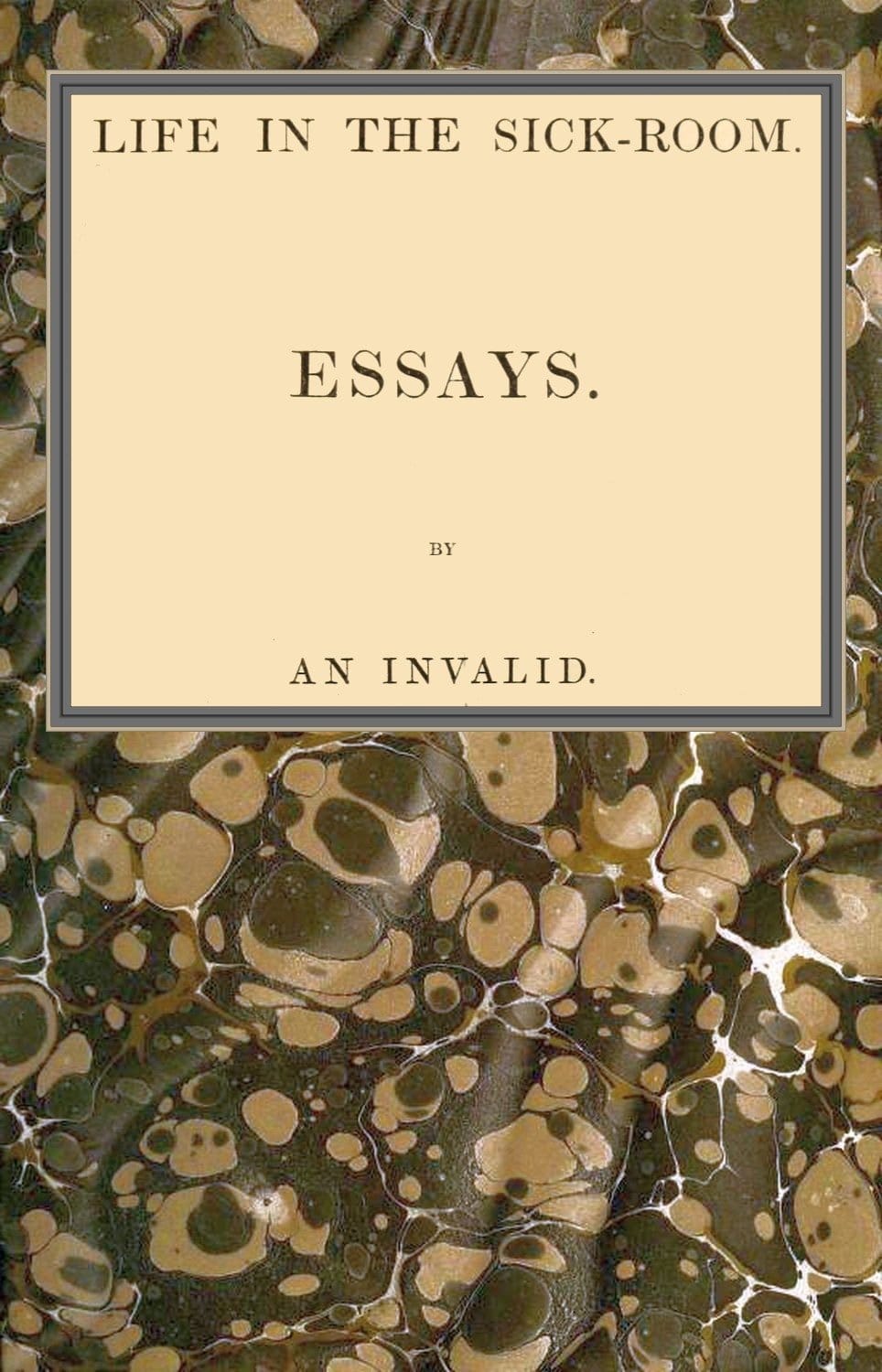
Life in the Sick-Room: Essays, published in 1844 by Harriet Martineau, is a collection of reflections on the experience of chronic illness. Martineau, believing herself to be suffering from an incurable condition, explores themes of suffering, sympathy, and the emotional insights gained from her illness. The work serves as both a personal narrative and an educational treatise, addressing the spiritual and psychological dimensions of being an invalid. It holds significance in Victorian literature, particularly in the context of invalidism, and includes additional writings and correspondence with notable figures like Florence Nightingale.
Editions
X-Ray
“The truth is, as all will declare who are subject to a frequently recurring pain, a familiar pain becomes more and more dreaded, instead of becoming lightly esteemed in proportion to its familiarity. The general sense of alarm which it probably occasioned when new, may have given way and disappeared before a knowledge of consequences, and a regular method of management or endurance; but the pain itself becomes more odious, more oppressive, more feared, in proportion to the accumulation of experience of weary hours, in proportion to the aggregate of painful associations which every visitation revives.””
— Harriet Martineau
“The reason may speak, and even through the lips, of hope and courage ; but the sensation of which I speak is peculiar ; so peculiarly connected with bodily agony, that I cannot but believe it felt wherever bodily agony is felt. It has nothing to do with the courage of the soul ; affords not the shadow of contradiction to patience, fortitude, religious trust, I mean simply that when extreme pain seizes on us, down go our spirits, fathoms deep ; and, though the soul may yet be submissive and even willing, the sickening question rises,”
— Harriet Martineau
“Biography will never fail. Would that we were all equally secure of a higher matter,”
— Harriet Martineau
“The weakest sufferers are precisely those who are least able to appropriate the future and its good things. If this be true of the weak, and if the strong find it irritating to be medicined with soft fictions, or presented with anything but sound truth, the popular method of consolation appears to be excluded altogether. If my own life were to be lived over again, I should, from the strength of this conviction, convert most of its words of intended consolation into a far more consolatory condolence. Never””
— Harriet Martineau
“If I were asked whether there is any one idea more potential than any other over every sort of suffering, in a mode of life like ours, most hearers of the question would make haste to answer for me that there is such a variety of potential ideas, suited to such wide differences of mood, of mind and body, that it must be impossible to measure the strength of any one. Nevertheless, I should reply that there is one, to me more powerful at present than I can now conceive any single idea to have been in any former state of my mind. It is this ; that it matters infinitely less what we do than what we are.””
— Harriet Martineau
“We all know how the present action of our new civilization works to the impairing of Privacy. As new discoveries are causing all penetrating physical lights so to abound as that, as has been said, we shall soon not know where in the world to get any darkness, so our new facilities for every sort of communication, work to reduce privacy much within its former limits. There are some limits, however, which ought to be preserved with vigilance and care, as indispensable, not only to comfort, but to some of the finest virtues and graces of mind and life. It is to be hoped that the privacy of viva voce conversation will ever remain sacred : but it is known that that which ought to be as holy, that of epistolary correspondence,”
— Harriet Martineau
“But when my heart has sickened at the sight, and at the thought of so much gratuitous pain, it has grown strong again in the reflection that, if unnecessary, this misery is temporary,”
— Harriet Martineau
“Are we not growing sensibly more merciful, more wisely humane towards empirics themselves, when they cease to be our oracles ? Are we not learning, from their jumbled discoveries and failures, that empiricism itself is a social function,””
— Harriet Martineau
“Meantime, what a work is done! Amidst the flat contradictions of fact, and oppositions of opinion,”
— Harriet Martineau
Link to this book
Add a free, dofollow link to Lex on your blog, forum, syllabus, or reading list.

<a href="https://lex-books.com/book/life-in-the-sick-room-essays-7a3b36d9-5d9f-4889-849c-e6f1ba61c880"><img src="https://lex-books.com/badges/read-on-lex.svg" alt="Read Life in the Sick-Room: Essays by Harriet Martineau free on Lex" width="160" height="40"></a>[](https://lex-books.com/book/life-in-the-sick-room-essays-7a3b36d9-5d9f-4889-849c-e6f1ba61c880)[url=https://lex-books.com/book/life-in-the-sick-room-essays-7a3b36d9-5d9f-4889-849c-e6f1ba61c880][img]https://lex-books.com/badges/read-on-lex.svg[/img][/url]Read Life in the Sick-Room: Essays by Harriet Martineau free on Lex: https://lex-books.com/book/life-in-the-sick-room-essays-7a3b36d9-5d9f-4889-849c-e6f1ba61c880Cite this book
Reading this edition for a paper or guide? Copy a citation.
Martineau, Harriet. Life in the Sick-Room: Essays. Lex, lex-books.com/book/life-in-the-sick-room-essays-7a3b36d9-5d9f-4889-849c-e6f1ba61c880.Martineau, H. (1844). Life in the Sick-Room: Essays. Lex. https://lex-books.com/book/life-in-the-sick-room-essays-7a3b36d9-5d9f-4889-849c-e6f1ba61c880Martineau, Harriet. Life in the Sick-Room: Essays. Lex. https://lex-books.com/book/life-in-the-sick-room-essays-7a3b36d9-5d9f-4889-849c-e6f1ba61c880.