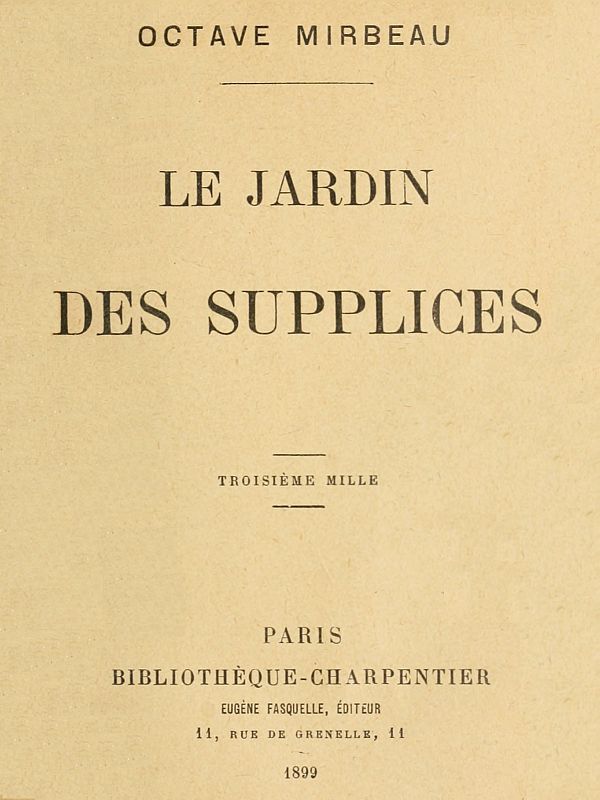
Le Jardin Des Supplices
1899
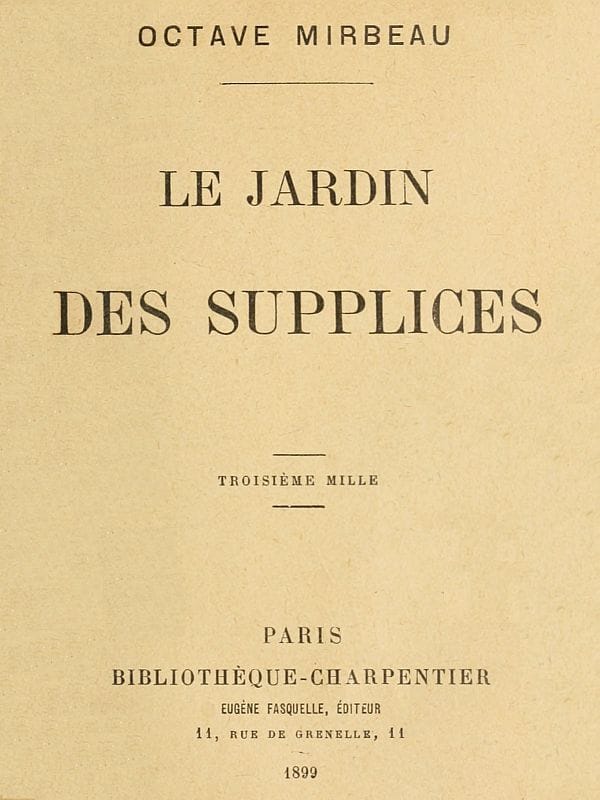
Le Jardin Des Supplices, published in 1899 by Octave Mirbeau, is a provocative novel that delves into the themes of violence and human nature. The narrative follows a dissolute Frenchman who, drawn into a garden in China where torture is practiced as an art form, confronts the depths of depravity and desire. Through philosophical discussions among male characters, the book critiques societal norms and examines the intrinsic connection between civilization and violence, making it a notable exploration of morality and the darker impulses of humanity.
Editions
X-Ray
“Come now, don't make such a funeral face. It isn't dying that's sad; it's living when you're not happy.””
— Octave Mirbeau
“What else do you do there except lie”
— Octave Mirbeau
“Monsters, monsters! But there are no monsters! What you call monsters are superior forms, or forms beyond your understanding. Aren't the gods monsters? Isn't a man of genius a monster, like a tiger or a spider, like all individuals who live beyond social lies, in the dazzling and divine immortality of things? Why, I too then-am a monster!””
— Octave Mirbeau
“I desire her and I hate her. I would like to take her in my arms and embrace her till she smothered, till she was crushed and I could drink death from her gushing veins.””
— Octave Mirbeau
“Why, flowers are violent, cruel, terrible, splendid...like love.””
— Octave Mirbeau
“Woman possesses the cosmic force of an element, an invincible force of destruction, like nature's. She is, in herself alone, all nature! Being the matrix of life, she is by that very fact the matrix of death - since it is from death that life is perpetually reborn, and since to annihilate death would be to kill life at its only fertile source.””
— Octave Mirbeau
“Wherever he goes, whatever he does, he will always see that word: murder”
— Octave Mirbeau
“Alas, the gates of life never swing open except upon death, never open except upon the palaces andgardens of death. And the universe appears to me like an immense, inexorable torture-garden… What Isay today, and what I heard, exists and cries and howls beyond this garden, which is no more than asymbol to me of the entire earth.””
— Octave Mirbeau
“In that atrocious second I understood that desire can attain the darkest human terror and give an actual idea of hell and its horror.””
— Octave Mirbeau
Link to this book
Add a free, dofollow link to Lex on your blog, forum, syllabus, or reading list.

<a href="https://lex-books.com/book/le-jardin-des-supplices-e40eb7e8-2994-4a46-b28a-c56b06afc540"><img src="https://lex-books.com/badges/read-on-lex.svg" alt="Read Le Jardin Des Supplices by Octave Mirbeau free on Lex" width="160" height="40"></a>[](https://lex-books.com/book/le-jardin-des-supplices-e40eb7e8-2994-4a46-b28a-c56b06afc540)[url=https://lex-books.com/book/le-jardin-des-supplices-e40eb7e8-2994-4a46-b28a-c56b06afc540][img]https://lex-books.com/badges/read-on-lex.svg[/img][/url]Read Le Jardin Des Supplices by Octave Mirbeau free on Lex: https://lex-books.com/book/le-jardin-des-supplices-e40eb7e8-2994-4a46-b28a-c56b06afc540Cite this book
Reading this edition for a paper or guide? Copy a citation.
Mirbeau, Octave. Le Jardin Des Supplices. Lex, lex-books.com/book/le-jardin-des-supplices-e40eb7e8-2994-4a46-b28a-c56b06afc540.Mirbeau, O. (1899). Le Jardin Des Supplices. Lex. https://lex-books.com/book/le-jardin-des-supplices-e40eb7e8-2994-4a46-b28a-c56b06afc540Mirbeau, Octave. Le Jardin Des Supplices. Lex. https://lex-books.com/book/le-jardin-des-supplices-e40eb7e8-2994-4a46-b28a-c56b06afc540.