Le Feu (journal D'une Escouade)
1916
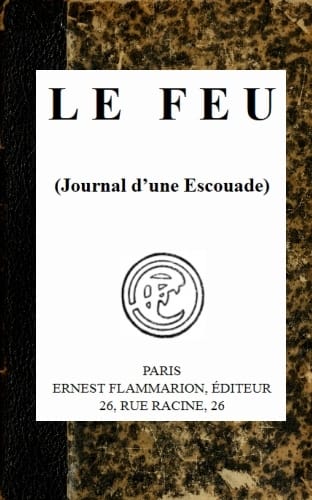
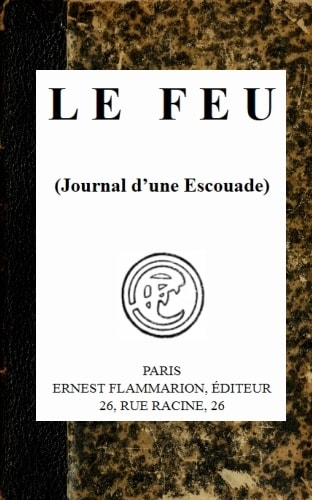
Le Feu (Under Fire), published in 1916 by Henri Barbusse, is a novel based on the author's experiences in World War I. It offers a harrowing portrayal of soldiers in the trenches, capturing their struggles with the grim realities of war, including camaraderie, suffering, and the psychological toll of combat. The narrative follows a soldier's perspective, detailing the daily life of the French Sixth Battalion as they navigate the horrors of battle and the longing for home amidst the chaos. This work is notable for its vivid descriptions and its influence on later war literature, comparable to Hemingway's and Remarque's classics.
Editions
X-Ray
“These are not soldiers, these are men. They are notadventurers or warriors, designed for human butchery - as butchers or cattle. They are the ploughmen or workers that one recognizes even in their uniforms. They are uprooted civilians. They are ready, waiting for the signal for death or murder, but when you examine their faces between the vertical ranks of bayonets, they are nothing but men.””
— Henri Barbusse
“Shame on military glory, shame on armies, shame on the soldier's profession, which changes men, some into stupid victims, others into base executioners. Yes shame, that's true – but it's too true, it's true in eternity, but not yet for us.””
— Henri Barbusse
“Déjà, le mois de septembre, lendemain d'août et veille d'octobre et qui est par sa situation le plus émouvant des mois parsème les beaux jours de quelques fins avertissements. Déjà, on comprend ces feuilles mortes qui courent sur les pierres plates comme une bande de moineaux.””
— Henri Barbusse
“Two armies fighting each other are like one big army that commits suicide.””
— Henri Barbusse
“All these men with their corpse-like faces, in front of us and behind, driven to exhaustion, emptied of words and will....All these men laden with earth, who, you could say, are carrying their own graves...””
— Henri Barbusse
“My silent comrade, who is making great strides with lowered head, points out a field: "The cemetery," he says; "it was there before it was everywhere, before it laid hold on everything without end, like a plague.””
— Henri Barbusse
“Paradis says to me, "That's war.""Yes, that's it," he repeats in a far-away voice, "that's war. It's not anything else."He means”
— Henri Barbusse
“An aeroplane booms overhead. We follow its evolutions with our faces skyward, our necks twisted, our eyes watering at the piercing brightness of the sky. Lamuse declares to me, when we have brought our gaze back to earth, “Those machines ’ll never become practical, never.”“How can you say that? Look at the progress they’ve made already, and the speed of it.”“Yes, but they’ll stop there. They’ll never do any better, never.””
— Henri Barbusse
“In a state of war, one is always waiting. We have become waiting-machines. For the moment it is food we are waiting for. Then it will be the post. But each in its turn. When we have done with dinner we will think about the letters. After that, we shall set ourselves to wait for something else.””
— Henri Barbusse
Link to this book
Add a free, dofollow link to Lex on your blog, forum, syllabus, or reading list.

<a href="https://lex-books.com/book/le-feu-journal-d-une-escouade-b04bd213-7d73-4f5f-b587-5c2b94ea4c82"><img src="https://lex-books.com/badges/read-on-lex.svg" alt="Read Le Feu (journal D'une Escouade) by Henri Barbusse free on Lex" width="160" height="40"></a>[](https://lex-books.com/book/le-feu-journal-d-une-escouade-b04bd213-7d73-4f5f-b587-5c2b94ea4c82)[url=https://lex-books.com/book/le-feu-journal-d-une-escouade-b04bd213-7d73-4f5f-b587-5c2b94ea4c82][img]https://lex-books.com/badges/read-on-lex.svg[/img][/url]Read Le Feu (journal D'une Escouade) by Henri Barbusse free on Lex: https://lex-books.com/book/le-feu-journal-d-une-escouade-b04bd213-7d73-4f5f-b587-5c2b94ea4c82Cite this book
Reading this edition for a paper or guide? Copy a citation.
Barbusse, Henri. Le Feu (journal D'une Escouade). Lex, lex-books.com/book/le-feu-journal-d-une-escouade-b04bd213-7d73-4f5f-b587-5c2b94ea4c82.Barbusse, H. (1916). Le Feu (journal D'une Escouade). Lex. https://lex-books.com/book/le-feu-journal-d-une-escouade-b04bd213-7d73-4f5f-b587-5c2b94ea4c82Barbusse, Henri. Le Feu (journal D'une Escouade). Lex. https://lex-books.com/book/le-feu-journal-d-une-escouade-b04bd213-7d73-4f5f-b587-5c2b94ea4c82.