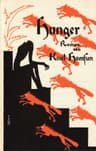
Hunger
In 1890, a young Norwegian writer published a novel that would reshape modern fiction. Knut Hamsun's Hunger drops readers into the fractured mind of an unnamed narrator starving in the streets of Christiania, and the result is neither melodrama nor social critique but something far more unsettling: a plunge into the labyrinth of consciousness itself. The protagonist has a room, barely. He has ambitions to write, theoretically. What he lacks is food, money, and any purchase on the world. Yet his true adversary is not simply hunger but the creeping suspicion that his suffering might be meaningless, that his artistic ambitions mask a deeper fraud. Hamsun renders each fluctuation between pride and self-abasement with surgical precision, dragging the reader into the protagonist's unmoored psychology until distinctions between fact and fantasy dissolve. This was the novel that taught subsequent masters what psychological fiction could do. Kafka, Joyce, Miller all trace lines back to Hamsun's breakthrough. Yet Hunger remains sui generis, a book less about poverty than about the terrifying gap between who we imagine ourselves to be and who we actually are.
Editions
X-Ray
“...I will exile my thoughts if they think of you again, and I will rip my lips out if they say your name once more. Now if you do exist, I will tell you my final word in life or in death, I tell you goodbye.””
— Knut Hamsun
“I suffered no pain, my hunger had taken the edge off; instead I felt pleasantly empty, untouched by everything around me and happy to be unseen by all. I put my legs up on the bench and leaned back, the best way to feel the true well-being of seclusion. There wasn't a cloud in my mind, nor did I feel any discomfort, and I hadn't a single unfulfilled desire or craving as far as my thought could reach. I lay with open eyes in a state of utter absence from myself and felt deliciously out of it.””
— Knut Hamsun
“Truth is neither ojectivity nor the balanced view; truth is a selfless subjectivity.””
— Knut Hamsun
“The intelligent poor individual was a much finer observer than the intelligent rich one. The poor individual looks around him at every step, listens suspiciously to every word he hears from the people he meets; thus, every step he takes presents a problem, a task, for his thoughts and feelings. He is alert and sensitive, he is experienced, his soul has been burned...””
— Knut Hamsun
“Keep it, keep it!" I answered. "You are very welcome to it! It is only a couple of small things, doesn't amount to anything”
— Knut Hamsun
“I was on the verge of crying with grief at still being alive.””
— Knut Hamsun
“It was not my intention to collapse; no, I would die standing.””
— Knut Hamsun
“And the great spirit of darkness spread a shroud over me...everything was silent-everything. But upon the heights soughed the everlasting song, the voice of the air, the distant, toneless humming which is never silent.””
— Knut Hamsun
“I see stars before my eyes, and my thoughts are swept up into a hurricane of light.””
— Knut Hamsun
Link to this book
Add a free, dofollow link to Lex on your blog, forum, syllabus, or reading list.

<a href="https://lex-books.com/book/hunger-ff452eaf-b1fb-4ad8-af92-64e93115c478"><img src="https://lex-books.com/badges/read-on-lex.svg" alt="Read Hunger by Knut Hamsun free on Lex" width="160" height="40"></a>[](https://lex-books.com/book/hunger-ff452eaf-b1fb-4ad8-af92-64e93115c478)[url=https://lex-books.com/book/hunger-ff452eaf-b1fb-4ad8-af92-64e93115c478][img]https://lex-books.com/badges/read-on-lex.svg[/img][/url]Read Hunger by Knut Hamsun free on Lex: https://lex-books.com/book/hunger-ff452eaf-b1fb-4ad8-af92-64e93115c478Cite this book
Reading this edition for a paper or guide? Copy a citation.
Hamsun, Knut. Hunger. Lex, lex-books.com/book/hunger-ff452eaf-b1fb-4ad8-af92-64e93115c478.Hamsun, K. (n.d.). Hunger. Lex. https://lex-books.com/book/hunger-ff452eaf-b1fb-4ad8-af92-64e93115c478Hamsun, Knut. Hunger. Lex. https://lex-books.com/book/hunger-ff452eaf-b1fb-4ad8-af92-64e93115c478.