What would you like to read?Search books, authors, genres, shelves, users...
Search books, authors, genres, shelves, users...Search books, authors, genres, shelves, users...

What would you like to read?Search books, authors, genres, shelves, users...
Search books, authors, genres, shelves, users...Search books, authors, genres, shelves, users...
1877-1965
No author biography available.
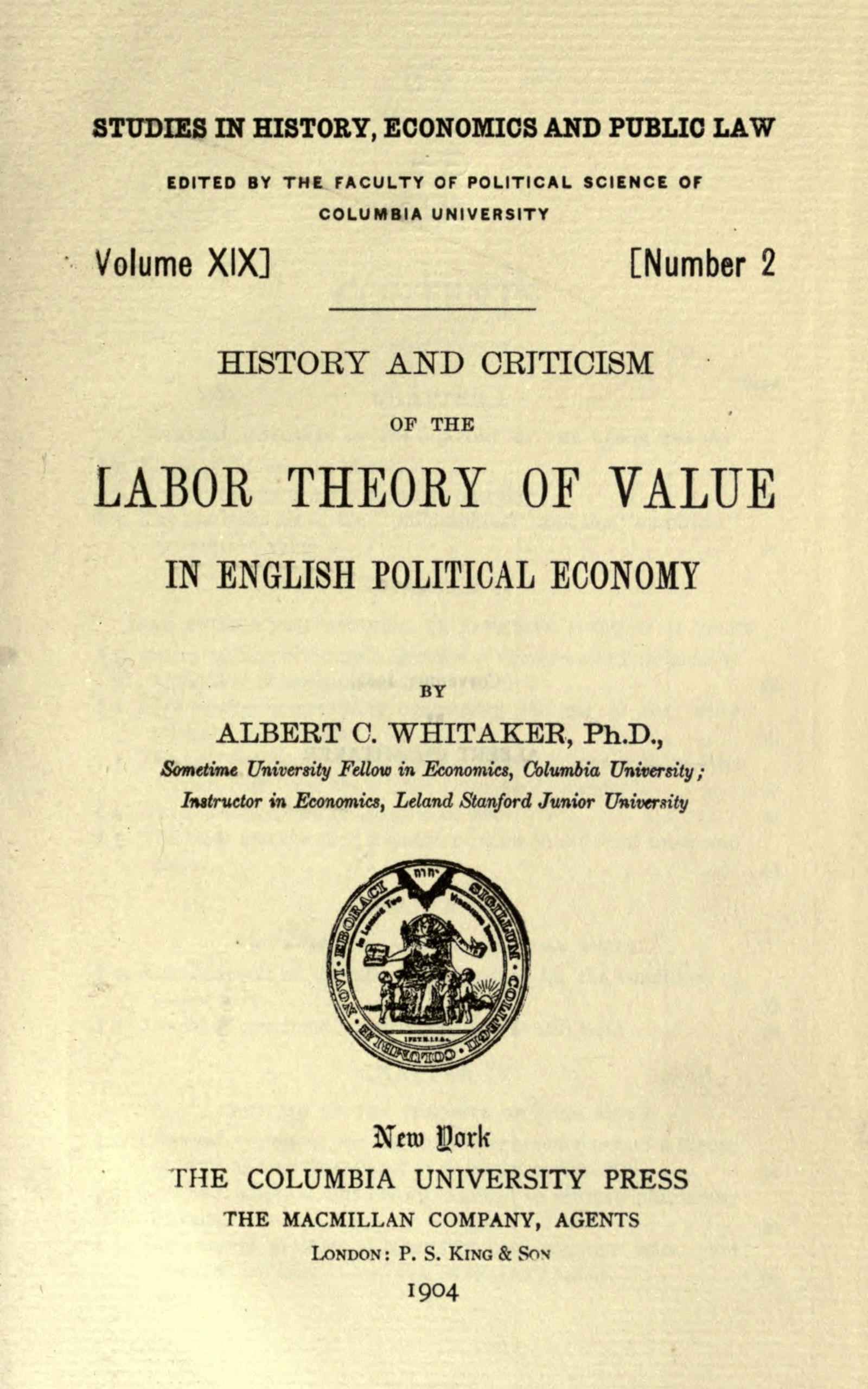
1904
A scholarly historical study written in the early 20th century. It examines how English economists developed and debated the labor theory of value, separating “philosophical” (primitive, essence-seeking) accounts from “empirical” (market and cost-based) explanations, and follows the doctrine from Adam Smith and Ricardo through Malthus, McCulloch, James Mill, Torrens, Senior, John Stuart Mill, and Cairnes. The opening of the work sets its scope and method, rejecting the idea of a single, unified “classical” labor theory and framing the history around two strands: a philosophical account that roots value in labor and an empirical account that explains market prices by entrepreneurs’ costs. It then dissects Adam Smith’s multiple and inconsistent treatments—his labor-cost regulator versus labor-command measure, his handling of labor as both productive power and disutility, and his corn-as-index idea—before showing how Smith abandons labor-cost for advanced society while retaining labor-command as a measure. Whitaker criticizes this move, then turns to Ricardo as a more consistent architect who treats utility as a prerequisite, excludes pure scarcity goods, counts indirect labor, and grapples—often obscurely—with profits and the fixed-versus-circulating capital complication in normal price (wages plus profits). The excerpt closes by introducing McCulloch, James Mill, and Torrens, highlighting McCulloch’s dogmatic broadening of “labor” (to include nature and machines) and noting his anticipation of the later Marxian “organic composition of capital” problem and its aggregate-value “solution.”
