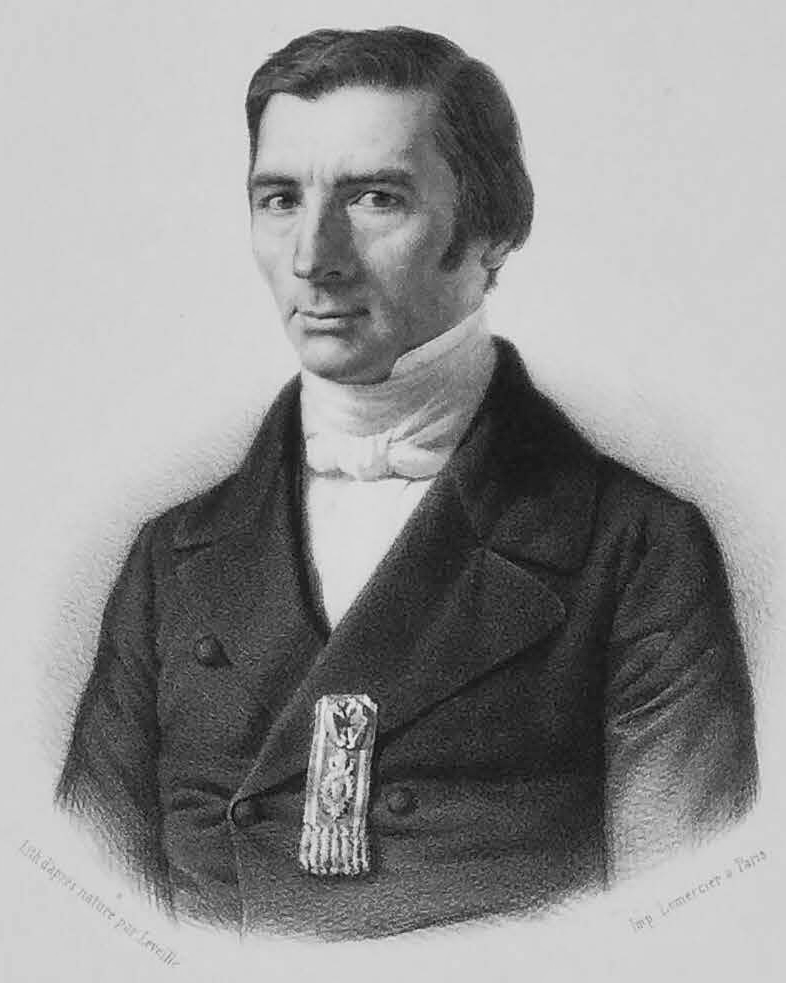
Harmonies of Political Economy: Translated from the Third French Edition, with a Notice of the Life and Writings of the Author
1850
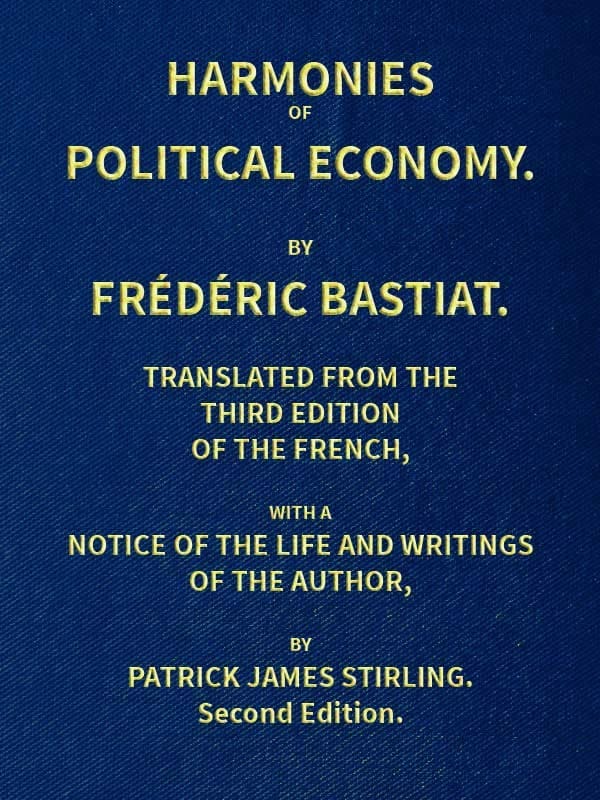
Harmonies of Political Economy: Translated from the Third French Edition, with a Notice of the Life and Writings of the Author
1850
Translated by Patrick James Stirling
Frédéric Bastiat possessed a rare gift: he made economics devastatingly funny. In this, his masterwork, the French liberal thinker mounts a gleeful assault on economic fallacies using wit, satire, and dialogue so sharp it still cuts. The famous 'Candlemakers' Petition' remains a textbook example of how to mock protectionism by seriously arguing for tariffs against sunlight. But beneath the humor lies a serious philosophical argument: that human interests, when freed from artificial constraints, tend toward harmony rather than conflict. Bastiat celebrates the 'intricate social mechanism' in which every person, pursuing their own rational self-interest, contributes to a whole greater than its parts. Written partly in prison (where political activism landed him) and completed by friends after his death at 49, this book dedicated to France's youth pulses with optimistic faith in liberty and reason. For readers who believe ideas matter, who enjoy watching a brilliant mind dismantle nonsense, who want to understand why free trade defenders still cite Bastiat 170 years later.
Editions

X-Ray
“Suppose two countries, A and B. A possesses over B all kinds of advantages. You infer from this, that every sort of industry will concentrate itself in A, and that B is powerless. A, you say, sells much more than it buys; B buys much more than it sells. I might dispute this, but I respect your hypothesis. On this hypothesis, labour is much in demand in A, and will soon rise in price there. Iron, coal, land, food, capital, are much in demand in A, and they will soon rise in price there. Contemporaneously with this, labour, iron, coal, land, food, capital, are in little request in B, and will soon fall in price there. Nor is this all. While A is always selling, and B is always buying, money passes from B to A. It becomes abundant in A, and scarce in B. But abundance of money means that we must have plenty of it to buy everything else. Then in A, to the real dearness which arises from a very active demand, there is added a nominal dearness, which is due to a redundancy of the precious metals. Scarcity””
— Frédéric Bastiat
“But if men are, on the one hand, irresistibly impelled towards what is for their profit, and if, on the other, they resist instinctively what is hurtful, we are forced to conclude that each nation carries in its bosom a natural force of expansion, and a not less natural force of resistance, which forces are equally injurious to all other nations; or, in other words, that antagonism and war are the natural state of human society.””
— Frédéric Bastiat
“man becomes rich in proportion to the remunerative nature of his labor;””
— Frédéric Bastiat
Link to this book
Add a free, dofollow link to Lex on your blog, forum, syllabus, or reading list.

<a href="https://lex-books.com/book/harmonies-of-political-economy-translated-from-the-third-french-edition-with-a-n-5e0bacd5-f2a6-406b-9b35-2d056a87ea4e"><img src="https://lex-books.com/badges/read-on-lex.svg" alt="Read Harmonies of Political Economy: Translated from the Third French Edition, with a Notice of the Life and Writings of the Author by Frédéric Bastiat free on Lex" width="160" height="40"></a>[](https://lex-books.com/book/harmonies-of-political-economy-translated-from-the-third-french-edition-with-a-n-5e0bacd5-f2a6-406b-9b35-2d056a87ea4e)[url=https://lex-books.com/book/harmonies-of-political-economy-translated-from-the-third-french-edition-with-a-n-5e0bacd5-f2a6-406b-9b35-2d056a87ea4e][img]https://lex-books.com/badges/read-on-lex.svg[/img][/url]Read Harmonies of Political Economy: Translated from the Third French Edition, with a Notice of the Life and Writings of the Author by Frédéric Bastiat free on Lex: https://lex-books.com/book/harmonies-of-political-economy-translated-from-the-third-french-edition-with-a-n-5e0bacd5-f2a6-406b-9b35-2d056a87ea4eCite this book
Reading this edition for a paper or guide? Copy a citation.
Bastiat, Frédéric. Harmonies of Political Economy: Translated from the Third French Edition, with a Notice of the Life and Writings of the Author. Lex, lex-books.com/book/harmonies-of-political-economy-translated-from-the-third-french-edition-with-a-n-5e0bacd5-f2a6-406b-9b35-2d056a87ea4e.Bastiat, F. (1850). Harmonies of Political Economy: Translated from the Third French Edition, with a Notice of the Life and Writings of the Author. Lex. https://lex-books.com/book/harmonies-of-political-economy-translated-from-the-third-french-edition-with-a-n-5e0bacd5-f2a6-406b-9b35-2d056a87ea4eBastiat, Frédéric. Harmonies of Political Economy: Translated from the Third French Edition, with a Notice of the Life and Writings of the Author. Lex. https://lex-books.com/book/harmonies-of-political-economy-translated-from-the-third-french-edition-with-a-n-5e0bacd5-f2a6-406b-9b35-2d056a87ea4e.