Het Stoomhuis: De Waanzinnige Der Nerbudda (2/2)
1880
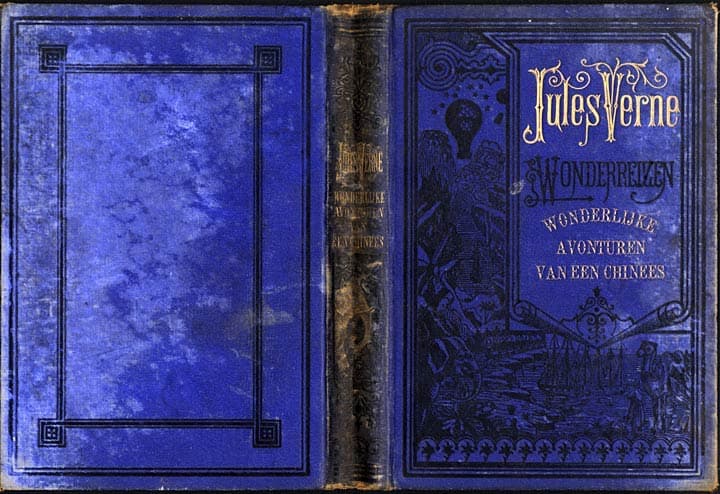
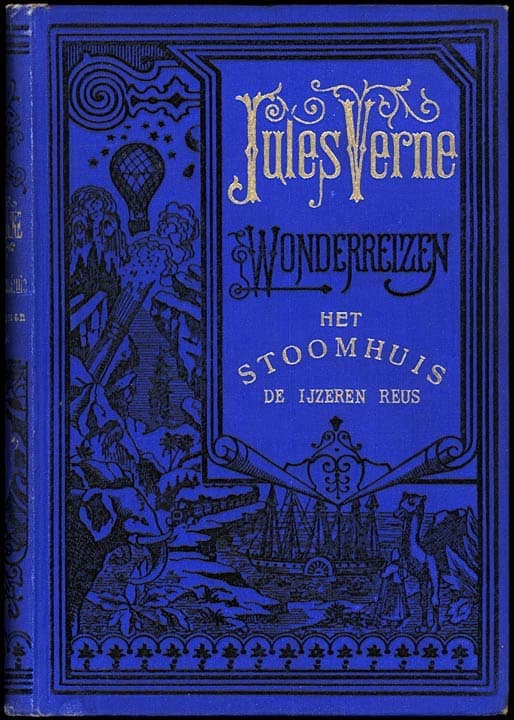
A fictional novel written in the late 19th century. This work is part of Verne's broader explorations of adventure narratives that often feature exotic locales and thrilling escapades. The story introduces characters such as the adventurous captain Hod, who is on the hunt for wild animals in the Indian wilderness, hinting at themes of wildlife, survival, and the dichotomy between man and nature. The opening of the narrative sets a dramatic tone by recounting the tragic death caused by a venomous snake in India, which captivates the attention of the main characters. They are invited to visit the kraal—a makeshift camp prepared for the capture of wild animals—established by Matthias van Guitt, a seasoned animal supplier. In this setting, readers encounter a range of exotic animals and the various challenges faced by both the humans and the wildlife. The dialogue among characters reveals their motivations for hunting and capturing these animals, providing insights into the ethical considerations surrounding their adventures. Overall, the beginning evokes a rich tapestry of adventure, highlighting the characters' encounters with nature and each other in the captivating environment of the Indian jungle.
Editions
X-Ray
“Life is not all sunshine, but yet I would willingly consent to live ten centuries out of pure curiosity!” That””
— Jules Verne
“The Ranee was killed in a hand to hand fight before Gwalior. This famous queen, who was devoted to the Nabob, and was his most faithful companion during the insurrection, fell by the hand of Sir Edward Munro. Nana Sahib, by the dead body of Lady Munro at Cawnpore, the colonel, by the dead body of the Ranee at Gwalior, represent the revolt and the suppression, and were thus made enemies whose hatred would find terrible vent if they ever met face to face! The””
— Jules Verne
“But when the mind once allows a doubt to gain an entrance, the value of deeds performed grow less, their character changes, we forget the past and dread the future. And””
— Jules Verne
“As I remarked before, the Asiatic elephant is smaller than the African, which is frequently twelve feet high, and its tusks are in proportion. In the island of Ceylon a certain number of animals are found deprived of these appendages, but “mucknas,” which is the name given them, are rare on the mainland of India. Behind””
— Jules Verne
“Kâlagani evidently knew this thinly-peopled region perfectly, and guided us across it most admirably. On the 29th September our train began to ascend the northern slope of the Vindyas, in order to reach the pass of Sirgour. Hitherto we had met with no obstacle or difficulty, although this country is one of the worst in repute of all India, because it is a favourite retreat of criminals. Robbers haunt the highways, and it is here that the Dacoits carry on their double trade of thieves and poisoners. Great caution is desirable when travelling in this district. Steam House was now about to penetrate the very worst part of the Bundelkund, namely, the mountainous region of the Vindhyas. We were within about sixty miles of Jubbulpore, the nearest station on the railway between Bombay and Allahabad; it was no great distance, but we could not expect to get over the ground as quickly as we had done on the plains of Scind. Steep ascents, bad roads, rocky ground, sharp turnings, and narrow defiles. All these must be looked for, and would reduce the rate of our speed. It would be necessary to reconnoitre carefully our line of march, as well as the halting-places, and during both day and night keep a very sharp look-out. Kâlagani””
— Jules Verne
“A moving wall of oxen advanced, and our mighty elephant himself was brought to a standstill. There was nothing to regret in this enforced halt, however, for a most curious spectacle was presented to our observations. A drove of four or five thousand oxen encumbered the road, and, as our guide had supposed, they belonged to a caravan of Brinjarees. “These people,” said Banks, “are the Zingaris of Hindostan. They are a people rather than a tribe, and have no fixed abode, dwelling under tents in summer, in huts during the winter or rainy season. They are the porters and carriers of India, and I saw how they worked during the insurrection of 1857. By a sort of tacit agreement between the belligerents, their convoys were permitted to pass through the disturbed provinces. In fact, they kept up the supply of provisions to both armies. If these Brinjarees belong to one part of India more than to another, I should say it was Rajpootana, and perhaps more particularly the kingdom of Milwar.””
— Jules Verne
“It was at Gwalior that the Ranee of Jansi, the devoted friend of Nana Sahib, defended herself heroically to the last.””
— Jules Verne
“We reached the left bank of the Jumna. This important stream forms the boundary of Rajasthan, the country of the Rajahs, dividing it from Hindostan, or the country of the Hindoos. We””
— Jules Verne
“Since passing across the Upper Ganges fifteen days previous to this, a fertile country had opened before us, called the Doab, a district lying in the angle formed by the Ganges and the Jumna, which two rivers unite near Allahabad. My””
— Jules Verne
Link to this book
Add a free, dofollow link to Lex on your blog, forum, syllabus, or reading list.

<a href="https://lex-books.com/book/het-stoomhuis-de-waanzinnige-der-nerbudda-2-2-79a39ea7-fbb9-4201-95e1-77ced4727d3d"><img src="https://lex-books.com/badges/read-on-lex.svg" alt="Read Het Stoomhuis: De Waanzinnige Der Nerbudda (2/2) by Jules Verne free on Lex" width="160" height="40"></a>[](https://lex-books.com/book/het-stoomhuis-de-waanzinnige-der-nerbudda-2-2-79a39ea7-fbb9-4201-95e1-77ced4727d3d)[url=https://lex-books.com/book/het-stoomhuis-de-waanzinnige-der-nerbudda-2-2-79a39ea7-fbb9-4201-95e1-77ced4727d3d][img]https://lex-books.com/badges/read-on-lex.svg[/img][/url]Read Het Stoomhuis: De Waanzinnige Der Nerbudda (2/2) by Jules Verne free on Lex: https://lex-books.com/book/het-stoomhuis-de-waanzinnige-der-nerbudda-2-2-79a39ea7-fbb9-4201-95e1-77ced4727d3dCite this book
Reading this edition for a paper or guide? Copy a citation.
Verne, Jules. Het Stoomhuis: De Waanzinnige Der Nerbudda (2/2). Lex, lex-books.com/book/het-stoomhuis-de-waanzinnige-der-nerbudda-2-2-79a39ea7-fbb9-4201-95e1-77ced4727d3d.Verne, J. (1880). Het Stoomhuis: De Waanzinnige Der Nerbudda (2/2). Lex. https://lex-books.com/book/het-stoomhuis-de-waanzinnige-der-nerbudda-2-2-79a39ea7-fbb9-4201-95e1-77ced4727d3dVerne, Jules. Het Stoomhuis: De Waanzinnige Der Nerbudda (2/2). Lex. https://lex-books.com/book/het-stoomhuis-de-waanzinnige-der-nerbudda-2-2-79a39ea7-fbb9-4201-95e1-77ced4727d3d.
![Mathias Sandorf [3]: Een Model-Volksplanting](/_next/image?url=https%3A%2F%2Fd3b2n8gj62qnwr.cloudfront.net%2FCOVERS%2Fgutenberg_covers75k%2Febook-22908.png&w=3840&q=75)

![Mathias Sandorf [2]: De Middellandsche Zee](/_next/image?url=https%3A%2F%2Fd3b2n8gj62qnwr.cloudfront.net%2FCOVERS%2Fgutenberg_covers75k%2Febook-69576.png&w=3840&q=75)
![Mathias Sandorf [1]: Een Verijdelde Samenzwering; Dokter Antekirrt](/_next/image?url=https%3A%2F%2Fd3b2n8gj62qnwr.cloudfront.net%2FCOVERS%2Fgutenberg_covers75k%2Febook-76280.png&w=3840&q=75)