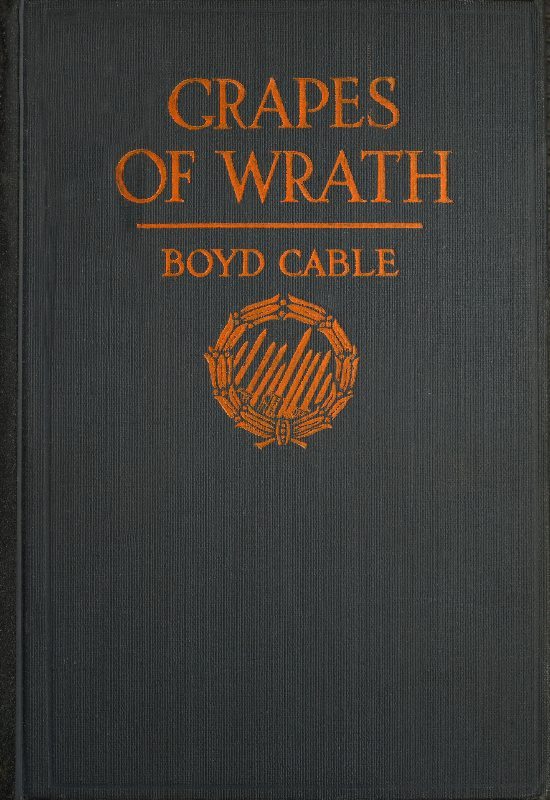
Grapes of Wrath
1917

Written in the midst of the Great War's carnage, this novel captures what it meant to be an ordinary soldier waiting for the whistle that would send you over the top. Boyd Cable places us inside the 5/6 Service Battalion of the Stonewalls, among men like Larry Arundel, Billy Simson, and the Kentucky-born Jefferson Lee, as they march toward the Somme and the thunder of artillery that has become their constant companion. The soldiers trade dark jokes and rumors, their conversations revealing the peculiar camaraderie that forms when young men know they are living on borrowed time. Cable renders the waiting itself as a kind of torture: the alert, the tension, the brotherhood forged in mud and fear. This is not a novel of glory or heroics but of the infantryman's lot - the weight of equipment, the roar of shells, and the strange humor men use to survive the unsurvivable. For readers who want to understand what WWI actually felt like to those in the trenches, this is essential, unflinching testimony from someone who was there.
Editions
X-Ray
“she is to be made to pay to the last bitter squeezing of the grapes of wrath for the blood and misery she plunged Europe into. Theh will be no mercy fo' heh.””
— Boyd Cable
“Here surely in these broken dead, in the silent, dejected prisoners, in the very earth she had seized and that now had been wrested from her, was Germany's vintage, the tramplings out of the grapes of a wrath long stored, the smitten of the swift sword that flashed unloosed at last in the gun-fire lightning at play across the sky.””
— Boyd Cable
“Fust time I've been glad o' a tin o' bully,'' he shouted, exhibiting a flattened tin of preserved meat. "But I s'pose it was the biscuits that was really the shell-proof bit.””
— Boyd Cable
“On one occasion, for instance, when his position had been " spotted" by enemy sharp-shooters, he got a bullet through his cap, one through his shoulder-strap, one through the inside of his sleeve close to his heart, and fifty-three others near enough for him to hear them pass”
— Boyd Cable
Link to this book
Add a free, dofollow link to Lex on your blog, forum, syllabus, or reading list.

<a href="https://lex-books.com/book/grapes-of-wrath-7f213b72-8930-4dd7-802b-1ee1367a3a9f"><img src="https://lex-books.com/badges/read-on-lex.svg" alt="Read Grapes of Wrath by Boyd Cable free on Lex" width="160" height="40"></a>[](https://lex-books.com/book/grapes-of-wrath-7f213b72-8930-4dd7-802b-1ee1367a3a9f)[url=https://lex-books.com/book/grapes-of-wrath-7f213b72-8930-4dd7-802b-1ee1367a3a9f][img]https://lex-books.com/badges/read-on-lex.svg[/img][/url]Read Grapes of Wrath by Boyd Cable free on Lex: https://lex-books.com/book/grapes-of-wrath-7f213b72-8930-4dd7-802b-1ee1367a3a9fCite this book
Reading this edition for a paper or guide? Copy a citation.
Cable, Boyd. Grapes of Wrath. Lex, lex-books.com/book/grapes-of-wrath-7f213b72-8930-4dd7-802b-1ee1367a3a9f.Cable, B. (1917). Grapes of Wrath. Lex. https://lex-books.com/book/grapes-of-wrath-7f213b72-8930-4dd7-802b-1ee1367a3a9fCable, Boyd. Grapes of Wrath. Lex. https://lex-books.com/book/grapes-of-wrath-7f213b72-8930-4dd7-802b-1ee1367a3a9f.