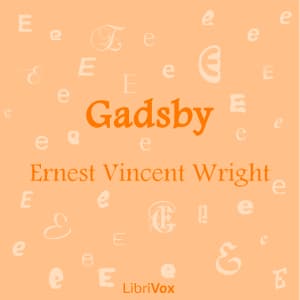
Gadsby: A Story of Over 50,000 Words Without Using the Letter "e
1939
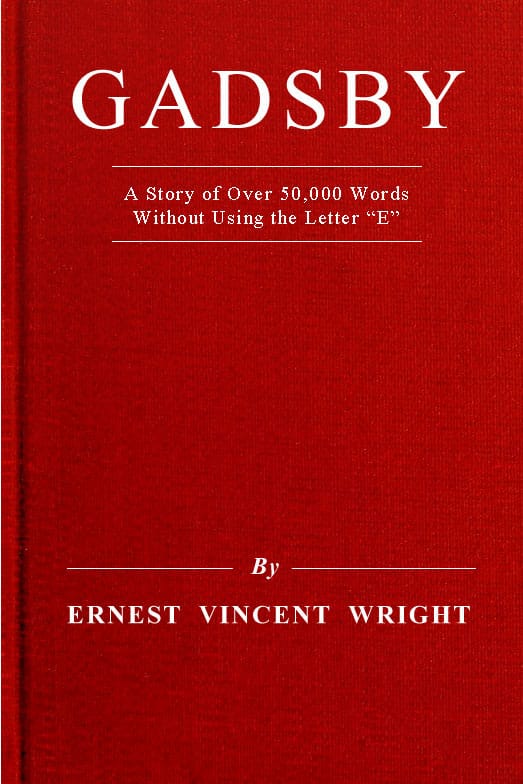
Gadsby: A Story of Over 50,000 Words Without Using the Letter "e
1939
The most ambitious lipogram in English history. Ernest Vincent Wright spent five years writing 50,000 words without using the letter E - the most common letter in the language. Every sentence required impossible choices. No "the," "be," "were," "she," "he," "they," or "their." The result reads as a peculiar, slightly stilted period piece about John Gadsby, a fifty-year-old man who rallies the young people of decaying Branton Hills to transform their stagnant town of 2,000 into a thriving city of 60,000. Against opposition, they form an Organization of Youth, building civic spirit and improving living standards through two decades that span from 1906 through the Harding administration. The story feels both naive and sincere - small-town American idealism rendered in a voice that sounds like no other novel in existence. It's a curiosity, certainly. But it's also a genuine achievement: a book that could only have been written by someone stubborn enough to spend half a decade refusing the most common letter in English, and passionate enough to make it sing.
Editions
X-Ray
“Boys, at war, so far away, will naturally droop, both in body and mind, from lack of a particular girl’s snuggling and cuddling.””
— Ernest Vincent Wright
“In this country, two things stand first in rank: your flag and your mail. You all know what honor you pay to your flag, but you should know, also, that your mail,”
— Ernest Vincent Wright
“For mankind knows hardly a joy which will surpass that of approval of his work.””
— Ernest Vincent Wright
“By slow, thoughtful watching, you can gain much, as against working up a wild, panicky condition.””
— Ernest Vincent Wright
“What a City Council should do, and what it will do, don’t alwaysmatch up.””
— Ernest Vincent Wright
“Though it was long thought that woman's brain was minor in comparison with man's, woman, as a class, now-a-day shows an all-round activity; and has brought staid control to official actions which had had a long run through domination by man;”
— Ernest Vincent Wright
“Oh, how an animal that is hurt looks up at you, John! An animal’s actions can inform you if it is in pain. It don’t hop and jump around as usual. No. You find a sad, crouching, cringing, small bunch of fur or hair, whining, and plainly asking you to aid it. It isn't hard to find out what is wrong, John; any man or woman who would pass by such a sight, just isn't worth knowing. I just can’t withstand it! Why, I think that not only animals, but plants can know pain. I carry a drink to many a poor, thirsty growing thing; or, if it is torn up I put it kindly back, and fix its soil up as comfortably as I can. Anything that is living, John, is worthy of Man’s aid.””
— Ernest Vincent Wright
“A man should so carry on his daily affairs as to bring no word of admonition from anybody; for a man’s doings should put a stain upon no soul but his own.””
— Ernest Vincent Wright
“Isn't it surprising what an array of things a woman can drag forth, burrowing into attics, rooms and nooks! Things long out of mind; an old thing; a worn-out thing; but it has lain in that room, nook or bag until just such a riot of soap and scrubbing brush brings it out. And, as I think of it, a human mind could, and should go through just such a ransacking, occasionally; for you don’t know half of what an accumulation of rubbish is kicking about, in its dark, musty corridors. Old fashions in thoughts; bigotry; vanity; all lying stagnant. So why not drag out and sort all that stuff, discarding all which is of no valuation? About half of us will find, in our minds, a room, having on its door a card, saying: “It Was Not So In My Day.” Go at that room, right off. That “My Day” is long past. “Today” is boss, now. If that “My Day” could crawl up on “Today,” what a mix-up in World affairs would occur! Ox cart against aircraft; oil lamps against arc lights! Slow, mail information against radio! But, as all this stuff is laid out, what will you do with it? Nobody wants it. So I say, burn it, and tomorrow morning, how happy you will find that musty old mind!””
— Ernest Vincent Wright
Link to this book
Add a free, dofollow link to Lex on your blog, forum, syllabus, or reading list.

<a href="https://lex-books.com/book/gadsby-a-story-of-over-50-000-words-without-using-the-letter-e-d71a29a1-5d3a-458a-b35d-1380ab67032a"><img src="https://lex-books.com/badges/read-on-lex.svg" alt="Read Gadsby: A Story of Over 50,000 Words Without Using the Letter "e by Ernest Vincent Wright free on Lex" width="160" height="40"></a>[](https://lex-books.com/book/gadsby-a-story-of-over-50-000-words-without-using-the-letter-e-d71a29a1-5d3a-458a-b35d-1380ab67032a)[url=https://lex-books.com/book/gadsby-a-story-of-over-50-000-words-without-using-the-letter-e-d71a29a1-5d3a-458a-b35d-1380ab67032a][img]https://lex-books.com/badges/read-on-lex.svg[/img][/url]Read Gadsby: A Story of Over 50,000 Words Without Using the Letter "e by Ernest Vincent Wright free on Lex: https://lex-books.com/book/gadsby-a-story-of-over-50-000-words-without-using-the-letter-e-d71a29a1-5d3a-458a-b35d-1380ab67032aCite this book
Reading this edition for a paper or guide? Copy a citation.
Wright, Ernest Vincent. Gadsby: A Story of Over 50,000 Words Without Using the Letter "e. Lex, lex-books.com/book/gadsby-a-story-of-over-50-000-words-without-using-the-letter-e-d71a29a1-5d3a-458a-b35d-1380ab67032a.Wright, E. V. (1939). Gadsby: A Story of Over 50,000 Words Without Using the Letter "e. Lex. https://lex-books.com/book/gadsby-a-story-of-over-50-000-words-without-using-the-letter-e-d71a29a1-5d3a-458a-b35d-1380ab67032aWright, Ernest Vincent. Gadsby: A Story of Over 50,000 Words Without Using the Letter "e. Lex. https://lex-books.com/book/gadsby-a-story-of-over-50-000-words-without-using-the-letter-e-d71a29a1-5d3a-458a-b35d-1380ab67032a.