Flatland: A Romance of Many Dimensions
1884
Flatland: A Romance of Many Dimensions
1884
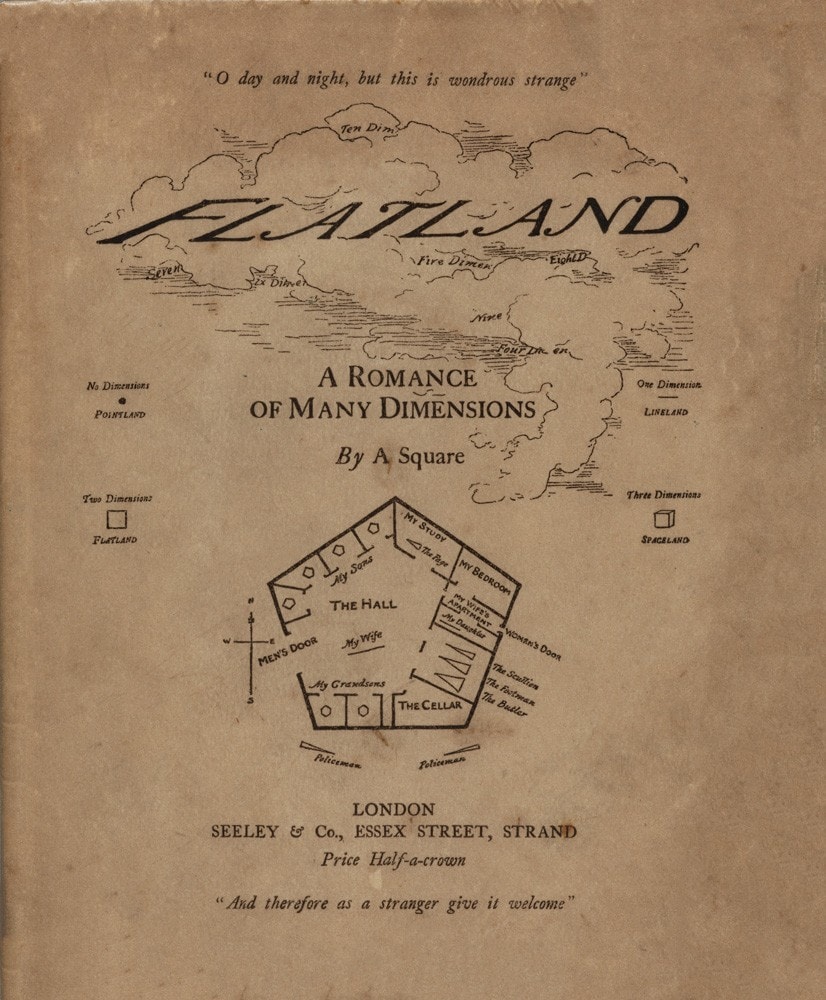
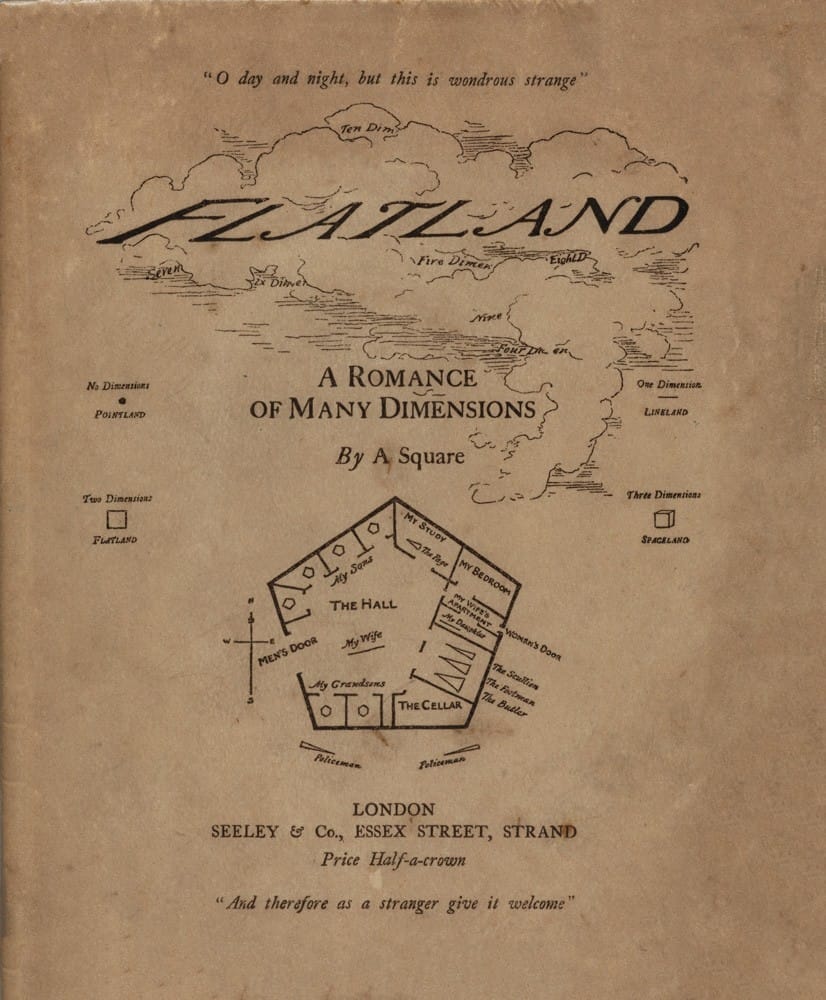
What if your entire reality was a single sheet of paper? Edwin Abbott Abbott's 1884 masterpiece imagines just that, a world where inhabitants are geometric shapes, where social status is determined by how many sides you have, and where women are barely-visible straight lines at the bottom of a brutal hierarchy. Our guide is A Square, a respectable mathematician who believes he understands his world until a mysterious visitor from the third dimension appears and turns everything he knows inside out. Through encounters with beings of fewer dimensions, characters in Lineland, Pointland, and beyond, A Square comes to grips with a terrifying possibility: there might be dimensions his mind cannot conceive. Part vicious satire of Victorian class obsession, part philosophical mind-bender about the limits of human perception, Flatland achieves the rare feat of being genuinely funny and genuinely profound. It asks what we lose when we can't imagine beyond our own circumstances, and what we might gain if we try.
Editions

X-Ray
“...learn this lesson, that to be self-contented is to be vile and ignorant, and that to aspire is better than to be blindly and impotently happy..””
— Edwin Abbott Abbott
“Upward, not Northward””
— Edwin Abbott Abbott
“Behold yon miserable creature. That Point is a Being like ourselves, but confined to the non-dimensional Gulf. He is himself his own World, his own Universe; of any other than himself he can form no conception; he knows not Length, nor Breadth, nor Height, for he has had no experience of them; he has no cognizance even of the number Two; nor has he a thought of Plurality, for he is himself his One and All, being really Nothing. Yet mark his perfect self-contentment, and hence learn this lesson, that to be self-contented is to be vile and ignorant, and that to aspire is better than to be blindly and impotently happy.””
— Edwin Abbott Abbott
“Either this is madness or it is Hell.” “It is neither,” calmly replied the voice of the Sphere, “it is Knowledge; it is Three Dimensions: open your eye once again and try to look steadily.””
— Edwin Abbott Abbott
“Like all great art, it defies the tyrant Time.””
— Edwin Abbott Abbott
“I have actually known a case where a Woman has exterminated her whole household, and half an hour afterwards, when her rage was over and the fragments swept away, has asked what has become of her husband and her children.””
— Edwin Abbott Abbott
“Distress not yourself if you cannot at first understand the deeper mysteries of Spaceland. By degrees they will dawn upon you.””
— Edwin Abbott Abbott
“In One Dimensions, did not a moving Point produce a Line with two terminal points?In two Dimensions, did not a moving Line produce a Square wit four terminal points?In Three Dimensions, did not a moving Square produce - did not the eyes of mine behold it - that blessed being, a Cube, with eight terminal points?And in Four Dimensions, shall not a moving Cube - alas, for Analogy, and alas for the Progress of Truth if it be not so - shall not, I say the motion of a divine Cube result in a still more divine organization with sixteen terminal points?Behold the infallible confirmation of the Series, 2, 4, 8, 16: is not this a Geometrical Progression? Is not this - if I might qupte my Lord's own words - "Strictly according to Analogy"?Again, was I not taught by my Lord that as in a Line there are two bonding points, and in a Square there are four bounding Lines, so in a Cube there must be six bounding Squares? Behold once more the confirming Series: 2, 4, 6: is not this an Arithmetical Progression? And consequently does it not of necessity follow that the more divine offspring of the divine Cube in the Land of Four Dimensions, must have eight bounding Cubes: and is not this also, as my Lord has taught me to believe, "strictly according to analogy"?””
— Edwin Abbott Abbott
“I call our world Flatland, not because we call it so, but to make its nature clearer to you, my happy readers, who are privileged to live in Space.””
— Edwin Abbott Abbott
Link to this book
Add a free, dofollow link to Lex on your blog, forum, syllabus, or reading list.

<a href="https://lex-books.com/book/flatland-a-romance-of-many-dimensions-f89f8068-a8d1-4810-89fa-c618d5ab52a5"><img src="https://lex-books.com/badges/read-on-lex.svg" alt="Read Flatland: A Romance of Many Dimensions by Edwin Abbott Abbott free on Lex" width="160" height="40"></a>[](https://lex-books.com/book/flatland-a-romance-of-many-dimensions-f89f8068-a8d1-4810-89fa-c618d5ab52a5)[url=https://lex-books.com/book/flatland-a-romance-of-many-dimensions-f89f8068-a8d1-4810-89fa-c618d5ab52a5][img]https://lex-books.com/badges/read-on-lex.svg[/img][/url]Read Flatland: A Romance of Many Dimensions by Edwin Abbott Abbott free on Lex: https://lex-books.com/book/flatland-a-romance-of-many-dimensions-f89f8068-a8d1-4810-89fa-c618d5ab52a5Cite this book
Reading this edition for a paper or guide? Copy a citation.
Abbott, Edwin Abbott. Flatland: A Romance of Many Dimensions. Lex, lex-books.com/book/flatland-a-romance-of-many-dimensions-f89f8068-a8d1-4810-89fa-c618d5ab52a5.Abbott, E. A. (1884). Flatland: A Romance of Many Dimensions. Lex. https://lex-books.com/book/flatland-a-romance-of-many-dimensions-f89f8068-a8d1-4810-89fa-c618d5ab52a5Abbott, Edwin Abbott. Flatland: A Romance of Many Dimensions. Lex. https://lex-books.com/book/flatland-a-romance-of-many-dimensions-f89f8068-a8d1-4810-89fa-c618d5ab52a5.