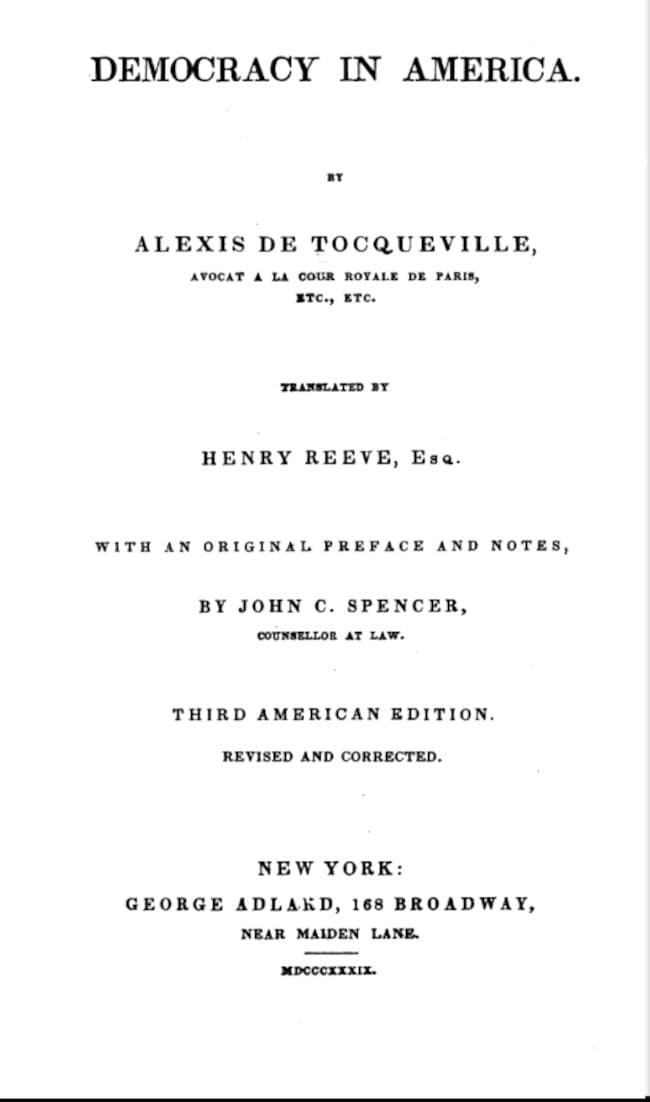
Democracy in America — Volume 2
1840
Democracy in America — Volume 2
1840
Translated by Henry Reeve
In this second volume of his masterwork, Tocqueville turns his penetrating gaze from American institutions to the American mind itself. A French aristocrat who loved liberty but feared its excesses, he had already in Volume One described how democracy shaped America's politics and social life. Now he asks the deeper question: how does democracy reshape thought? He finds a people who trust their own reasoning over tradition, who skeptical of abstract systems, who navigate belief with a restless pragmatism. Tocqueville diagnoses both the genius and the peril of this approach, the creative energy it unleashes, but also the risk of a shallow conformism where everyone thinks alike because no one thinks deeply. His observations on religion, philosophy, and the democratic character remain startlingly relevant. He saw the loneliness of individualistic societies, the tyranny of majority opinion, the way prosperity could soften citizens into passive consumers. Written in 1840, this book reads like prophecy because Tocqueville understood something permanent about democratic life: its endless tension between freedom and cohesion, equality and excellence, innovation and decay.
Editions
X-Ray
“I do not know if the people of the United States would vote for superior men if they ran for office, but there can be no doubt that such men do not run.””
— Alexis de Tocqueville
“Nothing is more wonderful than the art of being free, but nothing is harder to learn how to use than freedom.””
— Alexis de Tocqueville
“Society is endangered not by the great profligacy of a few, but by the laxity of morals amongst all.””
— Alexis de Tocqueville
“everybody feels the evil, but no one has courage or energy enough to seek the cure””
— Alexis de Tocqueville
“Men will not accept truth at the hands of their enemies, and truth is seldom offered to them by their friends””
— Alexis de Tocqueville
“When I refuse to obey an unjust law, I do not contest the right of the majority to command, but I simply appeal from the sovereignty of the people to the sovereignty of mankind.””
— Alexis de Tocqueville
“As I see it, only God can be all-powerful without danger, because his wisdom and justice are always equal to his power. Thus there is no authority on earth so inherently worthy of respect, or invested with a right so sacred, that I would want to let it act without oversight or rule without impediment (p. 290).””
— Alexis de Tocqueville
“Slavery...dishonors labor. It introduces idleness into society, and with idleness, ignorance and pride, luxury and distress. It enervates the powers of the mind and benumbs the activity of man.””
— Alexis de Tocqueville
Link to this book
Add a free, dofollow link to Lex on your blog, forum, syllabus, or reading list.

<a href="https://lex-books.com/book/democracy-in-america-volume-2-641d8c44-580f-4962-8397-9262c69cd524"><img src="https://lex-books.com/badges/read-on-lex.svg" alt="Read Democracy in America — Volume 2 by Alexis de Tocqueville free on Lex" width="160" height="40"></a>[](https://lex-books.com/book/democracy-in-america-volume-2-641d8c44-580f-4962-8397-9262c69cd524)[url=https://lex-books.com/book/democracy-in-america-volume-2-641d8c44-580f-4962-8397-9262c69cd524][img]https://lex-books.com/badges/read-on-lex.svg[/img][/url]Read Democracy in America — Volume 2 by Alexis de Tocqueville free on Lex: https://lex-books.com/book/democracy-in-america-volume-2-641d8c44-580f-4962-8397-9262c69cd524Cite this book
Reading this edition for a paper or guide? Copy a citation.
Tocqueville, Alexis de. Democracy in America — Volume 2. Lex, lex-books.com/book/democracy-in-america-volume-2-641d8c44-580f-4962-8397-9262c69cd524.Tocqueville, A. D. (1840). Democracy in America — Volume 2. Lex. https://lex-books.com/book/democracy-in-america-volume-2-641d8c44-580f-4962-8397-9262c69cd524Tocqueville, Alexis de. Democracy in America — Volume 2. Lex. https://lex-books.com/book/democracy-in-america-volume-2-641d8c44-580f-4962-8397-9262c69cd524.