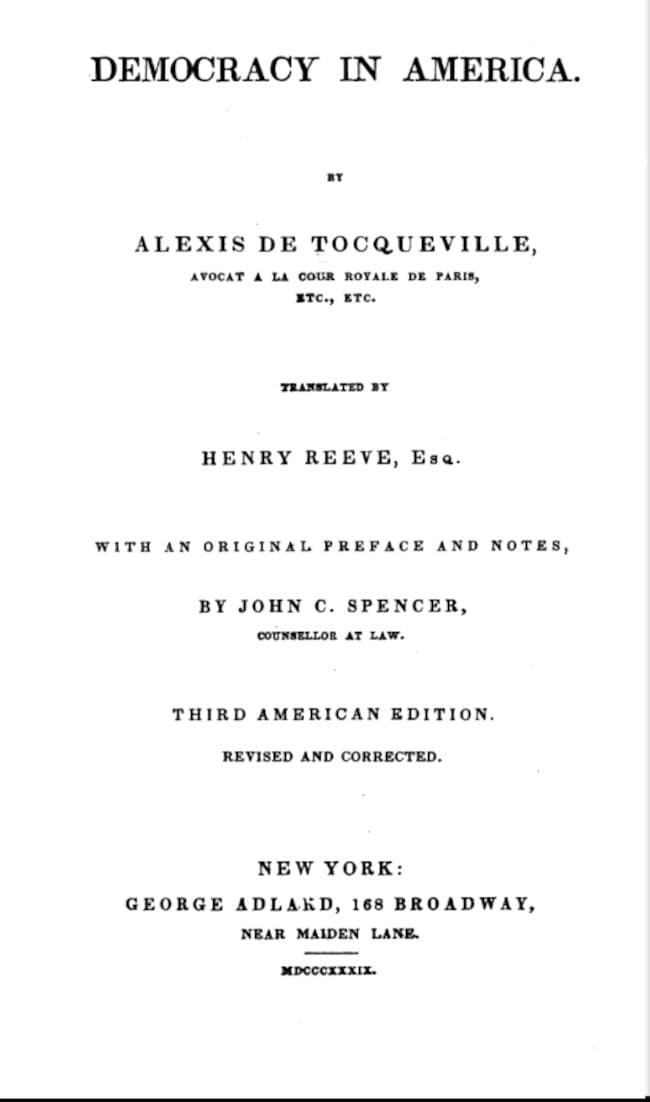
American Institutions and Their Influence
In 1831, a young French aristocrat crossed the Atlantic with a singular mission: to understand how democracy actually worked in practice, before it consumed Europe as it seemed destined to do. Alexis de Tocqueville spent nine months traveling through America, observing everything from New England town meetings to Southern plantations, from prisons to churches, from political conventions to literary salons. What emerged was neither a simple celebration nor a critique, but something rarer: a portrait of democracy in motion, rendered with aristocratic precision and philosophical ambition. He identified the radical equality of conditions as America's defining feature, traced how its decentralized religion sustained civic life, and mapped the thousand small liberties that made democratic life possible. Yet he also saw the dangers: the tyranny of majority opinion, the isolation of individuals, the quiet concentration of power. Nearly two centuries old, this remains the wisest book ever written about American democracy and the tensions that still define it.
Editions
Link to this book
Add a free, dofollow link to Lex on your blog, forum, syllabus, or reading list.

<a href="https://lex-books.com/book/american-institutions-and-their-influence-c7216447-f990-48a7-b4e4-fca299e8a3d9"><img src="https://lex-books.com/badges/read-on-lex.svg" alt="Read American Institutions and Their Influence by Alexis de Tocqueville free on Lex" width="160" height="40"></a>[](https://lex-books.com/book/american-institutions-and-their-influence-c7216447-f990-48a7-b4e4-fca299e8a3d9)[url=https://lex-books.com/book/american-institutions-and-their-influence-c7216447-f990-48a7-b4e4-fca299e8a3d9][img]https://lex-books.com/badges/read-on-lex.svg[/img][/url]Read American Institutions and Their Influence by Alexis de Tocqueville free on Lex: https://lex-books.com/book/american-institutions-and-their-influence-c7216447-f990-48a7-b4e4-fca299e8a3d9Cite this book
Reading this edition for a paper or guide? Copy a citation.
Tocqueville, Alexis de. American Institutions and Their Influence. Lex, lex-books.com/book/american-institutions-and-their-influence-c7216447-f990-48a7-b4e4-fca299e8a3d9.Tocqueville, A. D. (n.d.). American Institutions and Their Influence. Lex. https://lex-books.com/book/american-institutions-and-their-influence-c7216447-f990-48a7-b4e4-fca299e8a3d9Tocqueville, Alexis de. American Institutions and Their Influence. Lex. https://lex-books.com/book/american-institutions-and-their-influence-c7216447-f990-48a7-b4e4-fca299e8a3d9.