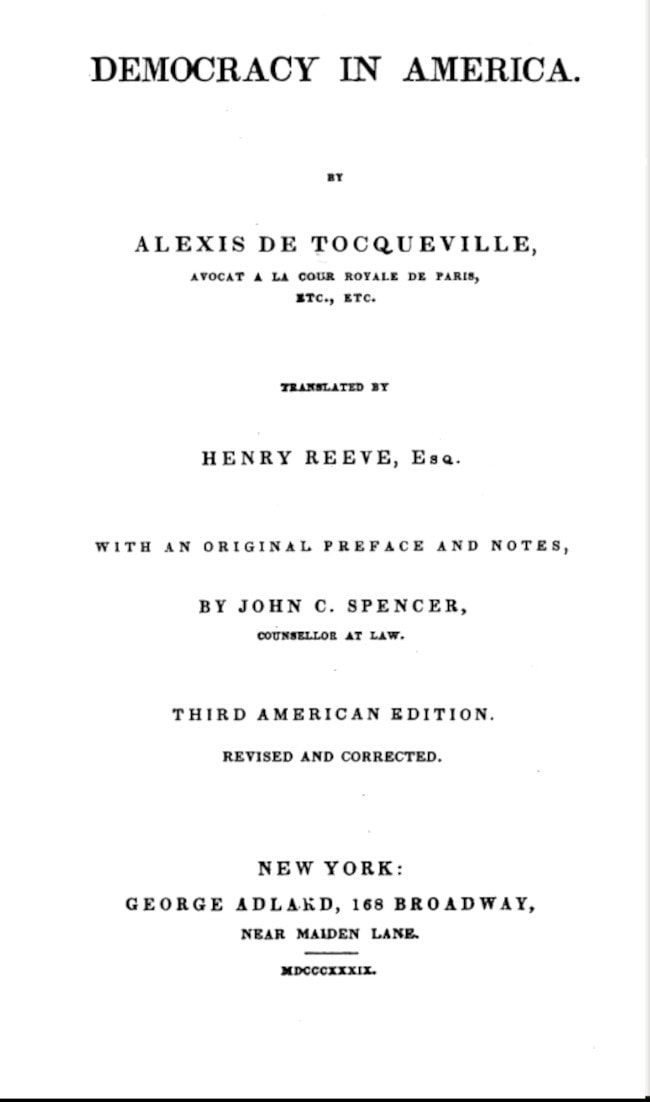
Democracy in America — Volume 1
1835
In 1831, a twenty-five-year-old French aristocrat crossed the Atlantic to study a nation that had existed for barely half a century. What Alexis de Tocqueville found there would become the most penetrating analysis of American democracy ever written by a foreign observer, and arguably the most influential work of political philosophy ever produced about the United States. Traveling from New England to the frontier, from courtrooms to churches, from prisons to town meetings, he saw through the surface of American life to the deeper currents of equality, individualism, and civic religion that would shape the nation's character. He identified both the remarkable strengths of democratic governance and the subtle dangers lurking within it: the tyranny of the majority, the softening of manners, the risk that citizens might grow too comfortable and passive. Nearly two centuries later, his observations still reverberate. He understood that democracy is not merely a system of government but a social condition, one that transforms everything from family life to commerce to the human soul. This is the book you return to when you want to understand what America is, and what it might become.
Editions
X-Ray
“I do not know if the people of the United States would vote for superior men if they ran for office, but there can be no doubt that such men do not run.””
— Alexis de Tocqueville
“Nothing is more wonderful than the art of being free, but nothing is harder to learn how to use than freedom.””
— Alexis de Tocqueville
“Society is endangered not by the great profligacy of a few, but by the laxity of morals amongst all.””
— Alexis de Tocqueville
“everybody feels the evil, but no one has courage or energy enough to seek the cure””
— Alexis de Tocqueville
“Men will not accept truth at the hands of their enemies, and truth is seldom offered to them by their friends””
— Alexis de Tocqueville
“When I refuse to obey an unjust law, I do not contest the right of the majority to command, but I simply appeal from the sovereignty of the people to the sovereignty of mankind.””
— Alexis de Tocqueville
“As I see it, only God can be all-powerful without danger, because his wisdom and justice are always equal to his power. Thus there is no authority on earth so inherently worthy of respect, or invested with a right so sacred, that I would want to let it act without oversight or rule without impediment (p. 290).””
— Alexis de Tocqueville
“Slavery...dishonors labor. It introduces idleness into society, and with idleness, ignorance and pride, luxury and distress. It enervates the powers of the mind and benumbs the activity of man.””
— Alexis de Tocqueville
Link to this book
Add a free, dofollow link to Lex on your blog, forum, syllabus, or reading list.

<a href="https://lex-books.com/book/democracy-in-america-volume-1-fb22895e-f92e-4036-8ac5-f983db4c94c7"><img src="https://lex-books.com/badges/read-on-lex.svg" alt="Read Democracy in America — Volume 1 by Alexis de Tocqueville free on Lex" width="160" height="40"></a>[](https://lex-books.com/book/democracy-in-america-volume-1-fb22895e-f92e-4036-8ac5-f983db4c94c7)[url=https://lex-books.com/book/democracy-in-america-volume-1-fb22895e-f92e-4036-8ac5-f983db4c94c7][img]https://lex-books.com/badges/read-on-lex.svg[/img][/url]Read Democracy in America — Volume 1 by Alexis de Tocqueville free on Lex: https://lex-books.com/book/democracy-in-america-volume-1-fb22895e-f92e-4036-8ac5-f983db4c94c7Cite this book
Reading this edition for a paper or guide? Copy a citation.
Tocqueville, Alexis de. Democracy in America — Volume 1. Lex, lex-books.com/book/democracy-in-america-volume-1-fb22895e-f92e-4036-8ac5-f983db4c94c7.Tocqueville, A. D. (1835). Democracy in America — Volume 1. Lex. https://lex-books.com/book/democracy-in-america-volume-1-fb22895e-f92e-4036-8ac5-f983db4c94c7Tocqueville, Alexis de. Democracy in America — Volume 1. Lex. https://lex-books.com/book/democracy-in-america-volume-1-fb22895e-f92e-4036-8ac5-f983db4c94c7.