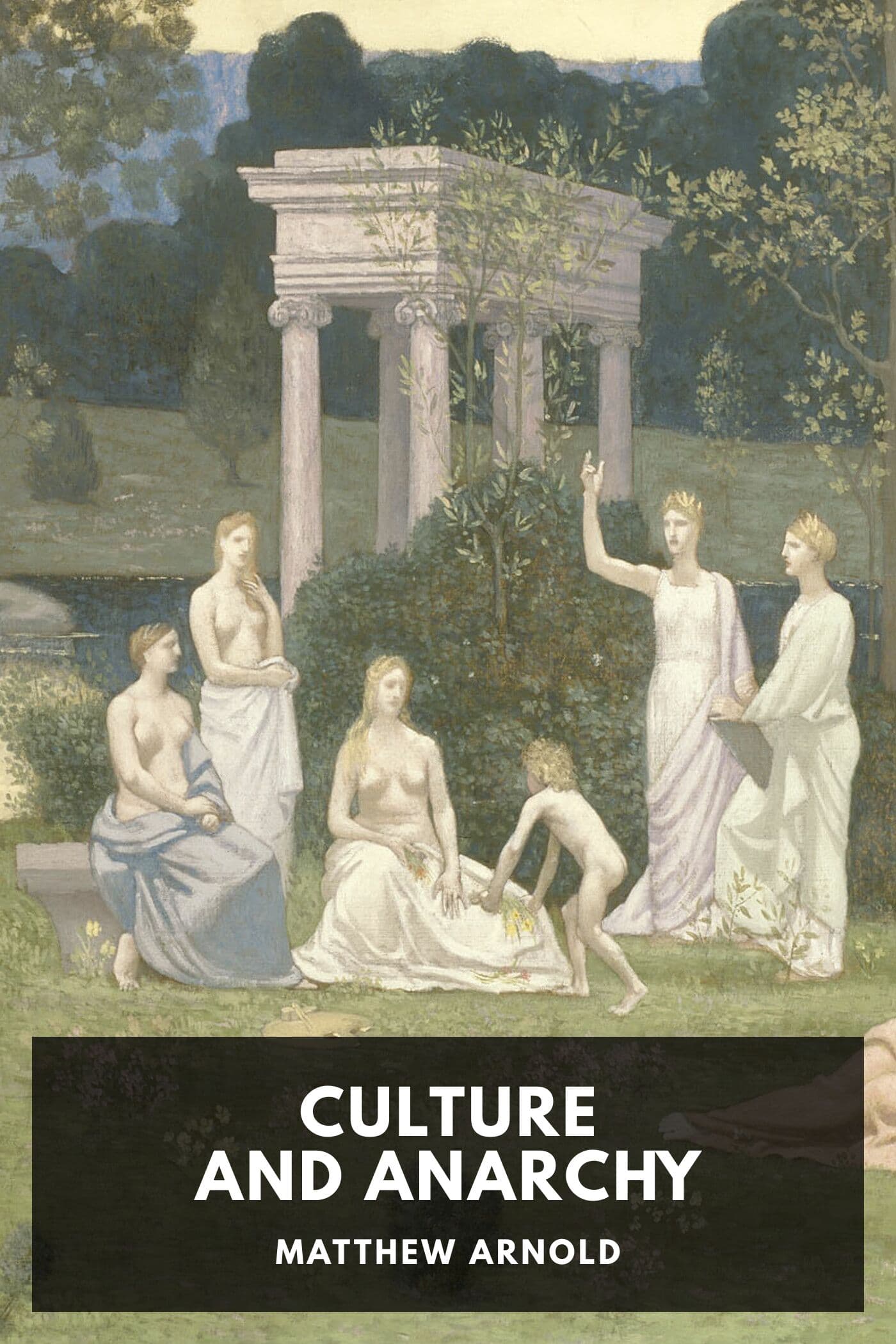
Culture and Anarchy
1869
A passionate, witty, and deeply serious diagnosis of a society tearing itself apart. Written in 1869, when industrialization and class warfare threatened to unravel Victorian England, Matthew Arnold proposed a radical cure: not politics or religion, but culture the careful cultivation of our best self through the finest thoughts and expressions of humanity. Arnold's famous phrase "the best which has been thought and said in the world" isn't aristocratic snobbery. It's a democratic vision, arguing that culture should flow freely among all classes, dissolving the barriers that keep people mechanical and parochial. With sharp satirical flair, he classifies his contemporaries into Barbarians, Philistines, and Populace, each trapped in their own stock notions and habits. His remedy is "sweetness and light" a society where reason and creativity create a stream of fresh thought upon our inheritedcertainties. More than a historical document, this is a book that asks whether civilization can survive its own divisions through self-improvement rather than force. For anyone worried about cultural fragmentation, political polarization, or the meaning of being "cultured" in a democratic age, Arnold remains startlingly relevant.
Editions
X-Ray
“The whole scope of the essay is to recommend culture as the great help out of our present difficulties; culture being a pursuit of our total perfection by means of getting to know, on all the matters which most concern us, the best which has been thought and said in the world, and, through this knowledge, turning a stream of fresh and free thought upon our stock notions and habits, which we now follow staunchly but mechanically, vainly imagining that there is a virtue in following them staunchly which makes up for the mischief of following them mechanically. This, and this alone, is the scope of the following essay.””
— Matthew Arnold
“The sterner self of the Populace likes bawling, hustling, and smashing; the lighter self, beer.””
— Matthew Arnold
“For what can give a finer example of that frankness and manly self- confidence which our great public schools, and none of them so much as Eton, are supposed to inspire, of that buoyant ease in holding up one's head, speaking out what is in one's mind, and flinging off all sheepishness and awkwardness, than to see an Eton assistant-master offering in fact himself as evidence that to combine boarding-house- keeping with teaching is a good thing, and his brother as evidence that to train and race little boys for competitive examinations is a good thing?””
— Matthew Arnold
“The fewer there are who follow the way to perfection, the harder that way is to find.””
— Matthew Arnold
“In our political system everybody is comforted. Our guides and governors who have to be elected by the influence of the Barbarians, and who depend on their favour, sing the praises of the Barbarians, and say all the smooth things that can be said of them. With Mr. Tennyson, they celebrate 'the great broad−shouldered genial Englishman,' with his 'sense of duty,' his 'reverence for the laws,' and his 'patient force,' who saves us from the 'revolts, republics, revolutions, most no graver than a schoolboy's barring out,' which upset other and less broad−shouldered nations. Our guides who are chosen by the Philistines and who have to look to their favour, tell the Philistines how 'all the world knows that the great middle class of this country supplies the mind, the will, and the power requisite for all the great and good things that have to be done,' and congratulate them on their 'earnest good sense, which penetrates through sophisms, ignores commonplaces, and gives to conventional illusions their true value.' Our guides who look to the favour of the Populace, tell them that 'theirs are the brightest powers of sympathy, and the readiest powers of action.””
— Matthew Arnold
“Now, the use of culture is that it helps us, by means of its spiritual standard of perfection, to regard wealth as but machinery, and not only to say as a matter of words that we regard wealth as but machinery, but really to perceive and feel that it is so. If it were not for this purging effect wrought upon our minds by culture, the whole world, the future as well as the present, would inevitably belong to the Philistines. The people who believe most that our greatness and welfare are proved by our being very rich, and who most give their lives and thoughts to becoming rich, are just the very people whom we call Philistines. Culture says: 'Consider these people, then, their way of life, their habits, their manners, the very tones of their voice; look at them attentively; observe the literature they read, the things which give them pleasure, the words which come forth out of their mouths, the thoughts which make the furniture of their minds; would any amount of wealth be worth having with the condition that one was to become just like these people by having it?””
— Matthew Arnold
“Hebraism and Hellenism,−−between these two points ofinfluence moves our world. At one time it feels more powerfully the attraction of one of them, at another time of the other; and it ought to be, though it never is, evenly and happily balanced between them.The final aim of both Hellenism and Hebraism, as of all great spiritual disciplines, is no doubt the same: man's perfection or salvation.””
— Matthew Arnold
“Let me go back for a moment to Bishop Wilson, who says:−−'First, never go against the best light you have;secondly, take care that your light be not darkness.””
— Matthew Arnold
“One has often wondered whether upon the whole earth there is anything so unintelligent, so unapt to perceive how the world is really going, as an ordinary young Englishman of our upper class””
— Matthew Arnold
Link to this book
Add a free, dofollow link to Lex on your blog, forum, syllabus, or reading list.

<a href="https://lex-books.com/book/culture-and-anarchy-263b0f5a-a067-432c-91a6-ad0f94b28719"><img src="https://lex-books.com/badges/read-on-lex.svg" alt="Read Culture and Anarchy by Matthew Arnold free on Lex" width="160" height="40"></a>[](https://lex-books.com/book/culture-and-anarchy-263b0f5a-a067-432c-91a6-ad0f94b28719)[url=https://lex-books.com/book/culture-and-anarchy-263b0f5a-a067-432c-91a6-ad0f94b28719][img]https://lex-books.com/badges/read-on-lex.svg[/img][/url]Read Culture and Anarchy by Matthew Arnold free on Lex: https://lex-books.com/book/culture-and-anarchy-263b0f5a-a067-432c-91a6-ad0f94b28719Cite this book
Reading this edition for a paper or guide? Copy a citation.
Arnold, Matthew. Culture and Anarchy. Lex, lex-books.com/book/culture-and-anarchy-263b0f5a-a067-432c-91a6-ad0f94b28719.Arnold, M. (1869). Culture and Anarchy. Lex. https://lex-books.com/book/culture-and-anarchy-263b0f5a-a067-432c-91a6-ad0f94b28719Arnold, Matthew. Culture and Anarchy. Lex. https://lex-books.com/book/culture-and-anarchy-263b0f5a-a067-432c-91a6-ad0f94b28719.