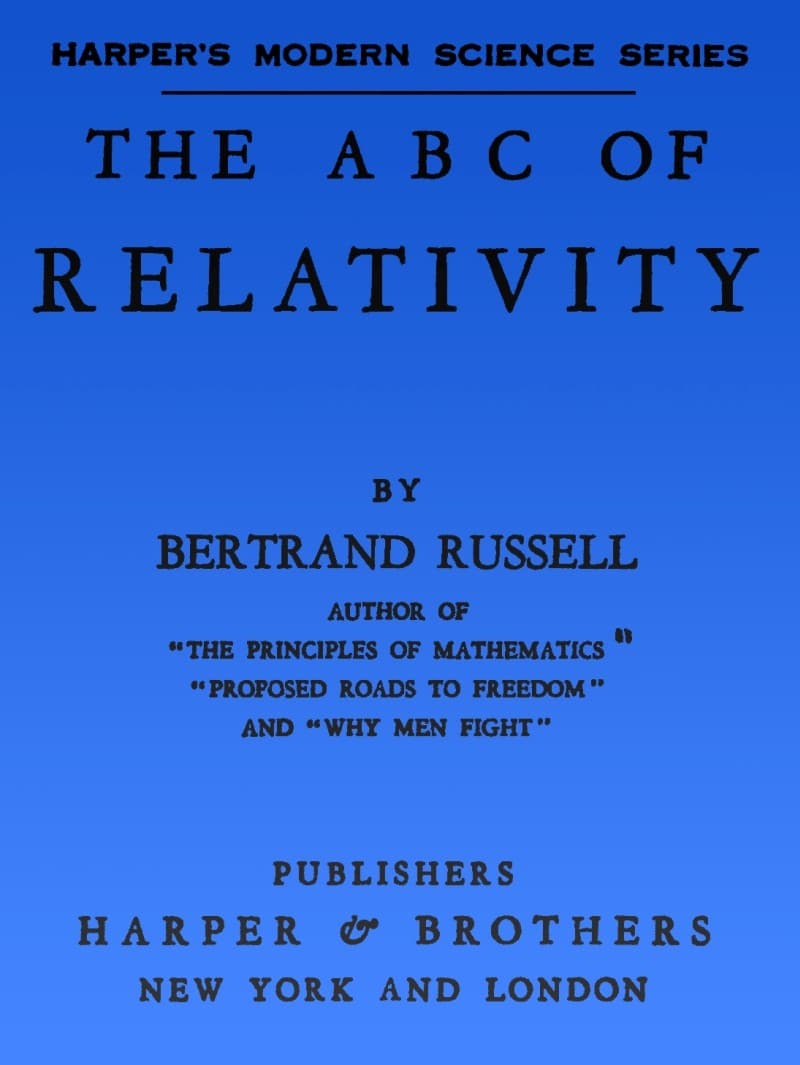
ABC of Relativity
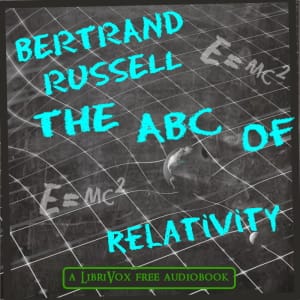
In 1925, three weeks before Einstein's theory would be confirmed by a solar eclipse, Bertrand Russell set out to do something seemingly impossible: explain relativity to someone who had never studied physics. The result is a masterclass in lucid exposition, where a philosopher-mathematician turns his analytical rigor to the most revolutionary idea in modern science. Russell begins with simple observations a falling elevator, a train moving past a platform and builds carefully toward the mind-bending consequences of Einstein's insight: that space and time are not fixed stages but flexible dimensions warped by motion and gravity. He navigates the famous twins paradox, the bending of light, the relationship between mass and energy, all while maintaining a conversational clarity that never talks down to his reader. What emerges is not just an explanation of physics but a portrait of how science actually thinks, how old certainties crumble, and how we must remake our common sense to match reality. Nearly a century later, Russell's book remains the ideal entry point for anyone curious about what Einstein really said and why it changed everything.
Editions

Link to this book
Add a free, dofollow link to Lex on your blog, forum, syllabus, or reading list.

<a href="https://lex-books.com/book/abc-of-relativity-2f1fd23b-c481-4752-ba3d-f5187f76057a"><img src="https://lex-books.com/badges/read-on-lex.svg" alt="Read ABC of Relativity by Bertrand Russell free on Lex" width="160" height="40"></a>[](https://lex-books.com/book/abc-of-relativity-2f1fd23b-c481-4752-ba3d-f5187f76057a)[url=https://lex-books.com/book/abc-of-relativity-2f1fd23b-c481-4752-ba3d-f5187f76057a][img]https://lex-books.com/badges/read-on-lex.svg[/img][/url]Read ABC of Relativity by Bertrand Russell free on Lex: https://lex-books.com/book/abc-of-relativity-2f1fd23b-c481-4752-ba3d-f5187f76057aCite this book
Reading this edition for a paper or guide? Copy a citation.
Russell, Bertrand. ABC of Relativity. Lex, lex-books.com/book/abc-of-relativity-2f1fd23b-c481-4752-ba3d-f5187f76057a.Russell, B. (n.d.). ABC of Relativity. Lex. https://lex-books.com/book/abc-of-relativity-2f1fd23b-c481-4752-ba3d-f5187f76057aRussell, Bertrand. ABC of Relativity. Lex. https://lex-books.com/book/abc-of-relativity-2f1fd23b-c481-4752-ba3d-f5187f76057a.