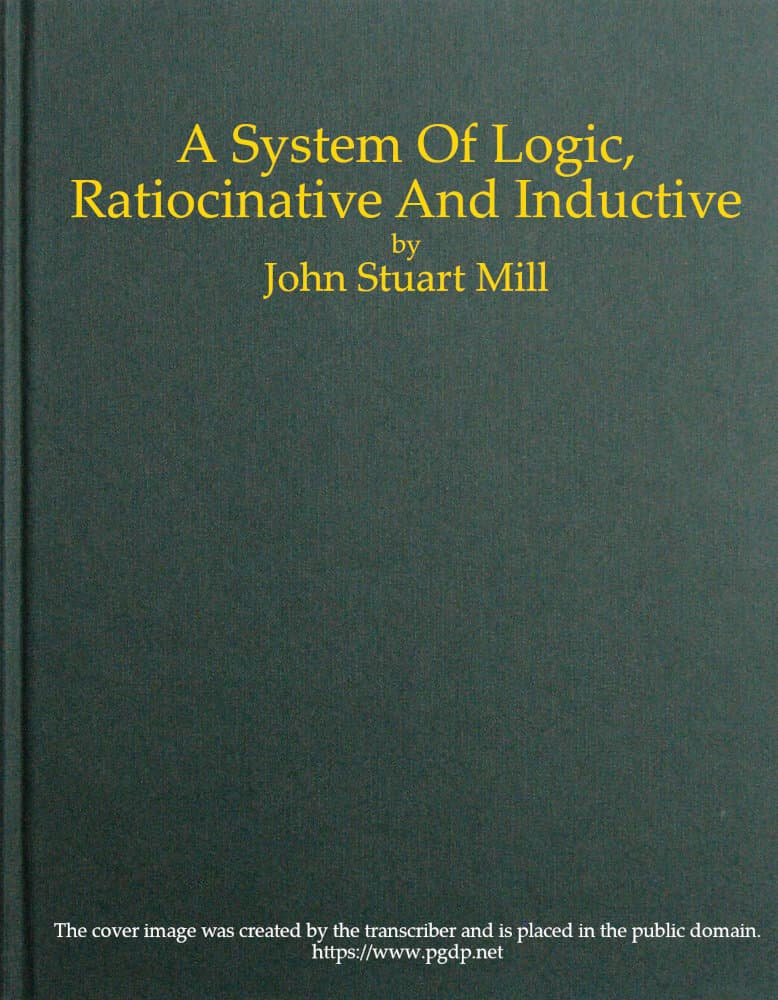
A System of Logic: Ratiocinative and Inductive, 7th Edition, Vol. II
1843
A System of Logic: Ratiocinative and Inductive, 7th Edition, Vol. II
1843
A System of Logic: Ratiocinative and Inductive, first published in 1843 by John Stuart Mill, is a foundational philosophical work that examines the principles of evidence and scientific investigation. This second volume delves into various reasoning types, particularly induction, and discusses the nature and limits of scientific hypotheses. Mill critiques intuitionism and advocates for a reliance on empirical knowledge in social planning and political action, reflecting Enlightenment ideals. The work is notable for establishing Mill as a leading figure in the empirical school of logic.
Editions
X-Ray
“concise mode of expressing the same meaning is, that inseparable accidents are properties which are universal to the species, but not necessary to it. Thus, blackness is an attribute of a crow,””
— John Stuart Mill
“Although, however, Hobbes's theory of Predication, according to the well-known remark of Leibnitz, and the avowal of Hobbes himself, 32 renders truth and falsity completely arbitrary, with no standard but the will of men, it must not be concluded that either Hobbes, or any of the other thinkers who have in the main agreed with him, did in fact consider the distinction between truth and error as less real, or attached less importance to it, than other people.””
— John Stuart Mill
“This leads to the consideration of a third great division of names, into connotative and non-connotative, the latter sometimes, but improperly, called absolute.””
— John Stuart Mill
“Logic, according to the conception here formed of it, has no concern with the nature of the act of judging or believing; the consideration of that act, as a phenomenon of the mind, belongs to another science. Philosophers, however, from Descartes downward, and especially from the era of Leibnitz and Locke, have by no means observed this distinction; and would have treated with great disrespect any attempt to analyze the import of Propositions, unless founded on an analysis of the act of Judgment.””
— John Stuart Mill
“The following are the classes into which, according to this school of philosophy, Things in general might be reduced: Οὐσία, Substantia. Ποσὸν, Quantitas. Ποιόν, Qualitas. Πρός τι, Relatio. Ποιεῖν, Actio. Πάσχειν, Passio. Ποῦ, Ubi. Πότε, Quando. Κεῖσθακ, Situs. Ἔχειν, Habitus.””
— John Stuart Mill
“Either A is B or C is D,” means, “if A is not B, C is D; and if C is not D, A is B.” All hypothetical propositions, therefore, though disjunctive in form, are conditional in meaning; and the words hypothetical and conditional may be, as indeed they generally are, used synonymously.””
— John Stuart Mill
“And one of the commonest forms of fallacious reasoning arising from ambiguity, is that of arguing from a metaphorical expression as if it were literal; that is, as if a word, when applied metaphorically, were the same name as when taken in its original sense: which will be seen more particularly in its place.””
— John Stuart Mill
“An intermediate case is that of a name used analogically or metaphorically; that is, a name which is predicated of two things, not univocally, or exactly in the same signification, but in significations somewhat similar, and which being derived one from the other, one of them may be considered the primary, and the other a secondary signification.””
— John Stuart Mill
“Logic is not the science of Belief, but the science of Proof, or Evidence. In so far as belief professes to be founded on proof, the office of logic is to supply a test for ascertaining whether or not the belief is well grounded. With the claims which any proposition has to belief on the evidence of consciousness”
— John Stuart Mill
Link to this book
Add a free, dofollow link to Lex on your blog, forum, syllabus, or reading list.

<a href="https://lex-books.com/book/a-system-of-logic-ratiocinative-and-inductive-7th-edition-vol-ii-aaa0365d-c2bb-491f-8584-2b09b2d6284a"><img src="https://lex-books.com/badges/read-on-lex.svg" alt="Read A System of Logic: Ratiocinative and Inductive, 7th Edition, Vol. II by John Stuart Mill free on Lex" width="160" height="40"></a>[](https://lex-books.com/book/a-system-of-logic-ratiocinative-and-inductive-7th-edition-vol-ii-aaa0365d-c2bb-491f-8584-2b09b2d6284a)[url=https://lex-books.com/book/a-system-of-logic-ratiocinative-and-inductive-7th-edition-vol-ii-aaa0365d-c2bb-491f-8584-2b09b2d6284a][img]https://lex-books.com/badges/read-on-lex.svg[/img][/url]Read A System of Logic: Ratiocinative and Inductive, 7th Edition, Vol. II by John Stuart Mill free on Lex: https://lex-books.com/book/a-system-of-logic-ratiocinative-and-inductive-7th-edition-vol-ii-aaa0365d-c2bb-491f-8584-2b09b2d6284aCite this book
Reading this edition for a paper or guide? Copy a citation.
Mill, John Stuart. A System of Logic: Ratiocinative and Inductive, 7th Edition, Vol. II. Lex, lex-books.com/book/a-system-of-logic-ratiocinative-and-inductive-7th-edition-vol-ii-aaa0365d-c2bb-491f-8584-2b09b2d6284a.Mill, J. S. (1843). A System of Logic: Ratiocinative and Inductive, 7th Edition, Vol. II. Lex. https://lex-books.com/book/a-system-of-logic-ratiocinative-and-inductive-7th-edition-vol-ii-aaa0365d-c2bb-491f-8584-2b09b2d6284aMill, John Stuart. A System of Logic: Ratiocinative and Inductive, 7th Edition, Vol. II. Lex. https://lex-books.com/book/a-system-of-logic-ratiocinative-and-inductive-7th-edition-vol-ii-aaa0365d-c2bb-491f-8584-2b09b2d6284a.