A Christian Directory, Part 4: Christian Politics
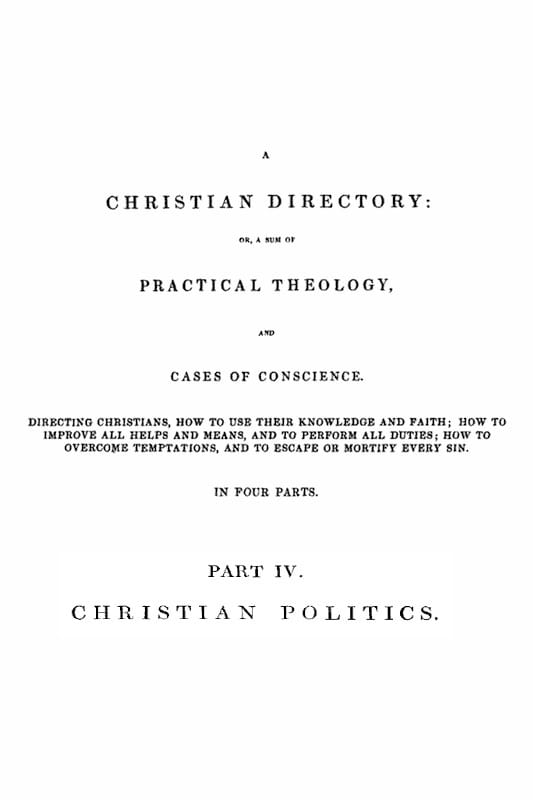
A Christian Directory, Part 4: Christian Politics
Richard Baxter's Christian Politics emerges from one of the most tumultuous periods in English history, and the urgency of that moment pulses through every page. As a Puritan pastor who lived through civil war, the execution of a king, and the Restoration, Baxter brought hard-won experience to the question that haunts every generation of believers: how should a Christian relate to political power? This fourth part of his Christian Directory offers no abstract treatise but rather rigorous, practical guidance on the duties of rulers and subjects alike, grounded in the conviction that government originates from God yet remains accountable to divine law. Baxter distinguishes between what belongs to Caesar and what belongs to God with careful theological precision, addressing everything from the obligations of magistrates to the rights and limits of conscientious objection. The work endures not as a historical curiosity but as a substantive engagement with questions that remain urgent: the moral foundations of authority, the tension between obedience and conscience, and the proper boundaries between church and state. For readers interested in the intellectual foundations of Western political thought or the history of Christian engagement with governance, Baxter remains a formidable conversation partner.
Editions

Link to this book
Add a free, dofollow link to Lex on your blog, forum, syllabus, or reading list.

<a href="https://lex-books.com/book/a-christian-directory-part-4-christian-politics-0a9dc240-d4c6-4760-9bab-3d456cd3e87f"><img src="https://lex-books.com/badges/read-on-lex.svg" alt="Read A Christian Directory, Part 4: Christian Politics by Richard Baxter free on Lex" width="160" height="40"></a>[](https://lex-books.com/book/a-christian-directory-part-4-christian-politics-0a9dc240-d4c6-4760-9bab-3d456cd3e87f)[url=https://lex-books.com/book/a-christian-directory-part-4-christian-politics-0a9dc240-d4c6-4760-9bab-3d456cd3e87f][img]https://lex-books.com/badges/read-on-lex.svg[/img][/url]Read A Christian Directory, Part 4: Christian Politics by Richard Baxter free on Lex: https://lex-books.com/book/a-christian-directory-part-4-christian-politics-0a9dc240-d4c6-4760-9bab-3d456cd3e87fCite this book
Reading this edition for a paper or guide? Copy a citation.
Baxter, Richard. A Christian Directory, Part 4: Christian Politics. Lex, lex-books.com/book/a-christian-directory-part-4-christian-politics-0a9dc240-d4c6-4760-9bab-3d456cd3e87f.Baxter, R. (n.d.). A Christian Directory, Part 4: Christian Politics. Lex. https://lex-books.com/book/a-christian-directory-part-4-christian-politics-0a9dc240-d4c6-4760-9bab-3d456cd3e87fBaxter, Richard. A Christian Directory, Part 4: Christian Politics. Lex. https://lex-books.com/book/a-christian-directory-part-4-christian-politics-0a9dc240-d4c6-4760-9bab-3d456cd3e87f.