Lex

Browse

GenresShelvesPremiumBlog

Company

AboutJobsPartnersSell on LexAffiliates

Audio

Lex StudioVoicesFirst chapter freeAudiobook pricingAudiobook samplesAudiobook guidesAudio blog

Resources

DocsInvite FriendsFAQ

Legal

Terms of ServicePrivacy Policygeneral@lex-books.com+1 951-551-2243WhatsApp (international)

© 2026 LexBooks, Inc. All rights reserved.

William Rose

anthologist, editor, poet and author; older brother of Stephen Vincent Benét.

Wikipedia

anthologist, editor, poet and author; older brother of Stephen Vincent Benét.

Famous Quotes

View all 3 quotes

“The proximate causes of the Flemish “peasant” revolt were local and immediate; its roots, the reason it could occur in the first place, were four centuries in creation. As Europe’s population increased threefold between the ninth and thirteenth centuries, the Continent’s demographic pyramid changed its shape. The base grew larger relative to its peak, and more distant: the gap between nobility and peasantry got bigger and bigger. Families that were noble by birth became more and more “noble” in behavior: dressing more opulently, entertaining more lavishly, and housing themselves more extravagantly, while the rural peasantry lived more or less the same as their many times great-grandparents.”

“And not merely slogan-shouting, but debate. The Chronicle of the courtier Theophanes faithfully records a debate—perhaps disputation is the better word—between Justinian (through his herald, or mandatus) and the chosen representative of the Green faction. The dialogue is startling on a number of grounds. First, the Green “debater” addresses the emperor, the viceroy of Christ on earth, practically as an equal. He addresses Justinian respectfully—as “Justinianus Augustus”—but registers his complaint precisely as if he were doing so before a small claims court, informing the most powerful man in the world that “my oppressor can be found in the shoemaker’s quarter.” For his part, Justinian, though clearly aware that he holds what might be called a preemptive advantage (“Verily, if you refuse to keep silent, I shall have you beheaded”), still debates both the truth of the Green claims and the theological position that he suggests informs those claims. Justinian tells his interlocutor, “I would have you baptized in the name of one God” only to receive the response, “I am baptized in One God,” evidently an attempt to contrast his Monophysite sympathies with the emperor’s orthodoxy. The Green spokesman accuses the emperor of suppressing the truth, of countenancing murder, and when he has had enough, he ends with “Goodbye Justice! You are no longer in fashion. I shall turn and become Jew; better to be a pagan than a Blue, God knows…”14 The most telling part of the entire dialogue, however, is that it was”

“The brain is evolutionarily hard-wired to do its best daydreaming only when it senses that it is safe to do so—when, in short, it is relaxed. In Kounios’s words, “The relaxation phase is crucial.5 That’s why so many insights happen during warm showers.” Or during Sunday afternoon walks on Glasgow Green, when the idea of a separate condenser seems to have excited the aSTG in the skull of James Watt. Eureka indeed.”

Books from the author
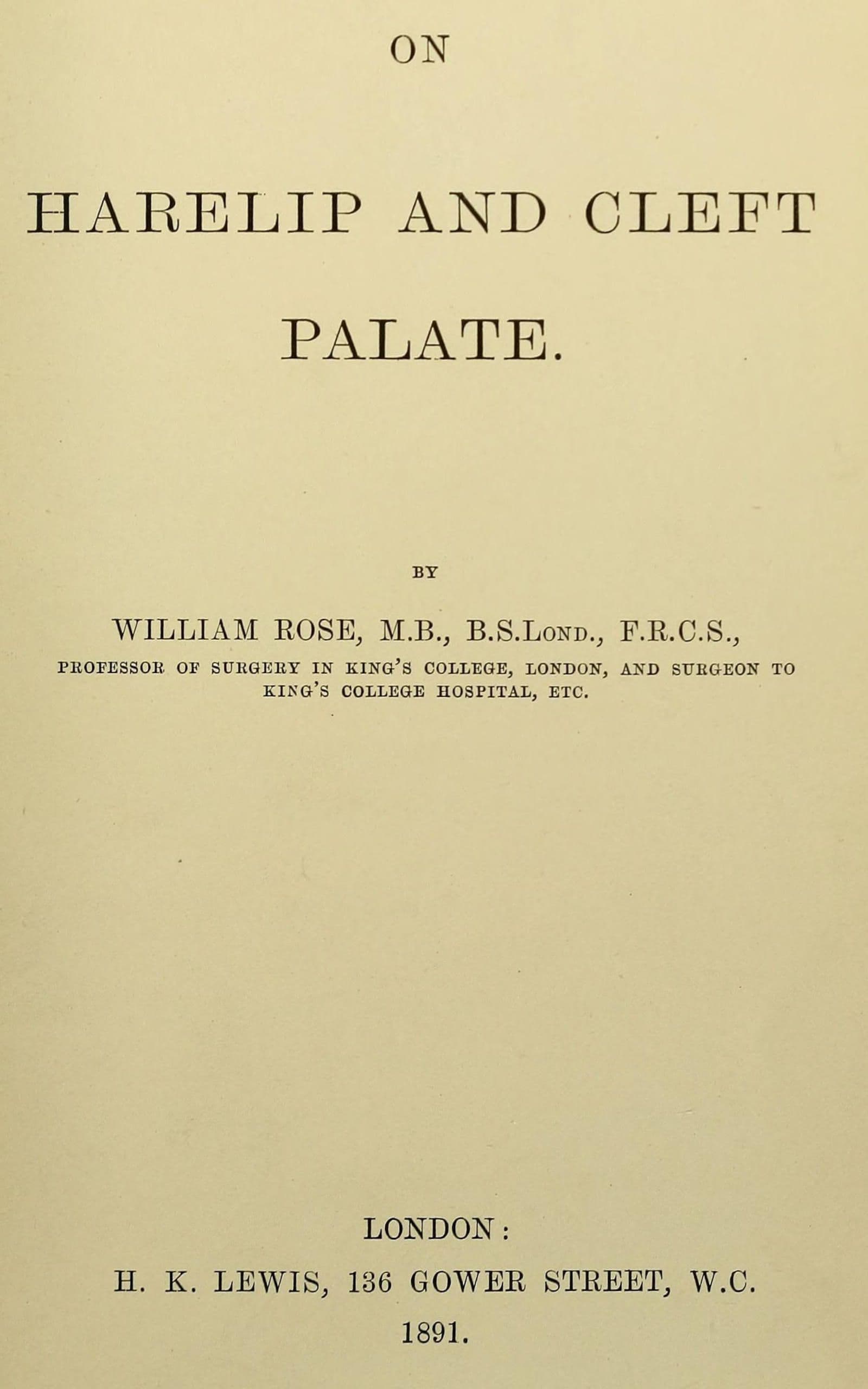
On Harelipand CleftPalate

1877

William Rose

On Harelip and Cleft Palate

More authors like this

right arrow
Albert F. Blaisdell
1847-1927
Charles Creighton
Charles Creighton
1847-1927
Robert Means Lawrence
1847-1935
S. S. Curry
S. S. Curry
1847-1921
Auguste Forel
Auguste Forel
1848-1931
Chas. A. Tyrrell
1846-1918
George M. Gould
George M. Gould
1848-1922
Orison Swett Marden
Orison Swett Marden
1848-1924
Albert Leffingwell
1845-1916
Elie Metchnikoff
Elie Metchnikoff
1845-1916
Horace Fletcher
Horace Fletcher
1849-1919
George Vivian Poore
1843-1904
R. Vashon Rogers
R. Vashon Rogers
1843-1911
Ellen H. Richards
Ellen H. Richards
1842-1911
Achilles Rose
1839-1916
Franz Hartmann
Franz Hartmann
1838-1912

Link to this page

Add a free, dofollow link to Lex on your blog, forum, syllabus, or reading list.

William Rose on Lex
HTML
<a href="https://lex-books.com/author/william-rose"><img src="https://lex-books.com/badges/read-on-lex.svg" alt="William Rose on Lex" width="160" height="40"></a>
Markdown
[![William Rose on Lex](https://lex-books.com/badges/read-on-lex.svg)](https://lex-books.com/author/william-rose)
BBCode
[url=https://lex-books.com/author/william-rose][img]https://lex-books.com/badges/read-on-lex.svg[/img][/url]
Plain link
William Rose on Lex: https://lex-books.com/author/william-rose