What would you like to read?Search books, authors, genres, shelves, users...
Search books, authors, genres, shelves, users...Search books, authors, genres, shelves, users...

What would you like to read?Search books, authors, genres, shelves, users...
Search books, authors, genres, shelves, users...Search books, authors, genres, shelves, users...
1 books
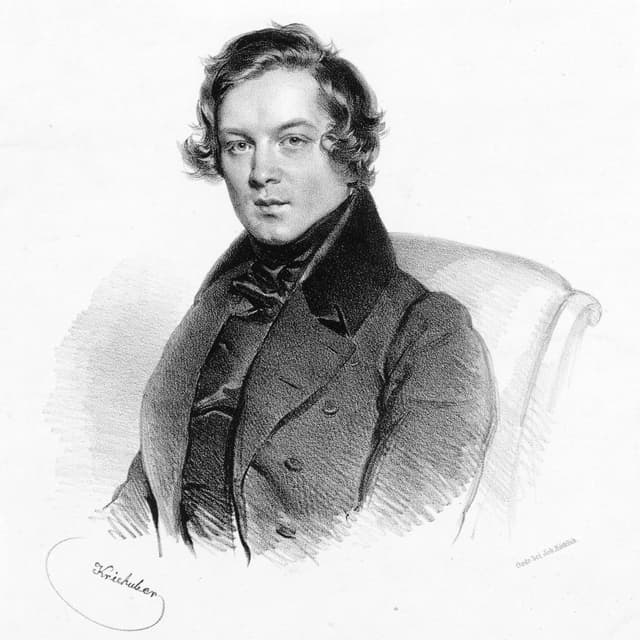
Robert Schumann[n 1] (/ˈʃuːmɑːn/; German: [ˈʁoːbɛʁt ˈʃuːman]; 8 June 1810 – 29 July 1856) was a German composer, pianist, and music critic of the early Romantic era. He composed in all the main musical genres of the time, writing for solo piano, voice and piano, chamber groups, orchestra, choir and the opera. His works typify the spirit of the Romantic era in German music. Schumann was born in Zwickau, Saxony, to an affluent middle-class family with no musical connections, and was initially unsure whether to pursue a career as a lawyer or to make a living as a pianist-composer. He studied law at the universities of Leipzig and Heidelberg but his main interests were music and Romantic literature. From 1829 he was a student of the piano teacher Friedrich Wieck, but his hopes for a career as a virtuoso pianist were frustrated by a worsening problem with his right hand, and he concentrated on composition. His early works were mainly piano pieces, including the large-scale Carnaval, Davidsbündlertänze (Dances of the League of David), Fantasiestücke (Fantasy Pieces), Kreisleriana and Kinderszenen (Scenes from Childhood) (1834–1838). He was a co-founder of the Neue Zeitschrift für Musik (New Musical Journal) in 1834 and edited it for ten years. In his writing for the journal and in his music he distinguished between two contrasting aspects of his personality, dubbing these alter egos "Florestan" for his impetuous self and "Eusebius" for his gentle poetic side. Despite the bitter opposition of Wieck, who did not regard his pupil as a suitable husband for her, Schumann married Wieck's daughter Clara in 1840. In the years immediately following their wedding Schumann composed prolifically, writing, first, songs and song‐cycles including Frauenliebe und Leben ("Woman's Love and Life") and Dichterliebe ("Poet's Love"). He turned his attention to orchestral music in 1841, completing the first of his four symphonies. In the following year he concentrated on chamber music, writing three string quartets, a Piano Quintet and a Piano Quartet. During the rest of the 1840s, between bouts of mental and physical ill health, he composed a variety of piano and other pieces and went with his wife on concert tours in Europe. His only opera, Genoveva (1850), was not a success and has seldom been staged since.

If, while at the piano, you attempt to form little melodies, that is very well; but if they come into your mind of themselves, when you are not practising, you may be still more pleased; for the internal organ of music is then roused in you. The fingers must do what the head desires; not the contrary.
If, while at the piano, you attempt to form little melodies, that is very well; but if they come into your mind of themselves, when you are not practising, you may be still more pleased; for the internal organ of music is then roused in you. The fingers must do what the head desires; not the contrary.