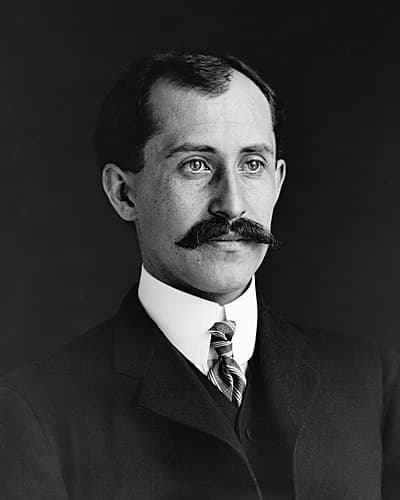
Orville Wright
Orville Wright was an American aviation pioneer best known for his role in inventing, building, and flying the world's first successful airplane alongside his brother, Wilbur. Their groundbreaking achievement occurred on December 17, 1903, when they completed the first controlled, sustained flight of an engine-powered, heavier-than-air aircraft, the Wright Flyer, near Kitty Hawk, North Carolina. This monumental event marked a turning point in human transportation and the beginning of the aviation age. The Wright brothers' innovative approach focused on developing a reliable system of aerodynamic control, which allowed pilots to steer and maintain equilibrium in flight, a significant departure from the emphasis on powerful engines that characterized the work of other aviation pioneers of their time. The Wright brothers' dedication to aeronautics was rooted in their mechanical skills, honed through years of working with bicycles and various machinery in their Dayton, Ohio shop. Their experience with bicycles particularly influenced their belief that an unstable vehicle, such as an aircraft, could be controlled with practice. Through extensive glider tests from 1900 to 1903, they refined their piloting skills and developed key technologies, including the three-axis control system that remains standard in aviation today. Orville's contributions to aviation, alongside Wilbur's, established a legacy that not only transformed transportation but also laid the groundwork for the future of flight, inspiring generations of engineers and aviators to come.
Famous Quotes
View all 3 quotes“If we all worked on the assumption that what is accepted as true is really true, there would be little hope of advance.”
“Learning the secret of flight from a bird was a good deal like learning the secret of magic from a magician.”
“If we all worked on the assumption that what is accepted as true were really true, there would be little hope of advance.”
Books from the author




Link to this page
Add a free, dofollow link to Lex on your blog, forum, syllabus, or reading list.

<a href="https://lex-books.com/author/orville-wright"><img src="https://lex-books.com/badges/read-on-lex.svg" alt="Orville Wright on Lex" width="160" height="40"></a>[](https://lex-books.com/author/orville-wright)[url=https://lex-books.com/author/orville-wright][img]https://lex-books.com/badges/read-on-lex.svg[/img][/url]Orville Wright on Lex: https://lex-books.com/author/orville-wright