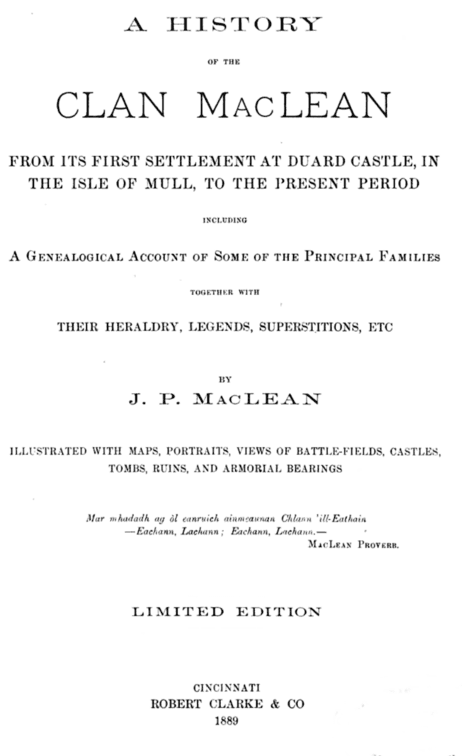
J. P. MacLean
J. P. MacLean was a prominent historian and author known for his extensive research on the Scottish Highlanders and their settlements in America. His most notable work, 'An Historical Account of the Settlements of Scotch Highlanders in America,' provided a comprehensive examination of the migration patterns, cultural practices, and contributions of Scottish immigrants to American society. This work not only highlighted the challenges faced by these settlers but also celebrated their enduring legacy in shaping various regions of the United States, particularly in the Appalachian areas. In addition to his historical accounts, MacLean authored 'A Manual of the Antiquity of Man,' which delved into the early human history and archaeological findings of North America. This work reflected his broader interest in anthropology and the origins of human civilization, contributing to the academic discourse of his time. MacLean's writings are significant for their meticulous research and dedication to preserving the history of Scottish immigrants, making him an important figure in the field of American history and ethnic studies. His legacy continues to influence scholars and readers interested in the intersection of culture and migration.
Famous Quotes
View all 5 quotes“The ruler of each clan was called a chief, who was really the chief man of his family. Each clan was divided into branches who had chieftains over them. The members of the clan claimed consanguinity to the chief. The idea never entered into the mind of a Highlander that the chief was anything more than the head of the clan. The relation he sustained was subordinate to the will of the people. Sometimes his sway was unlimited, but necessarily paternal. The tribesmen were strongly attached to the person of their chief. He stood in the light of a protector, who must defend them and right their wrongs. They rallied to his support, and in defense they had a contempt for danger. The sway of the chief was of such a nature as to cultivate an imperishable love of independence, which was probably strengthened by an exceptional hardiness of character.””
“In their school of life it was taught to consider courage an honorable virtue and cowardice the most disgraceful failing. Loving their native glen, they were ever ready to defend it to the last extremity. Their own good name and devotion to the clan emulated and held them to deeds of daring.””
“They were strict in not offending those with whom they were in amity. They had high notions of the duty of observing faith to allies and hospitality to guests.””
Books from the author



Link to this page
Add a free, dofollow link to Lex on your blog, forum, syllabus, or reading list.

<a href="https://lex-books.com/author/j-p-maclean"><img src="https://lex-books.com/badges/read-on-lex.svg" alt="J. P. MacLean on Lex" width="160" height="40"></a>[](https://lex-books.com/author/j-p-maclean)[url=https://lex-books.com/author/j-p-maclean][img]https://lex-books.com/badges/read-on-lex.svg[/img][/url]J. P. MacLean on Lex: https://lex-books.com/author/j-p-maclean