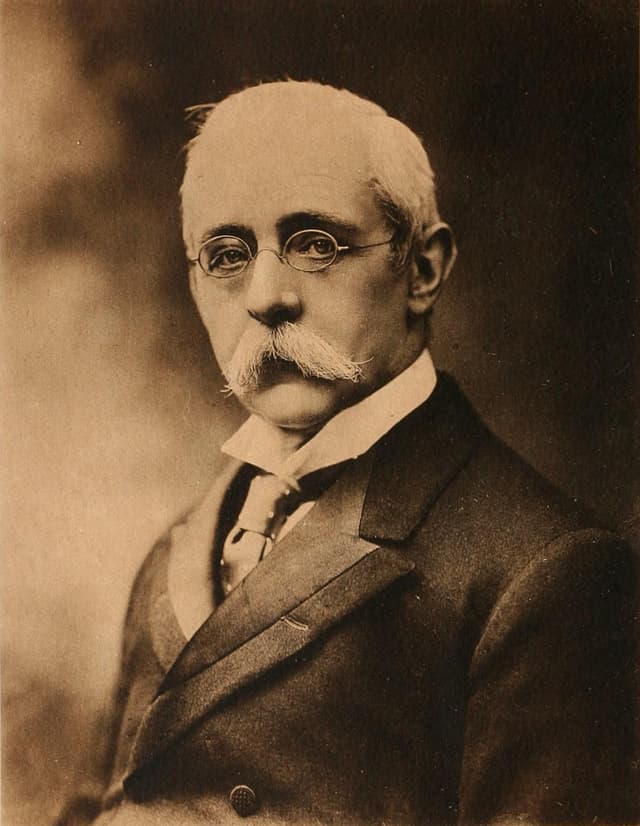
Herbert Allen Giles
Herbert Allen Giles was a prominent British diplomat and sinologist, renowned for his contributions to the understanding of Chinese language and literature. Educated at Charterhouse School, he embarked on a diplomatic career in China, where he spent significant time immersed in the culture and language. His expertise led him to hold the Professorship of Chinese at the University of Cambridge for an impressive 35 years, during which he made substantial contributions to sinology and the study of Chinese texts. Giles is perhaps best known for his modification of the Mandarin Chinese romanization system originally established by Thomas Wade, resulting in the widely adopted Wade–Giles system. His literary legacy includes notable translations of key Chinese philosophical texts, such as the Analects of Confucius, the Tao Te Ching, and the Chuang Tzu. His 1892 work, A Chinese–English Dictionary, became a vital resource for scholars and students alike, further solidifying his impact on the field. Through his scholarly work, Giles played a crucial role in bridging Eastern and Western thought, making Chinese literature more accessible to a global audience and influencing generations of sinologists and linguists.
Famous Quotes
View all 3 quotes“The flowers and the birds do not toil, they simply live. That is TAO. And for man a state of indifference and calm, the ἀταραξία not of the sceptic but of the mystic, a passive reflecting of the Eternal, is the ideal end. “The perfect man employs his mind as a mirror. It grasps nothing, it refuses nothing. It receives but does not keep. And thus he can triumph over matter without injury to himself”.”
“To the good I would be good; to the not-good I would also be good, in order to make them good.”
“Put yourself behind, and the world will put you in front; put yourself in front, and the world will put you behind.”
Books from the author


Link to this page
Add a free, dofollow link to Lex on your blog, forum, syllabus, or reading list.

<a href="https://lex-books.com/author/herbert-allen-giles"><img src="https://lex-books.com/badges/read-on-lex.svg" alt="Herbert Allen Giles on Lex" width="160" height="40"></a>[](https://lex-books.com/author/herbert-allen-giles)[url=https://lex-books.com/author/herbert-allen-giles][img]https://lex-books.com/badges/read-on-lex.svg[/img][/url]Herbert Allen Giles on Lex: https://lex-books.com/author/herbert-allen-giles