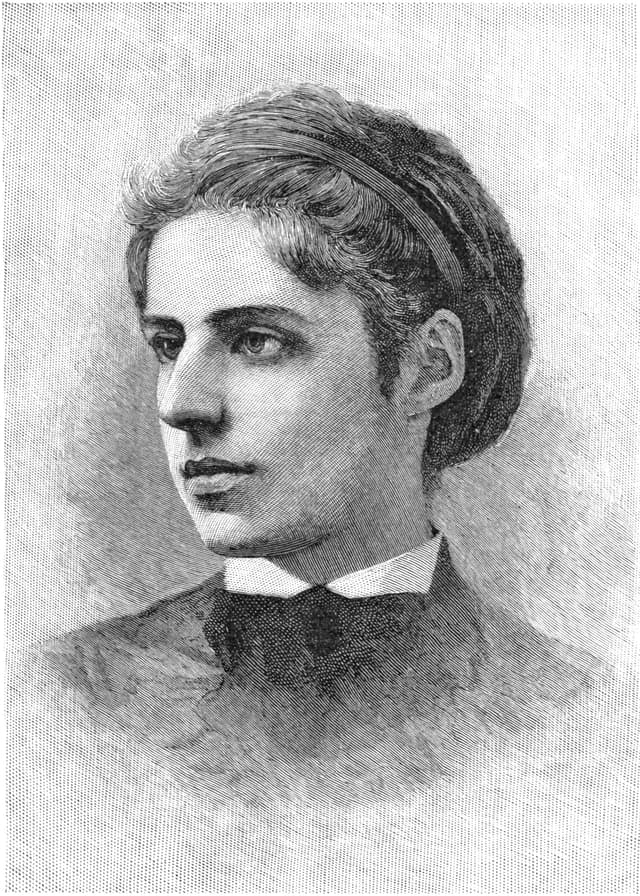
Emma Lazarus
Emma Lazarus was an influential American poet and activist whose work bridged the worlds of literature and social justice. Born into a prominent Jewish family in New York City, she began writing poetry at a young age and published her first collection, 'Poems and Translations,' in 1867. Lazarus's literary career flourished with notable works such as 'Admetus, and other Poems' and 'Jewish Poems and Translations,' which reflect her deep engagement with Jewish identity and culture. Her poetry often explored themes of exile, belonging, and the immigrant experience, making her a significant voice in American literature. Lazarus is perhaps best remembered for her sonnet 'The New Colossus,' written in 1883, which was inspired by the Statue of Liberty. This powerful poem redefined the statue as a symbol of hope and refuge for immigrants, particularly those fleeing persecution in Europe. The famous lines, 'Give me your tired, your poor, your huddled masses yearning to breathe free,' have become emblematic of America's identity as a nation of immigrants. Her activism extended beyond her poetry; she worked tirelessly to support Jewish refugees escaping antisemitic violence in Eastern Europe. Lazarus's legacy endures not only through her literary contributions but also through her advocacy for social justice and her role in shaping the narrative of American immigration.
Famous Quotes
View all 3 quotes“Give me your tired, your poor, Your huddled masses yearning to breathe free.”
“Give me your tired, your poor, Your huddled masses yearning to breathe free, The wretched refuse of your teeming shore. Send these, the homeless, tempest-tossed, to me: I lift my lamp beside the golden door.”
“Until we are all free, we are none of us free.”
Books from the author




Link to this page
Add a free, dofollow link to Lex on your blog, forum, syllabus, or reading list.

<a href="https://lex-books.com/author/emma-lazarus"><img src="https://lex-books.com/badges/read-on-lex.svg" alt="Emma Lazarus on Lex" width="160" height="40"></a>[](https://lex-books.com/author/emma-lazarus)[url=https://lex-books.com/author/emma-lazarus][img]https://lex-books.com/badges/read-on-lex.svg[/img][/url]Emma Lazarus on Lex: https://lex-books.com/author/emma-lazarus