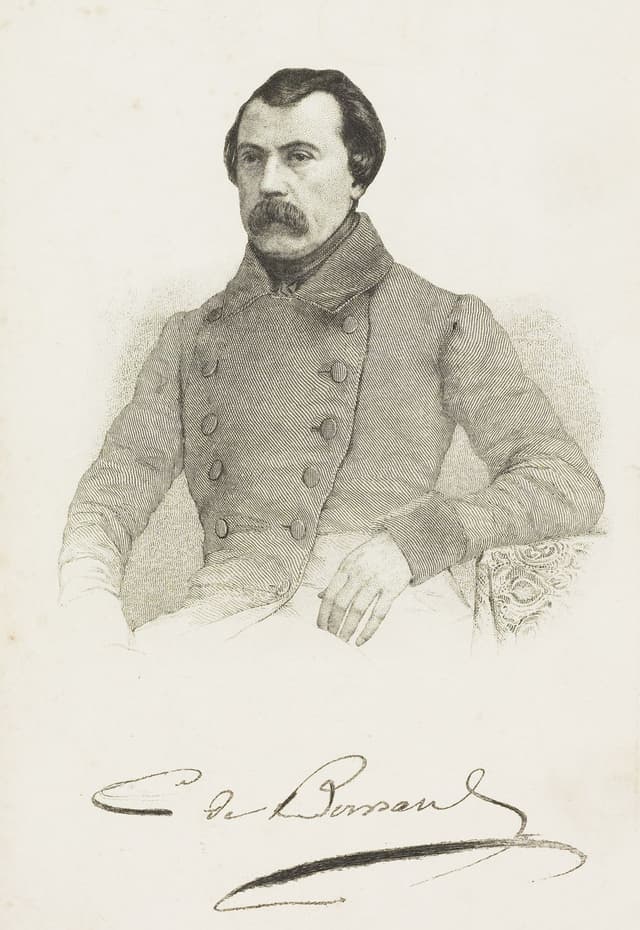
Charles de Bernard
Charles de Bernard was a French writer known for his contributions to the literary landscape of the 19th century. Born Pierre-Marie-Charles de Bernard du Grail de la Villette, he emerged as a prominent figure in the realm of French literature, particularly recognized for his novels that often explored themes of social critique and human psychology. His works, including 'Le Mémorial de Sainte-Hélène' and 'Les Deux Frères,' showcased his ability to weave intricate narratives that reflected the complexities of human relationships and societal norms of his time. De Bernard's literary significance lies in his innovative storytelling and his exploration of the human condition, which resonated with contemporary audiences and influenced later writers. His narratives often delved into the moral dilemmas faced by individuals, making him a precursor to more modern existential themes. Despite his relatively short life, his contributions to literature were notable for their depth and insight, leaving a lasting impact on the French literary canon. Today, he is remembered as a key figure who bridged the gap between romanticism and realism in literature.
Famous Quotes
View all 2 quotes“L'humanité a connu trois vexations. La première c'est Nicolas Copernic qui a déduit de ses observations du ciel que la Terre n'était pas au centre de l'univers. La deuxième c'est Charles Darwin qui a conclu que l'homme descendait d'un primate et était donc un animal comme les autres. La troisième c'est Sigmund Freud qui a signalé que la motivation réelle de la plupart de nos actes politiques ou artistiques était la sexualité.””
“Their era was ending when Jim Clyman got to Independence in ’44 and found Bill Sublette, who had first taken wagons up the Platte Valley in 1830, now taking invalids to Brown’s Hole for a summer’s outing. It was twenty-one years since Jim had first gone up the Missouri, forty years since Lewis and Clark wintered at the Mandan villages, thirty-three years since Wilson Hunt led the Astorians westward, twenty years since Clyman with Smith and Fitzpatrick crossed South Pass, eighteen years since Ashley, in the Wasatch Mountains, sold his fur company to Smith, Sublette, and Jackson. Thirty-two years ago Robert McKnight had been imprisoned by the Spanish for taking goods to Santa Fe. Twenty-three years ago William Becknell had defied the prohibition and returned from Santa Fe in triumph. Eighteen years ago the Patties had got to San Diego by the Gila route and Jed Smith had blazed the desert trail to San Bernardino Valley; fourteen years ago Ewing Young, with Kit Carson, had come over the San Bernardino Mountains, making for the San Joaquin. There had been a trading post at the mouth of Laramie Creek for just ten years. Bent’s Fort was fifteen years old. Now the streams were trapped out, and even if beaver should come back, the price of plews would never rise again. There were two or three thousand Americans in Oregon, a couple of hundred in California, and in Independence hundreds of wagons were yoking up. Bill Sublette and Black Harris were guiding movers. Carson and Fitzpatrick were completing the education of John Charles Frémont. Forty years since Lewis and Clark. Think back to that blank paper with some names sketched in, the Wind River peaks, the Tetons, the Picketwire River, the Siskidee, names which, mostly, the mountain men sketched in”
Books from the author





Link to this page
Add a free, dofollow link to Lex on your blog, forum, syllabus, or reading list.

<a href="https://lex-books.com/author/charles-de-bernard"><img src="https://lex-books.com/badges/read-on-lex.svg" alt="Charles de Bernard on Lex" width="160" height="40"></a>[](https://lex-books.com/author/charles-de-bernard)[url=https://lex-books.com/author/charles-de-bernard][img]https://lex-books.com/badges/read-on-lex.svg[/img][/url]Charles de Bernard on Lex: https://lex-books.com/author/charles-de-bernard