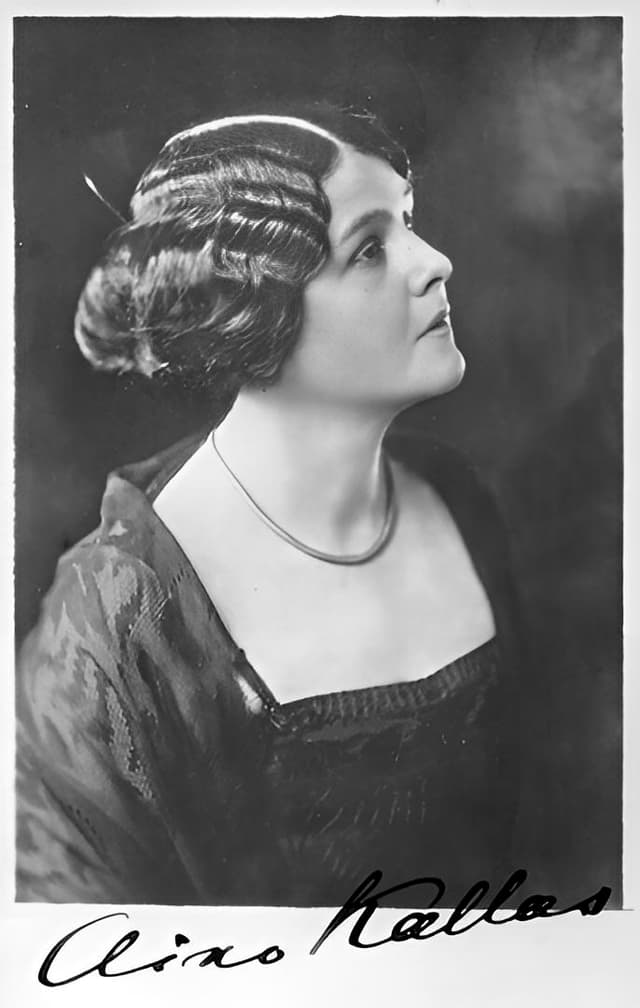
Aino Kallas
Aino Kallas was a Finnish-Estonian author renowned for her impactful contributions to Finnish literature. Born in 1878, she grew up in a culturally rich environment that influenced her literary pursuits. Kallas's works often explored themes of identity, nature, and the human condition, reflecting her deep connection to both Finnish and Estonian heritage. Her novellas, such as 'The Wolf's Bride' and 'Tales from the North,' are celebrated for their lyrical prose and psychological depth, establishing her as a significant voice in early 20th-century literature. Kallas's literary significance extends beyond her storytelling; she was a pioneer in blending folklore with modern narrative techniques. Her ability to weave traditional tales into contemporary contexts not only enriched Finnish literature but also contributed to the broader discourse on national identity in the face of cultural change. Aino Kallas's legacy endures as she remains a vital figure in the literary canon of Finland and Estonia, inspiring future generations of writers with her unique perspective and artistic vision.
Famous Quotes
View all 3 quotes“Yet just as the day has two halves, one governed by the sun and the other by the moon, so there are many who are people of the day and who busy themselves with daytime deeds, whilst others are children of the night, their minds consumed with nocturnal notions; but yet there are some in whom the two merge like the rising of the sun and the moon in a day.”
“Her hair was copper-red, like the grass of the shore on which the spring floods leave their rust; but her eyes were dark, like the pools among the marshes, drawing the beholder down into their depths, and their surface was still as bog-water.”
“For as from the same piece of clay a potter may fashion either a pot or a tile, so the Devil may shape a witch into a wolf or a cat or even a goat, without subtracting from her and without adding to her at all. For this occurs just as clay is first molded into one, then shaped into another form, for the Devil is a potter and his witches are but clay.”
Books from the author


Link to this page
Add a free, dofollow link to Lex on your blog, forum, syllabus, or reading list.

<a href="https://lex-books.com/author/aino-kallas"><img src="https://lex-books.com/badges/read-on-lex.svg" alt="Aino Kallas on Lex" width="160" height="40"></a>[](https://lex-books.com/author/aino-kallas)[url=https://lex-books.com/author/aino-kallas][img]https://lex-books.com/badges/read-on-lex.svg[/img][/url]Aino Kallas on Lex: https://lex-books.com/author/aino-kallas