Willy's Travels on the Railroad: Intended for Young Children
1847
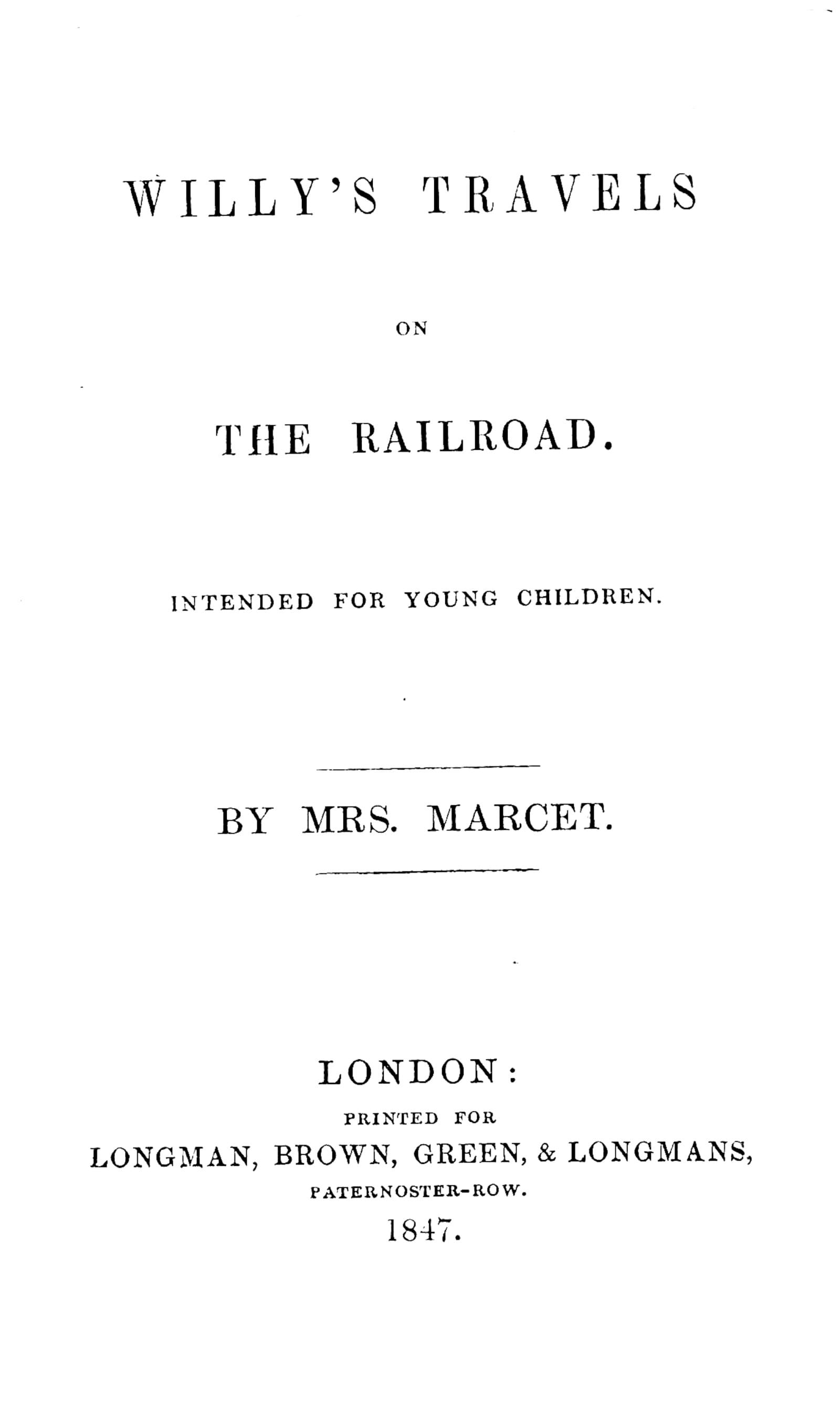
Willy's Travels on the Railroad: Intended for Young Children
1847
Six-year-old Willy has never ridden a steam locomotive before, and on this particular journey from London to Grandmamma's country house, everything is marvelous: the iron horse that breathes fire, the dark tunnel that swallows the train whole, the strange characters sharing the carriage. Through encounters with a spoiled classmate and a stern but kind old lady, Willy learns that self-control brings its own rewards. A market girl heading to Derby, with her blind mother hoping for a cure, teaches him about gratitude and poverty. At the great cotton mill, he watches water and steam turn wheels while children much like himself piece broken threads. In the arboretum he makes daisy chains with new friends as factories hum nearby. By journey's end, Willy reaches Grandmamma's quiet house and begins tending his own small garden, discovering the simple magic of peas and lettuces and a spinning-wheel. Written in 1847 as a vehicle for practical and moral instruction, the book transcends its didactic purpose: Willy's wonder feels genuine, his lessons emerge naturally from experience, and Mrs. Marcet writes about childhood curiosity with real affection. For readers who treasure historical children's literature and the quiet pleasures of discovering the world.
Editions
Link to this book
Add a free, dofollow link to Lex on your blog, forum, syllabus, or reading list.

<a href="https://lex-books.com/book/willy-s-travels-on-the-railroad-intended-for-young-children-40b5367a-37c9-415c-9f00-773d469de11c"><img src="https://lex-books.com/badges/read-on-lex.svg" alt="Read Willy's Travels on the Railroad: Intended for Young Children by Mrs. Marcet free on Lex" width="160" height="40"></a>[](https://lex-books.com/book/willy-s-travels-on-the-railroad-intended-for-young-children-40b5367a-37c9-415c-9f00-773d469de11c)[url=https://lex-books.com/book/willy-s-travels-on-the-railroad-intended-for-young-children-40b5367a-37c9-415c-9f00-773d469de11c][img]https://lex-books.com/badges/read-on-lex.svg[/img][/url]Read Willy's Travels on the Railroad: Intended for Young Children by Mrs. Marcet free on Lex: https://lex-books.com/book/willy-s-travels-on-the-railroad-intended-for-young-children-40b5367a-37c9-415c-9f00-773d469de11cCite this book
Reading this edition for a paper or guide? Copy a citation.
Marcet, Mrs.. Willy's Travels on the Railroad: Intended for Young Children. Lex, lex-books.com/book/willy-s-travels-on-the-railroad-intended-for-young-children-40b5367a-37c9-415c-9f00-773d469de11c.Marcet, M. (1847). Willy's Travels on the Railroad: Intended for Young Children. Lex. https://lex-books.com/book/willy-s-travels-on-the-railroad-intended-for-young-children-40b5367a-37c9-415c-9f00-773d469de11cMarcet, Mrs.. Willy's Travels on the Railroad: Intended for Young Children. Lex. https://lex-books.com/book/willy-s-travels-on-the-railroad-intended-for-young-children-40b5367a-37c9-415c-9f00-773d469de11c.
![Bertha's Visit to Her Uncle in England; Vol. 1 [Of 3]](/_next/image?url=https%3A%2F%2Fd3b2n8gj62qnwr.cloudfront.net%2FCOVERS%2Fgutenberg_covers75k%2Febook-58002.png&w=3840&q=75)
![Bertha's Visit to Her Uncle in England; Vol. 2 [Of 3]](/_next/image?url=https%3A%2F%2Fd3b2n8gj62qnwr.cloudfront.net%2FCOVERS%2Fgutenberg_covers75k%2Febook-58003.png&w=3840&q=75)
![Bertha's Visit to Her Uncle in England; Vol. 3 [Of 3]](/_next/image?url=https%3A%2F%2Fd3b2n8gj62qnwr.cloudfront.net%2FCOVERS%2Fgutenberg_covers75k%2Febook-58004.png&w=3840&q=75)