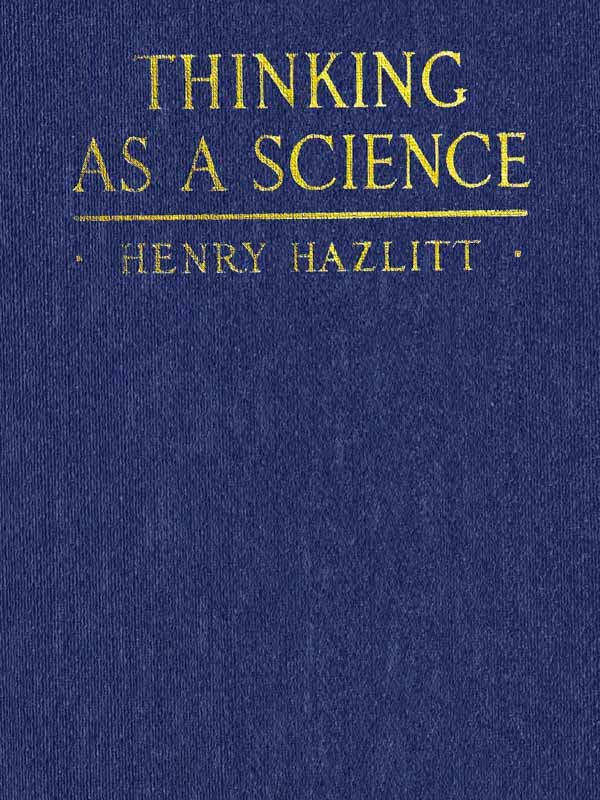
Thinking as a Science
1916
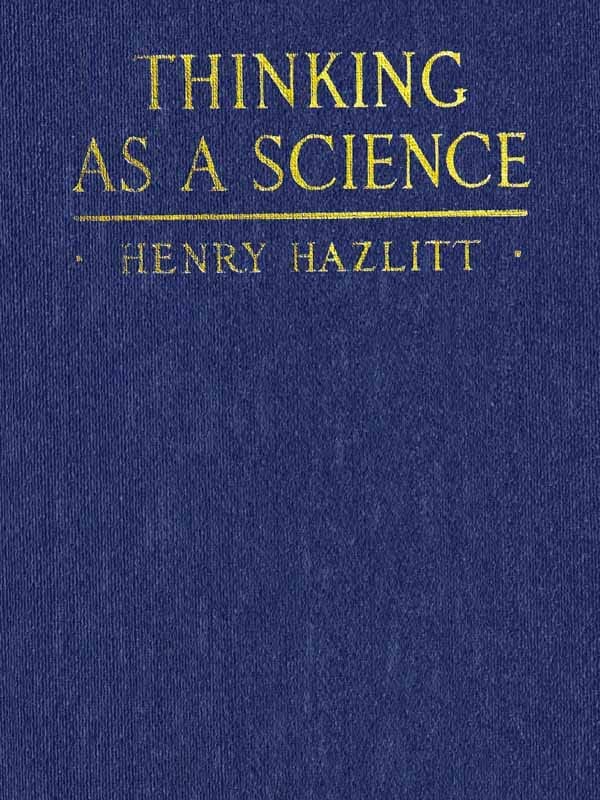
Written by a twenty-year-old Hazlitt in 1916, this slender volume attacks a problem that has only grown more urgent: most people mistake the act of having thoughts for the discipline of thinking. Hazlitt insists that genuine thinking is a skill, one that can be observed, analyzed, and refined like any other. He walks the reader through the mechanics of clear thought: how to observe accurately, analyze without bias, reason logically, and concentrate without the scattered mental chatter that passes for reflection in the modern mind. The book is relentlessly practical, peppered with exercises and examples that force you to confront how often you confuse familiarity with understanding. Hazlitt's prose is crisp and economical, befitting a man who would later become one of the twentieth century's most incisive economic and philosophical writers. Whether he is dissecting the lazy habits of casual reading or explaining why most "discussions" are merely two monologues in friendly disguise, he demands you raise your standards. A century later, when algorithms feed us conclusions and attention spans collapse, Hazlitt's manual for intellectual self-reliance feels less like a period piece and more like an emergency kit.
Editions

X-Ray
“A man with a scant vocabulary will almost certainly be a weak thinker. The richer and more copious one's vocabulary and the greater one's awareness of fine distinctions and subtle nuances of meaning, the more fertile and precise is likely to be one's thinking. Knowledge of things and knowledge of the words for them grow together. If you do not know the words, you can hardly know the thing.””
— Henry Hazlitt
“The only way we could remember would be by constant re-reading, for knowledge unused tends to drop out of mind. Knowledge used does not need to be remembered; practice forms habits and habits make memory unnecessary. The rule is nothing; the application is everything.””
— Henry Hazlitt
“Eternal vigilance is the price of an open mind.””
— Henry Hazlitt
“It has been frequently said that many of the world’s greatest inventions were due to accident. In a sense this is true. But the accident was prepared for by previous hard thinking. It would never have occurred had not this thinking taken place.””
— Henry Hazlitt
“What men do not know about they take for granted. Knowledge furnishes problems, and the discovery of problems itself constitutes an intellectual advance.””
— Henry Hazlitt
“La generación actual tiene el privilegio, que no tuvo ninguna otra, de contar con ese ingente acervo intelectual.””
— Henry Hazlitt
“La generación actual tiene el priviliegio, que no tuvo ninguna otra, de contar con ese ingente acervo intelectual.””
— Henry Hazlitt
“El divagador encara un problema, pierde interés y lo abandona. El hombre capaz de concentrarse persevera hasta que lo resuelve.””
— Henry Hazlitt
“The only way we can get rid of this desire to cling to our prejudices, is thoroughly to convince ourselves of the superiority of the truth; to leave not the slightest doubt in our own minds as to the value of looking with perfect indifference on all questions; to see that this is more advantageous than believing in that opinion which would benefit us most if true, more important than “being consistent,” more to be cherished than the comfortable feeling of certainty.””
— Henry Hazlitt
Link to this book
Add a free, dofollow link to Lex on your blog, forum, syllabus, or reading list.

<a href="https://lex-books.com/book/thinking-as-a-science-4755c879-6960-43f9-846e-47eadab401c4"><img src="https://lex-books.com/badges/read-on-lex.svg" alt="Read Thinking as a Science by Henry Hazlitt free on Lex" width="160" height="40"></a>[](https://lex-books.com/book/thinking-as-a-science-4755c879-6960-43f9-846e-47eadab401c4)[url=https://lex-books.com/book/thinking-as-a-science-4755c879-6960-43f9-846e-47eadab401c4][img]https://lex-books.com/badges/read-on-lex.svg[/img][/url]Read Thinking as a Science by Henry Hazlitt free on Lex: https://lex-books.com/book/thinking-as-a-science-4755c879-6960-43f9-846e-47eadab401c4Cite this book
Reading this edition for a paper or guide? Copy a citation.
Hazlitt, Henry. Thinking as a Science. Lex, lex-books.com/book/thinking-as-a-science-4755c879-6960-43f9-846e-47eadab401c4.Hazlitt, H. (1916). Thinking as a Science. Lex. https://lex-books.com/book/thinking-as-a-science-4755c879-6960-43f9-846e-47eadab401c4Hazlitt, Henry. Thinking as a Science. Lex. https://lex-books.com/book/thinking-as-a-science-4755c879-6960-43f9-846e-47eadab401c4.