The Souls of Black Folk
1903
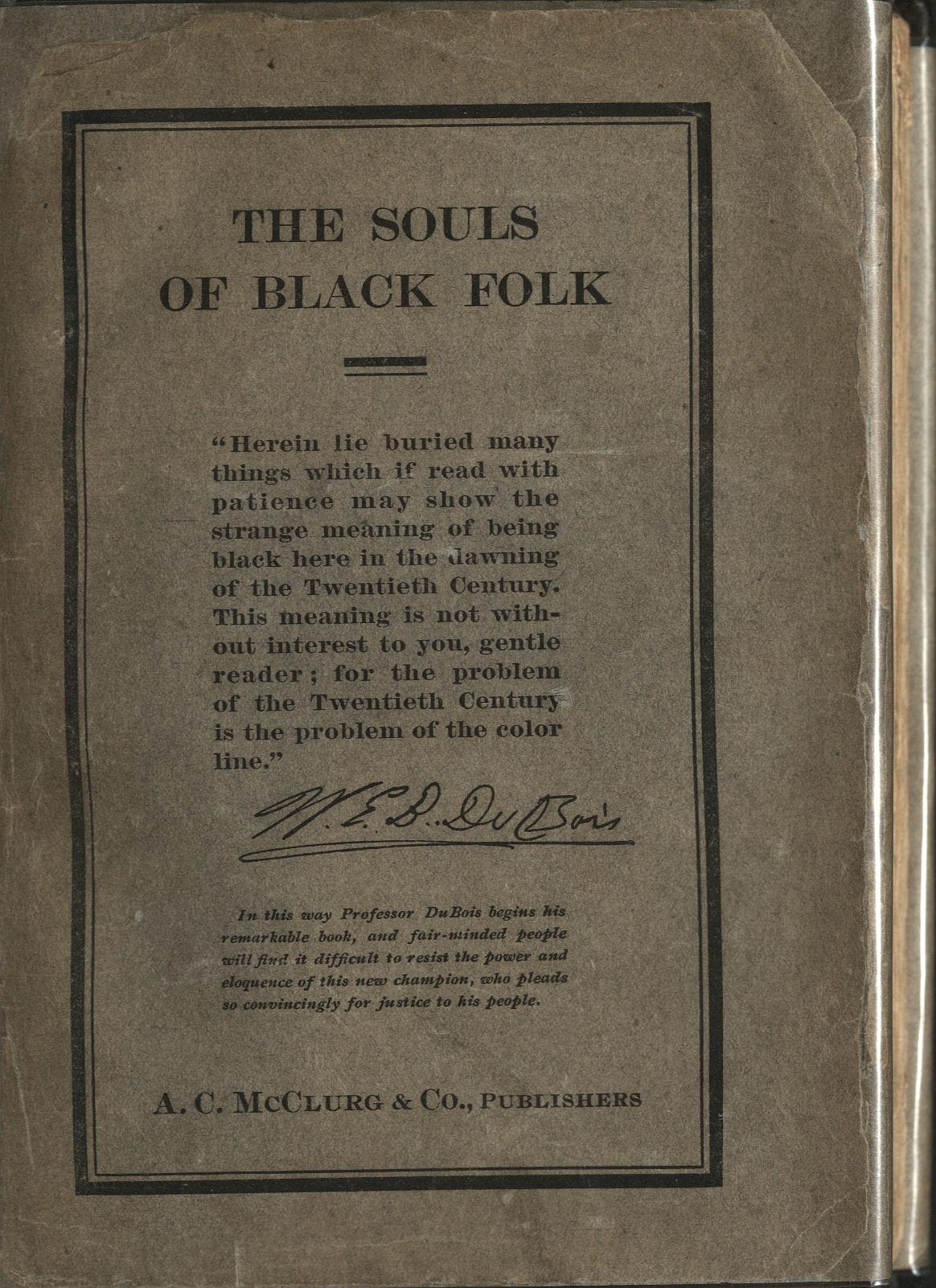
The book that invented a language for understanding Black identity in America. W.E.B. Du Bois wrote these fourteen essays in 1903, when Jim Crow was tightening its grip and the promise of Reconstruction had curdled into betrayal. He writes as both sociologist and poet, as a man who earned a PhD from Harvard and still could not escape the color line. Here, in prose that still shimmers with controlled fury, Du Bois introduces the concept that would become foundational to Black thought: double consciousness, the "sense of always looking at one's self through the eyes of others." He examines the Black church, the betrayed promise of Reconstruction, the crushing weight of "the problem of the twentieth century." And he directly challenges Booker T. Washington's strategy of submission, arguing that dignity cannot be negotiated away. This is not a appeal for tolerance. It is a demand for full humanity: political rights, higher education, the vote, the complete citizenship that America had promised and withheld. The book that shaped a century of struggle, and the essential text for anyone who wants to understand what it has meant, and means, to be Black in America.
Editions



X-Ray
“Herein lies the tragedy of the age: not that men are poor,”
— W. E. B. Du Bois
“One ever feels his twoness, -- an American, a Negro; two souls, two thoughts, two unreconciled strivings; two warring ideals in one dark body, whose strength alone keeps it from being torn asunder.””
— W. E. B. Du Bois
“The South believed an educated Negro to be a dangerous Negro. And the South was not wholly wrong; for education among all kinds of men always has had, and always will have, an element of danger and revolution, of dissatisfaction and discontent. Nevertheless, men strive to know.””
— W. E. B. Du Bois
“After the Egyptian and Indian, the Greek and Roman, the Teuton and Mongolian, the Negro is a sort of seventh son, born with a veil, and gifted with second-sight in this American world,”
— W. E. B. Du Bois
“Honest and earnest criticism from those whose interests are most nearly touched,- criticism of writers by readers, of government by those governed, of leaders by those led, - this is the soul of democracy and the safeguard of modern society””
— W. E. B. Du Bois
“I sit with Shakespeare, and he winces not. Across the color line I move arm and arm with Balzac and Dumas, where smiling men and welcoming women glide in gilded halls. From out of the caves of evening that swing between the strong-limbed Earth and the tracery of stars, I summon Aristotle and Aurelius and what soul I will, and they come all graciously with no scorn nor condescension. So, wed with Truth, I dwell above the veil. Is this the life you grudge us, O knightly America? Is this the life you long to change into the dull red hideousness of Georgia? Are you so afraid lest peering from this high Pisgah, between Philistine and Amalekite, we sight the Promised Land?””
— W. E. B. Du Bois
“To the real question, How does it feel to be a problem? I answer seldom a word.””
— W. E. B. Du Bois
“The problem of the twentieth century is the problem of the color line.””
— W. E. B. Du Bois
“The equality in political, industrial and social life which modern men must have in order to live, is not to be confounded with sameness. On the contrary, in our case, it is rather insistence upon the right of diversity; - upon the right of a human being to be a man even if he does not wear the same cut of vest, the same curl of hair or the same color of skin. Human equality does not even entail, as it is sometimes said, absolute equality of opportunity; for certainly the natural inequalities of inherent genius and varying gift make this a dubious phrase. But there is more and more clearly recognized minimum of opportunity and maximum of freedom to be, to move and to think, which the modern world denies to no being which it recognizes as a real man.””
— W. E. B. Du Bois
Link to this book
Add a free, dofollow link to Lex on your blog, forum, syllabus, or reading list.

<a href="https://lex-books.com/book/the-souls-of-black-folk-ad56b1ed-ec86-4bf6-9393-1ab6669e76d5"><img src="https://lex-books.com/badges/read-on-lex.svg" alt="Read The Souls of Black Folk by W. E. B. Du Bois free on Lex" width="160" height="40"></a>[](https://lex-books.com/book/the-souls-of-black-folk-ad56b1ed-ec86-4bf6-9393-1ab6669e76d5)[url=https://lex-books.com/book/the-souls-of-black-folk-ad56b1ed-ec86-4bf6-9393-1ab6669e76d5][img]https://lex-books.com/badges/read-on-lex.svg[/img][/url]Read The Souls of Black Folk by W. E. B. Du Bois free on Lex: https://lex-books.com/book/the-souls-of-black-folk-ad56b1ed-ec86-4bf6-9393-1ab6669e76d5Cite this book
Reading this edition for a paper or guide? Copy a citation.
Bois, W. E. B. Du. The Souls of Black Folk. Lex, lex-books.com/book/the-souls-of-black-folk-ad56b1ed-ec86-4bf6-9393-1ab6669e76d5.Bois, W. E. B. D. (1903). The Souls of Black Folk. Lex. https://lex-books.com/book/the-souls-of-black-folk-ad56b1ed-ec86-4bf6-9393-1ab6669e76d5Bois, W. E. B. Du. The Souls of Black Folk. Lex. https://lex-books.com/book/the-souls-of-black-folk-ad56b1ed-ec86-4bf6-9393-1ab6669e76d5.