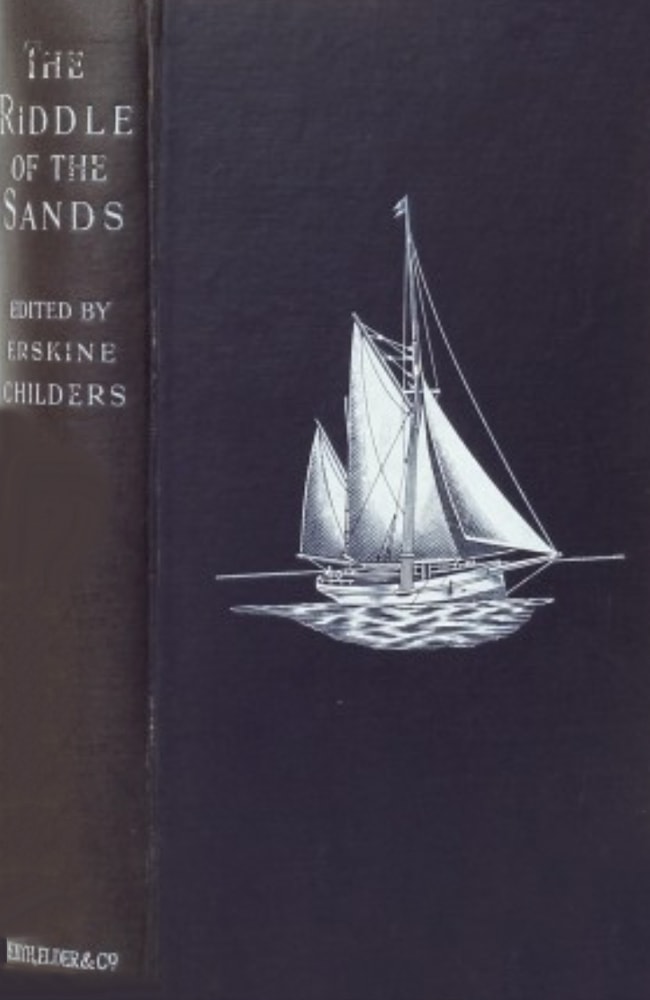
The Riddle of the Sands
1903
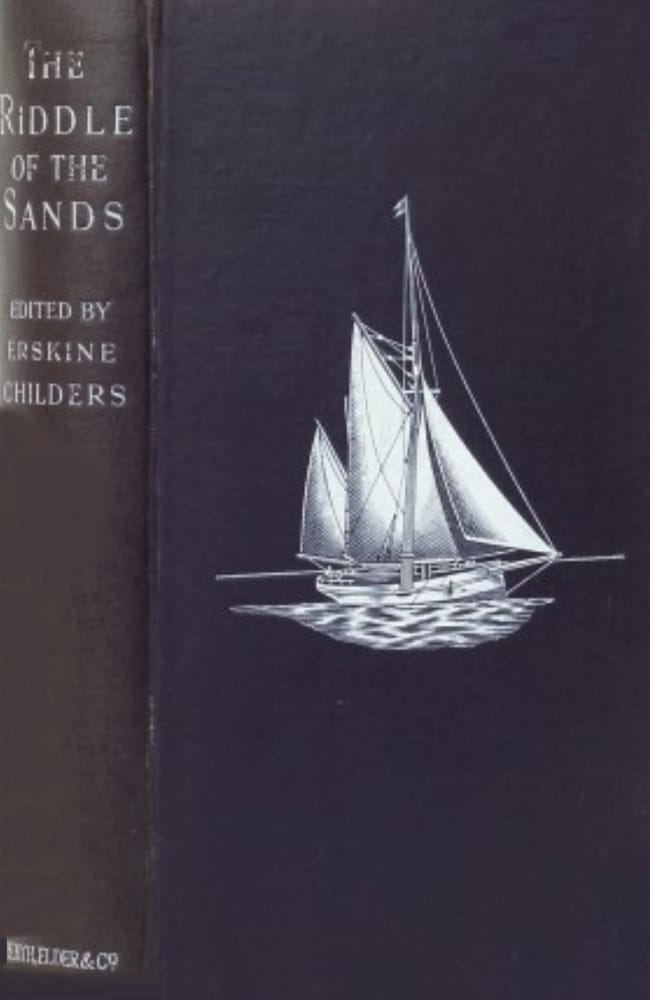
London is dull. The Season has ended, and Carruthers, a young man adrift in the post-summer metropolis, jumps at any escape. That escape arrives in the form of a letter from an old acquaintance, Davies, inviting him on a sailing trip to the Baltic. What begins as a pleasant cruise through the misty islands and treacherous sands of the Schleswig coast soon curdles into something far darker. Davies is not the easy-going sailor he once seemed; he has become obsessed with a theory about a German plan to invade England, and he needs Carruthers to help him prove it. As they pilot their small yacht through fog banks and across mudflats that appear and vanish with the tide, the two men enter a world of coded messages, midnight meetings, and the slow, sickening realization that war may not be a distant possibility but an imminent certainty. Written by Erskine Childers as a deliberate warning to British policymakers about the North Sea's vulnerabilities, this novel invented the modern spy thriller. Its obsessive attention to tidal charts, naval geography, and the mechanics of espionage set a template that Fleming, le Carré, and countless others would follow. A hundred years later, it remains unsurpassed as both a sailing adventure and a portrait of ordinary men drawn into extraordinary danger.
Editions

X-Ray
“A keen wind from the west struck our faces, and as swiftly as it had come the fog rolled away from us, in one mighty mass, stripping clean and pure the starry dome of heaven...””
— Erskine Childers
“- vague, very vague.””
— Erskine Childers
“Germany's a thundering great nation . . . I wonder if we shall ever fight her.””
— Erskine Childers
“The Dulcibella faced the storm as doggedly as ever, plunging her bowsprit into the sea and flinging green water over her bows. A wave of confidence and affection for her welled through me. I had been used to resent the weight and bulk of her unwieldy anchor and cable, but I saw their use now; varnish, paint, spotless decks, and snowy sails were foppish absurdities of a hateful past.””
— Erskine Childers
“As a soldier learns more in a week of war than in years of parades and pipeclay, so, cut off from all distractions, moving from bivouac to precarious bivouac, and depending, to some extent, for my life on my muscles and wits, I rapidly learnt my work and gained a certain dexterity.””
— Erskine Childers
“We’ve been safe so long, and grown so rich, that we’ve forgotten what we owe it to. But there’s no excuse for those blockheads of statesmen, as they call themselves, who are paid to see things as they are.””
— Erskine Childers
“at the town””
— Erskine Childers
“By Jove! we want a man like this Kaiser, who doesn't wait to be kicked, but works like a nigger for his country, and sees ahead.””
— Erskine Childers
Link to this book
Add a free, dofollow link to Lex on your blog, forum, syllabus, or reading list.

<a href="https://lex-books.com/book/the-riddle-of-the-sands-2c62f9b7-1647-4886-a178-b333161bebaa"><img src="https://lex-books.com/badges/read-on-lex.svg" alt="Read The Riddle of the Sands by Erskine Childers free on Lex" width="160" height="40"></a>[](https://lex-books.com/book/the-riddle-of-the-sands-2c62f9b7-1647-4886-a178-b333161bebaa)[url=https://lex-books.com/book/the-riddle-of-the-sands-2c62f9b7-1647-4886-a178-b333161bebaa][img]https://lex-books.com/badges/read-on-lex.svg[/img][/url]Read The Riddle of the Sands by Erskine Childers free on Lex: https://lex-books.com/book/the-riddle-of-the-sands-2c62f9b7-1647-4886-a178-b333161bebaaCite this book
Reading this edition for a paper or guide? Copy a citation.
Childers, Erskine. The Riddle of the Sands. Lex, lex-books.com/book/the-riddle-of-the-sands-2c62f9b7-1647-4886-a178-b333161bebaa.Childers, E. (1903). The Riddle of the Sands. Lex. https://lex-books.com/book/the-riddle-of-the-sands-2c62f9b7-1647-4886-a178-b333161bebaaChilders, Erskine. The Riddle of the Sands. Lex. https://lex-books.com/book/the-riddle-of-the-sands-2c62f9b7-1647-4886-a178-b333161bebaa.