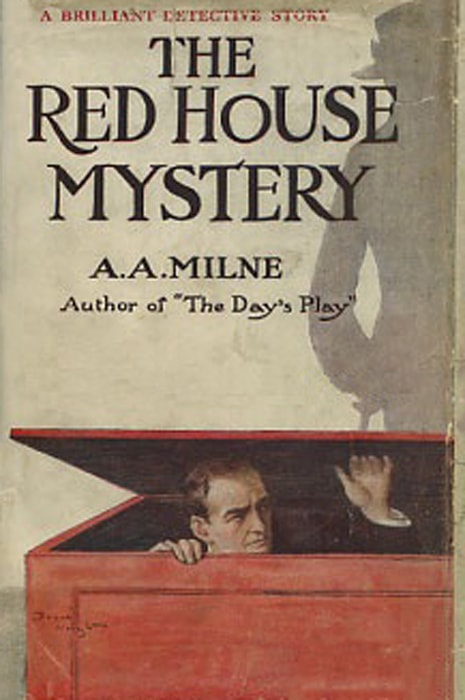
The Red House Mystery
1922
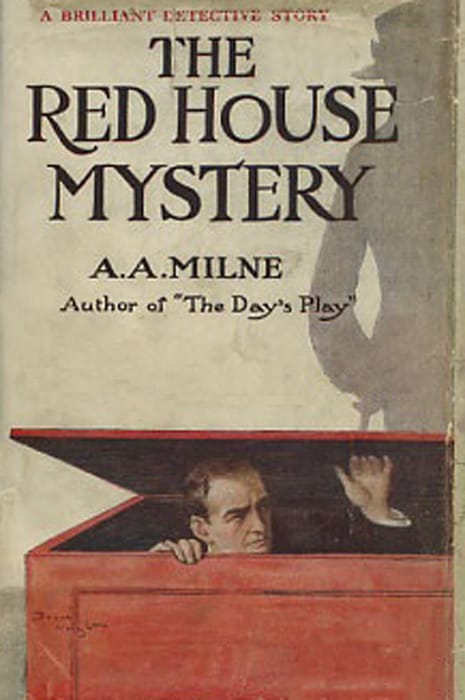
Who would expect the creator of Winnie-the-Pooh to write a cracking good mystery? A.A. Milne's sole venture into detective fiction proves he possessed a razor-sharp mind behind the whimsy. Set in the placid English countryside at the Red House, a comfortable bachelor residence, the story begins with the arrival of Mark Ablett's estranged brother Robert, and ends with Robert dead on the floor and Mark vanished into thin air. Was it self-defense, as the circumstances loosely suggest? Or did something more sinister drive the host to flee?Enter Anthony Gillingham and his chum Bill Beverley, two amateur detectives whose genteel pursuit of the truth unfolds between games of billiards, bowls, and afternoon tea. They navigate secret passageways, a locked room, and a cast of suspicious characters, including the charming estate manager Cayley, whose wit matches any of Pooh's beloved companions. The solution to the mystery hinges on a detail so cunningly planted that readers will want to turn back and re-read the opening chapters.This is Golden Age detection at its most delightful: a puzzle box wrapped in English civility, where nothing is as it appears and the solution, when it arrives, feels both surprising and inevitable. For lovers of Christie, Sayers, and the quiet pleasures of a country house in summer.
Editions

X-Ray
“Of course it's very hampering being a detective, when you don't know anything about detecting, and when nobody knows that you're doing detection, and you can't have people up to cross-examine them, and you have neither the energy nor the means to make proper inquiries; and, in short, when you're doing the whole thing in a thoroughly amateur, haphazard way.””
— A. A. Milne
“Are you prepared to be the complete Watson?" he asked."Watson?""Do-you-follow-me-Watson; that one. Are you prepared to have quite obvious things explained to you, to ask futile questions, to give me chances of scoring off you, to make brilliant discoveries of your own two or three days after I have made them myself all that kind of thing? Because it all helps.""My dear Tony," said Bill delightedly, "need you ask?" Antony said nothing, and Bill went on happily to himself, "I perceive from the strawberry-mark on your shirt-front that you had strawberries for dessert. Holmes, you astonish me. Tut, tut, you know my methods. Where is the tobacco? The tobacco is in the Persian slipper. Can I leave my practice for a week? I can.””
— A. A. Milne
“Do you remember," he said, "one of Holmes's little scores over Watson about the number of steps up to the Baker Street lodging? Poor old Watson had been up and down them a thousand times, but he had never thought of counting them, whereas Holmes had counted them as a matter of course, and knew that there were seventeen. And that was supposed to be the difference between observation and non-observation. Watson was crushed again, and Holmes appeared to him more amazing than ever. Now, it always seemed to me that in that matter Holmes was the ass, and Watson the sensible person. What on earth is the point of keeping in your head an unnecessary fact like that? If you really want to know at any time the number of steps to your lodging, you can ring up your landlady and ask her.””
— A. A. Milne
“From what I've read of detective stories, inspectors always do want to drag the pond first.””
— A. A. Milne
“You know, when once you've discovered a secret yourself, it always seems as if it must be so obvious to everybody else.””
— A. A. Milne
“Like all really nice people, you have a weakness for detective stories, and feel that there are not enough of them. So, after all that you have done for me, the least that I can do for you is to write you one.””
— A. A. Milne
“There is nothing that you and I could not accomplish together, if we gave our minds to it.””
— A. A. Milne
“The dedication: To John Vine Milne:My Dear Father,Like all really nice people, you have a weakness for detective stories, and feel that there are not enough of them. So after all that you have done for me, the least I can do for you is to write one. Here it is: with more gratitude and affection than I can well put down here.””
— A. A. Milne
“And now, what about a Watson? Are we to have a Watson? We are. Death to an author who keeps his unravelling for the last chapter, making all the other chapters but prologue to a five-minute drama. This is no way to write a story. Let us know from chapter to chapter what the detective is thinking. For this he must watsonize or soliloquize; the one is merely a dialogue form of the other, and, by that, more readable. A Watson, then, but not of necessity a fool of a Watson. A little slow, let him be, as so many of us are, but friendly, human, likeable ...””
— A. A. Milne
Link to this book
Add a free, dofollow link to Lex on your blog, forum, syllabus, or reading list.

<a href="https://lex-books.com/book/the-red-house-mystery-54c9c971-8a02-46a3-9e64-d0749e56ad2e"><img src="https://lex-books.com/badges/read-on-lex.svg" alt="Read The Red House Mystery by A. A. Milne free on Lex" width="160" height="40"></a>[](https://lex-books.com/book/the-red-house-mystery-54c9c971-8a02-46a3-9e64-d0749e56ad2e)[url=https://lex-books.com/book/the-red-house-mystery-54c9c971-8a02-46a3-9e64-d0749e56ad2e][img]https://lex-books.com/badges/read-on-lex.svg[/img][/url]Read The Red House Mystery by A. A. Milne free on Lex: https://lex-books.com/book/the-red-house-mystery-54c9c971-8a02-46a3-9e64-d0749e56ad2eCite this book
Reading this edition for a paper or guide? Copy a citation.
Milne, A. A.. The Red House Mystery. Lex, lex-books.com/book/the-red-house-mystery-54c9c971-8a02-46a3-9e64-d0749e56ad2e.Milne, A. A. (1922). The Red House Mystery. Lex. https://lex-books.com/book/the-red-house-mystery-54c9c971-8a02-46a3-9e64-d0749e56ad2eMilne, A. A.. The Red House Mystery. Lex. https://lex-books.com/book/the-red-house-mystery-54c9c971-8a02-46a3-9e64-d0749e56ad2e.