The Poems of Heine; Complete: Translated into the Original Metres; With a Sketch of His Life
1827
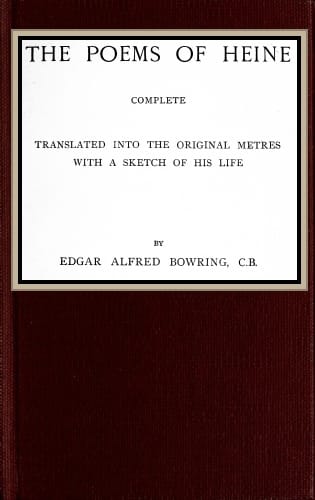
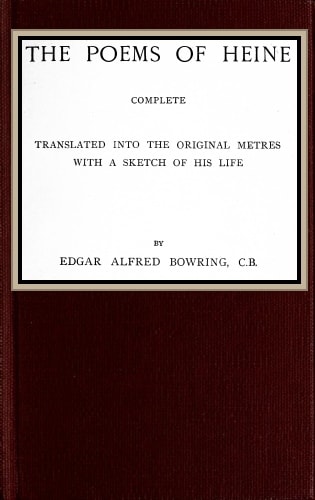
The Poems of Heine; Complete: Translated into the Original Metres; With a Sketch of His Life
1827
Translated by Edgar Alfred Bowring
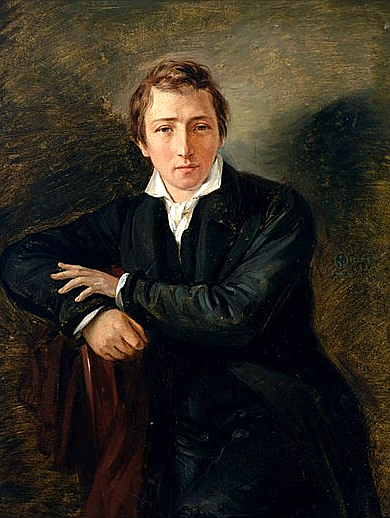
Heinrich Heine's collected poems represent one of the most distinctive voices in German literature: a poet capable of breaking your heart in one stanza and skewering the pompous in the next. This comprehensive volume gathers the work that made him famous across Europe, from the emotionally devastating love lyrics of the Book of Songs, where yearning and loss intertwine with almost unbearable tenderness, to his sharper satirical verses that delighted in puncturing the pretensions of the German states. Heine wrote with a peculiar dual brilliance: the tenderest romantic and the sharpest ironist, sometimes in the very same poem. Born Jewish in Düsseldorf, he inherited a legacy of persecution that shaped his wit into a weapon and his longing into something that cut deeper than simple sadness. Exiled from Germany for his political views, he wrote his greatest verses in Paris, while his work was banned in his homeland. Yet his lyrics found their way into the hearts of millions through the settings of Schubert, Schumann, and Brahms. This is Heine entire: love, sorrow, mockery, and exile rendered in verses that still ache and still sting.
Editions
X-Ray
“Sag mir, was bedeutet der Mensch?Woher ist er kommen? Wo geht er hin?Wer wohnt dort oben auf goldenen Sternen?””
— Heinrich Heine
“IT may perhaps be thought that I exhibit something of the brazen-facedness of a hardened offender in venturing once more””
— Heinrich Heine
“Ah, among the unhappiest blunders a man makes is this, that he childishly misjudges the value of the gifts that nature bestows on him most easily, and, contrariwise, considers most precious the endowments that come hardest. The precious stone buried in the earth's entrails, the pearl hidden in the ocean depths”
— Heinrich Heine
“First poems! They must be written on casual scraps of faded paper, interspersed here and there with withered flowers, or a lock of blond hair, or a discolored piece of ribbon, and the trace of a tear must still be visible in several places ... But first poems that are printed, in livid black and white, on dreadfully smooth paper are poems that have lost the finest points of their sweet, virginal charm, and now arouse a ghastly feeling of distaste in the author.””
— Heinrich Heine
Link to this book
Add a free, dofollow link to Lex on your blog, forum, syllabus, or reading list.

<a href="https://lex-books.com/book/the-poems-of-heine-complete-translated-into-the-original-metres-with-a-sketch-of-f7ca7bb8-e214-423c-bc65-cde12476b6e3"><img src="https://lex-books.com/badges/read-on-lex.svg" alt="Read The Poems of Heine; Complete: Translated into the Original Metres; With a Sketch of His Life by Heinrich Heine free on Lex" width="160" height="40"></a>[](https://lex-books.com/book/the-poems-of-heine-complete-translated-into-the-original-metres-with-a-sketch-of-f7ca7bb8-e214-423c-bc65-cde12476b6e3)[url=https://lex-books.com/book/the-poems-of-heine-complete-translated-into-the-original-metres-with-a-sketch-of-f7ca7bb8-e214-423c-bc65-cde12476b6e3][img]https://lex-books.com/badges/read-on-lex.svg[/img][/url]Read The Poems of Heine; Complete: Translated into the Original Metres; With a Sketch of His Life by Heinrich Heine free on Lex: https://lex-books.com/book/the-poems-of-heine-complete-translated-into-the-original-metres-with-a-sketch-of-f7ca7bb8-e214-423c-bc65-cde12476b6e3Cite this book
Reading this edition for a paper or guide? Copy a citation.
Heine, Heinrich. The Poems of Heine; Complete: Translated into the Original Metres; With a Sketch of His Life. Lex, lex-books.com/book/the-poems-of-heine-complete-translated-into-the-original-metres-with-a-sketch-of-f7ca7bb8-e214-423c-bc65-cde12476b6e3.Heine, H. (1827). The Poems of Heine; Complete: Translated into the Original Metres; With a Sketch of His Life. Lex. https://lex-books.com/book/the-poems-of-heine-complete-translated-into-the-original-metres-with-a-sketch-of-f7ca7bb8-e214-423c-bc65-cde12476b6e3Heine, Heinrich. The Poems of Heine; Complete: Translated into the Original Metres; With a Sketch of His Life. Lex. https://lex-books.com/book/the-poems-of-heine-complete-translated-into-the-original-metres-with-a-sketch-of-f7ca7bb8-e214-423c-bc65-cde12476b6e3.