The Law
1850
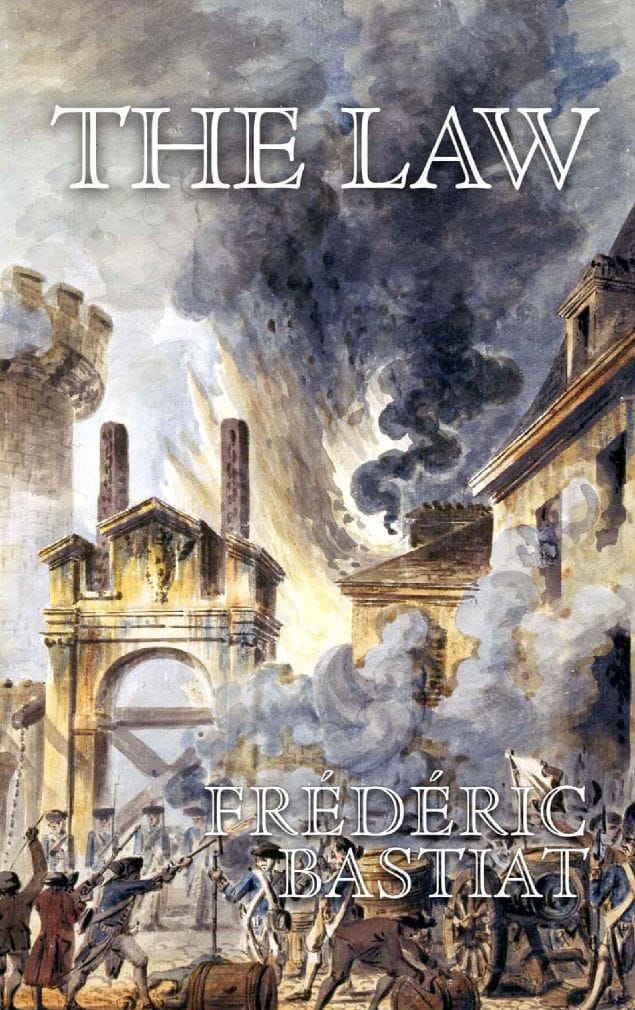
In 1850, a French economist wrote a short, fiery essay that still feels like it was published yesterday. Frédéric Bastiat wanted to answer one terrifying question: why do the people who make the law think they're above it? What he discovered was "legal plunder" - the systematic use of government force to take from some and give to others, dressed up in the language of justice and philanthropy. Bastiat saw this poison spreading through 19th-century France and warned that when law becomes an instrument of theft rather than protection, society collapses into legalized robbery where everyone fights everyone else for a slice of the coerced pie. His argument is devastating in its simplicity: the law should defend your life, your liberty, and your property - nothing more. Once it starts redistributing wealth, rewarding favorites, or enforcing particular beliefs, it has betrayed its only legitimate purpose. Written with the urgency of a man who knew he was running out of time, The Law is a passionate defense of human freedom that reads like a warning from history. It endures because it applies to every era, including our own, whenever the state decides it plays by different rules than the rest of us.
Editions
X-Ray
“Socialism, like the ancient ideas from which it springs, confuses the distinction between government and society. As a result of this, every time we object to a thing being done by government, the socialists conclude that we object to its being done at all. We disapprove of state education. Then the socialists say that we are opposed to any education. We object to a state religion. Then the socialists say that we want no religion at all. We object to a state-enforced equality. Then they say that we are against equality. And so on, and so on. It is as if the socialists were to accuse us of not wanting persons to eat because we do not want the state to raise grain.””
— Frédéric Bastiat
“If the natural tendencies of mankind are so bad that it is not safe to permit people to be free, how is it that the tendencies of these organizers are always good? Do not the legislators and their appointed agents also belong to the human race? Or do they believe that they themselves are made of a finer clay than the rest of mankind?””
— Frédéric Bastiat
“Life, liberty, and property do not exist because men have made laws. On the contrary, it was the fact that life, liberty, and property existed beforehand that caused men to make laws in the first place.””
— Frédéric Bastiat
“But how is this legal plunder to be identified? Quite simply. See if the law takes from some persons what belongs to them and gives it to other persons to whom it does not belong. See if the law benefits one citizen at the expense of another by doing what the citizen himself cannot do without committing a crime.””
— Frédéric Bastiat
“Now, legal plunder can be committed in an infinite number of ways. Thus we have an infinite number of plans for organizing it: tariffs, protection, benefits, subsidies, encouragements, progressive taxation, public schools, guaranteed jobs, guaranteed profits, minimum wages, a right to relief, a right to the tools of labor, free credit, and so on, and so on.””
— Frédéric Bastiat
“When law and morality contradict each other, the citizen has the cruel alternative of either losing his moral sense or losing his respect for the law.””
— Frédéric Bastiat
“As long as it is admitted that the law may be diverted from its true purpose--that it may violate property instead of protecting it--then everyone will want to participate in making the law, either to protect himself against plunder or to use it for plunder.””
— Frédéric Bastiat
“You say: "There are persons who lack education" and you turn to the law. But the law is not, in itself, a torch of learning which shines its light abroad. The law extends over a society where some persons have knowledge and others do not; where some citizens need to learn, and others can teach. In this matter of education, the law has only two alternatives: It can permit this transaction of teaching-and-learning to operate freely and without the use of force, or it can force human wills in this matter by taking from some of them enough to pay the teachers who are appointed by government to instruct others, without charge. But in the second case, the law commits legal plunder by violating liberty and property.””
— Frédéric Bastiat
“Life Is a Gift from God.We hold from God the gift which includes all others. This gift is life -- physical, intellectual, and moral life. But life cannot maintain itself alone. The Creator of life has entrusted us with the responsibility of preserving, developing, and perfecting it. In order that we may accomplish this, He has provided us with a collection of marvelous faculties. And He has put us in the midst of a variety of natural resources. By the application of our faculties to these natural resources we convert them into products, and use them. This process is necessary in order that life may run its appointed course. Life, faculties, production--in other words, individuality, liberty, property -- this is man. And in spite of the cunning of artful political leaders, these three gifts from God precede all human legislation, and are superior to it. Life, liberty, and property do not exist because men have made laws. On the contrary, it was the fact that life, liberty, and property existed beforehand that caused men to make laws in the first place.””
— Frédéric Bastiat
Link to this book
Add a free, dofollow link to Lex on your blog, forum, syllabus, or reading list.

<a href="https://lex-books.com/book/the-law-c608c4be-5184-4901-9533-331e8ac034e6"><img src="https://lex-books.com/badges/read-on-lex.svg" alt="Read The Law by Frédéric Bastiat free on Lex" width="160" height="40"></a>[](https://lex-books.com/book/the-law-c608c4be-5184-4901-9533-331e8ac034e6)[url=https://lex-books.com/book/the-law-c608c4be-5184-4901-9533-331e8ac034e6][img]https://lex-books.com/badges/read-on-lex.svg[/img][/url]Read The Law by Frédéric Bastiat free on Lex: https://lex-books.com/book/the-law-c608c4be-5184-4901-9533-331e8ac034e6Cite this book
Reading this edition for a paper or guide? Copy a citation.
Bastiat, Frédéric. The Law. Lex, lex-books.com/book/the-law-c608c4be-5184-4901-9533-331e8ac034e6.Bastiat, F. (1850). The Law. Lex. https://lex-books.com/book/the-law-c608c4be-5184-4901-9533-331e8ac034e6Bastiat, Frédéric. The Law. Lex. https://lex-books.com/book/the-law-c608c4be-5184-4901-9533-331e8ac034e6.