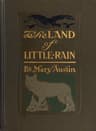
The Land of Little Rain
1903
In the high desert where California meets itself in broken ranges and sun-bleached valleys, Mary Austin found a language for what most writers miss. THE LAND OF LITTLE RAIN is not a nature guide or a travel narrative. It is something rarer: a sustained meditation on survival, silence, and the strange tenacity of life where water is the only prayer. Austin writes of the Owens Valley and Mojave with the intimacy of someone who has listened to the land rather than observed it. She introduces us to the Paiute who named places by what they offered, to miners and cattlemen carving existence from aridity, to creatures and plants that have made peace with drought in ways humans never quite manage. The prose has the lean beauty of the landscape it describes. There is no excess here, no sentimentality. Just the hard, luminous truth of a place that gives nothing away freely and therefore means everything when it does. This is the book for readers who have ever stood in a desert and felt, impossibly, at home.
Editions

X-Ray
“If one is inclined to wonder at first how so many dwellers came to be in the loneliest land that ever came out of God's hands, what they do there and why stay, one does not wonder so much after having lived there. None other than this long brown land lays such a hold on the affections. The rainbow hills, the tender bluish mists, the luminous radiance of the spring, have the lotus charm. They trick the sense of time, so that once inhabiting there you always mean to go away without quite realizing that you have not done it.””
— Mary Austin
“endurance. But prospectors and Indians get a kind of a weather shell that remains on the body until death.””
— Mary Austin
“En nuestra sociedad, cuando una mujer deja de cambiarse el peinado, uno supone que ha superado la crisis de su vida. Si sigue ondulándose o alisándose el cabello con las modas pasajeras, suele suponerse que nunca se ha enfrentado a nada demasiado trascendental para ella.””
— Mary Austin
“They trick the sense of time, so that once inhabiting there you always mean to go away without quite realizing that you have not done it. Men who have lived there, miners and cattlemen, will tell you this, not so fluently, but emphatically, cursing the land and going back to it. For””
— Mary Austin
“Trust Indians not to miss any virtues of the plant world! Nothing””
— Mary Austin
“perpetuity.””
— Mary Austin
Link to this book
Add a free, dofollow link to Lex on your blog, forum, syllabus, or reading list.

<a href="https://lex-books.com/book/the-land-of-little-rain-a6e5e38e-6922-4397-993f-c305d74ecb06"><img src="https://lex-books.com/badges/read-on-lex.svg" alt="Read The Land of Little Rain by Mary Austin free on Lex" width="160" height="40"></a>[](https://lex-books.com/book/the-land-of-little-rain-a6e5e38e-6922-4397-993f-c305d74ecb06)[url=https://lex-books.com/book/the-land-of-little-rain-a6e5e38e-6922-4397-993f-c305d74ecb06][img]https://lex-books.com/badges/read-on-lex.svg[/img][/url]Read The Land of Little Rain by Mary Austin free on Lex: https://lex-books.com/book/the-land-of-little-rain-a6e5e38e-6922-4397-993f-c305d74ecb06Cite this book
Reading this edition for a paper or guide? Copy a citation.
Austin, Mary. The Land of Little Rain. Lex, lex-books.com/book/the-land-of-little-rain-a6e5e38e-6922-4397-993f-c305d74ecb06.Austin, M. (1903). The Land of Little Rain. Lex. https://lex-books.com/book/the-land-of-little-rain-a6e5e38e-6922-4397-993f-c305d74ecb06Austin, Mary. The Land of Little Rain. Lex. https://lex-books.com/book/the-land-of-little-rain-a6e5e38e-6922-4397-993f-c305d74ecb06.