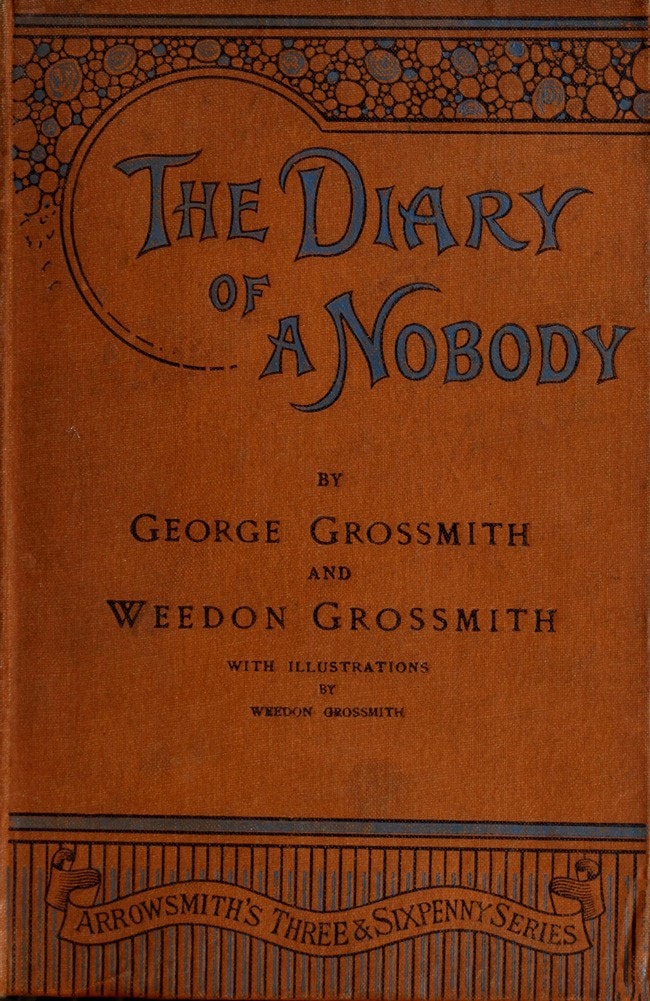
The Diary of a Nobody
1892
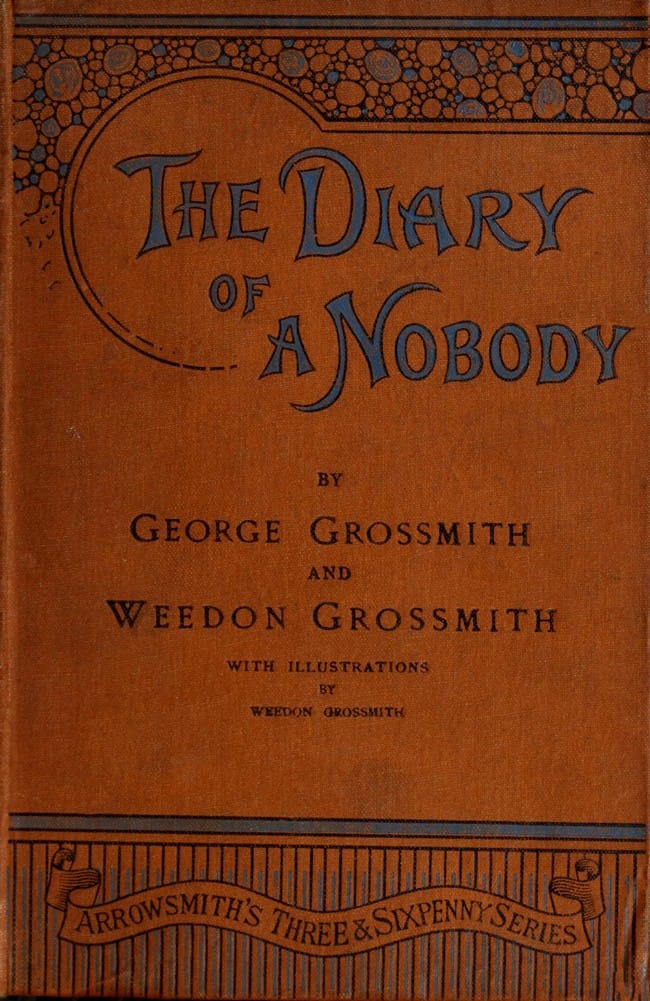
Charles Pooter is a man who believes he is somebody. The tragicomic miracle is that he isn't wrong to think so, he has a house, an occupation, a son who causes nothing but trouble, and a wife who tolerates him. But his diary, intended to immortalize his otherwise unremarkable existence, becomes instead a meticulous record of his own humiliations. Every social aspiration curdles into awkwardness. Every attempt at respectability collapses into farce. The diary spans fifteen months in the life of this Lower Middle-Class London clerk, chronicling dinner parties that go wrong, tradesmen who refuse to cooperate, friends who borrow money and don't return it, and his son Lupin's increasingly alarming romantic choices. Pooter records it all with complete sincerity, never once perceiving the gap between how he sees himself and how the reader sees him. The Grossmith brothers, this was their only collaboration, understood something essential about the human need to be significant, and how that need curdles into absurdity when left unexamined. The book endures because the specific target has become universal. We all know a Pooter. We all, in our more honest moments, are Pooter. It launched a genre of comic fiction about ordinary people and their grandiose self-perception, and it has never been out of print since 1892.
Editions


X-Ray
“I never was so immensely tickled by anything I had ever said before. I actually woke up twice during the night, and laughed till the bed shook.””
— George Grossmith
“What's the good of a home, if you are never in it?””
— George Grossmith
“Some people seem quite destitute a sense of humour.””
— George Grossmith
“. . . doesn't it seem odd that Gowing's always coming and Cummings' always going?””
— George Grossmith
“Charlie dear, it is I who have to be proud of you. And I am very, very proud of you. You have called me pretty; and as long as I am pretty in your eyes, I am happy. You, dear old Charlie, are not handsome, but you are good, which is far more noble.””
— George Grossmith
“He said he wouldn’t stay, as he didn’t care much for the smell of the paint, and fell over the scraper as he went out. Must get the scraper removed, or else I shall get into a scrape. I don’t often make jokes.””
— George Grossmith
“I believe I am happy because I am not ambitious.””
— George Grossmith
“He may wear what he likes in the future, for I shall never drive with him again. His conduct was shocking. When we passed Highgate Archway, he tried to pass everything and everybody. He shouted to respectable people who were walking quietly in the road to get out of the way; he flicked at the horse of an old man who was riding, causing it to rear; and, as I had to ride backwards, I was compelled to face a gang of roughs in a donkey-cart, whom Lupin had chaffed, and who turned and followed us for nearly a mile, bellowing, indulging in coarse jokes and laughter, to say nothing of occasionally pelting us with orange-peel.””
— George Grossmith
“It’s concerning you both; for doesn’t it seem odd that Gowing’s always coming and Cummings’ always going?” ””
— George Grossmith
Link to this book
Add a free, dofollow link to Lex on your blog, forum, syllabus, or reading list.

<a href="https://lex-books.com/book/the-diary-of-a-nobody-c30c3265-5231-429f-8551-deee4027ac56"><img src="https://lex-books.com/badges/read-on-lex.svg" alt="Read The Diary of a Nobody by George Grossmith free on Lex" width="160" height="40"></a>[](https://lex-books.com/book/the-diary-of-a-nobody-c30c3265-5231-429f-8551-deee4027ac56)[url=https://lex-books.com/book/the-diary-of-a-nobody-c30c3265-5231-429f-8551-deee4027ac56][img]https://lex-books.com/badges/read-on-lex.svg[/img][/url]Read The Diary of a Nobody by George Grossmith free on Lex: https://lex-books.com/book/the-diary-of-a-nobody-c30c3265-5231-429f-8551-deee4027ac56Cite this book
Reading this edition for a paper or guide? Copy a citation.
Grossmith, George. The Diary of a Nobody. Lex, lex-books.com/book/the-diary-of-a-nobody-c30c3265-5231-429f-8551-deee4027ac56.Grossmith, G. (1892). The Diary of a Nobody. Lex. https://lex-books.com/book/the-diary-of-a-nobody-c30c3265-5231-429f-8551-deee4027ac56Grossmith, George. The Diary of a Nobody. Lex. https://lex-books.com/book/the-diary-of-a-nobody-c30c3265-5231-429f-8551-deee4027ac56.