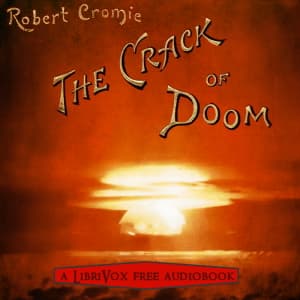
The Crack of Doom
1895
In 1895, a British traveler named Arthur Marcel encounters the enigmatic Herbert Brande aboard a ship bound for Queenstown. Brande's cold, cynical philosophy masks something far more disturbing: he's founded the Cui Bono Society, a clandestine group whose members possess terrifying knowledge about the fundamental nature of the universe and humanity's potential to destroy itself. Marcel is drawn into their orbit, captivated both by the society's ominous secrets and by Brande's striking sister, Natalie, whose elegance and mystery contrast sharply with her brother's chilling rationalism. What begins as philosophical conversation about the fate of mankind escalates into something far more sinister, as the society's experiments edge toward a discovery of apocalyptic proportions. Remarkably, this 1895 novel contains the first literary depiction of an atomic explosion, making it a startlingly prescient work that predicted the existential terror of the atomic age decades before Hiroshima. For readers who crave the uncanny feeling of looking backward from the future, this is early science fiction at its most haunting.
Editions
Link to this book
Add a free, dofollow link to Lex on your blog, forum, syllabus, or reading list.

<a href="https://lex-books.com/book/the-crack-of-doom-e9d03430-0055-47db-90bf-53c7388ad5a3"><img src="https://lex-books.com/badges/read-on-lex.svg" alt="Read The Crack of Doom by Robert Cromie free on Lex" width="160" height="40"></a>[](https://lex-books.com/book/the-crack-of-doom-e9d03430-0055-47db-90bf-53c7388ad5a3)[url=https://lex-books.com/book/the-crack-of-doom-e9d03430-0055-47db-90bf-53c7388ad5a3][img]https://lex-books.com/badges/read-on-lex.svg[/img][/url]Read The Crack of Doom by Robert Cromie free on Lex: https://lex-books.com/book/the-crack-of-doom-e9d03430-0055-47db-90bf-53c7388ad5a3Cite this book
Reading this edition for a paper or guide? Copy a citation.
Cromie, Robert. The Crack of Doom. Lex, lex-books.com/book/the-crack-of-doom-e9d03430-0055-47db-90bf-53c7388ad5a3.Cromie, R. (1895). The Crack of Doom. Lex. https://lex-books.com/book/the-crack-of-doom-e9d03430-0055-47db-90bf-53c7388ad5a3Cromie, Robert. The Crack of Doom. Lex. https://lex-books.com/book/the-crack-of-doom-e9d03430-0055-47db-90bf-53c7388ad5a3.